
The Science and Psychology Behind Dreaming: What Your Brain Does at Night

Your brain works overtime while you sleep, cycling through distinct phases every 90-120 minutes. During REM sleep, your mind creates vivid dreams as your visual cortex, hippocampus, and amygdala spring into action. You're not just seeing random images - your brain is actually processing emotions, consolidating memories, and preparing you for real-world challenges. These nighttime narratives serve as a sophisticated training simulator, helping you process daily experiences and regulate emotions. Even better, your dreams strengthen neural pathways for better threat detection and response. Understanding the science behind your dreams opens up fascinating discoveries into your brain's extraordinary capabilities.
Understanding REM Sleep Cycles
During your nightly rest, your brain cycles through distinct sleep phases, with REM (Rapid Eye Movement) sleep emerging as one of the most fascinating and central stages. Every 90 to 120 minutes, your brain enters this unique state of rapid eye movement (REM), with the longest periods occurring as morning approaches.
What makes dream sleep particularly intriguing is how your brain behaves during these periods. Neuroimaging studies reveal that your brain activity during REM closely mirrors your wakeful state, especially in regions tied to emotion, memory, and sensory processing. You're most likely to experience your most vivid dreams during REM sleep, as your brain's sensory areas become highly active.
The possible functions of REM sleep stages include emotional processing and memory consolidation. Your brain creates an ideal environment for processing emotional experiences by reducing noradrenaline, the molecule responsible for anxiety. This unique chemical state, combined with specific patterns of brain activity during REM, explains why sleep often helps you cope with emotional challenges. It's a natural form of overnight emotional therapy, where your brain works to process and integrate your daily experiences.
Brain Activity During Dreams
Peering into the dreaming brain reveals a complex concerto of neural activity that mirrors, yet distinctly differs from, your wakeful state. During REM sleep, your brain orchestrates a fascinating interplay between the visual cortex, hippocampus, and amygdala, creating the vivid imagery and emotional experiences you encounter in dreams. Frontal theta waves play a pivotal role in your ability to remember these nighttime adventures, linking your dream experiences to episodic memory storage.
Your brain's unique states during dreaming highlight just how extraordinary this process is. Those with Charcot-Wilbrand Syndrome, who've experienced visual cortex damage, lose their ability to recall dreams, demonstrating the essential role this region plays in dream formation.
Consider these remarkable aspects of your dreaming brain:
- Your amygdala becomes highly active, intensifying emotional responses and creating those heart-pounding dream scenarios
- Your hippocampus weaves complex narratives, blending memories and imagination into surreal storylines
- Your visual cortex lights up with activity, generating imagery that can feel as real as waking life
This intricate dance of brain activity during dreams continues to fascinate scientists and reveal new perspectives into consciousness.
Dreams and Memory Processing
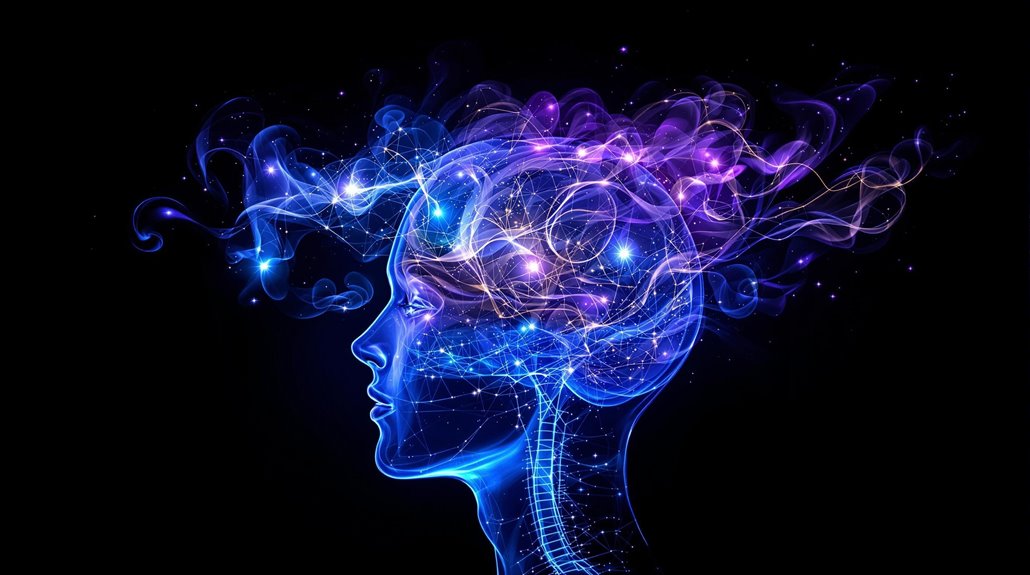
Your brain's intricate activity patterns during sleep serve a deeper purpose beyond creating dream narratives - they're actively processing and reorganizing your memories. During non-REM sleep, your brain strengthens individual episodic memories, while REM sleep takes on the fascinating task of blending and connecting these memories in novel ways.
The relationship between sleep and memory is particularly evident in how your brain handles relational facts. When you get adequate sleep, especially during REM phases, you'll perform better at tasks requiring you to connect different pieces of information. Dream content plays an essential role in memory consolidation and creative problem-solving. In fact, if you dream about a challenging task you're trying to master, you're likely to perform remarkably better - research shows dreamers are ten times more effective at solving maze puzzles than non-dreamers.
Through dream analysis, scientists have discovered that your brain doesn't randomly generate dream scenarios. Instead, it carefully selects important fragments from your daily experiences and attempts to integrate them with your existing knowledge, creating new connections and understandings that can help you better comprehend and navigate your waking life.
Emotional Regulation Through Dreams
While drifting through the deeper stages of sleep, the brain tackles an imperative task beyond memory formation - it processes and regulates your emotions. During REM sleep, your limbic system becomes highly active, working in concert with the prefrontal cortex to process complex emotional experiences. This natural form of emotional regulation helps you maintain psychological balance, something Sigmund Freud theorized but couldn't scientifically prove.
Recent sleep medicine research reveals that your brain uses dreams to:
- Strip away the raw emotional reactivity from difficult experiences
- Connect current emotional triggers with past memories for better processing
- Create a safe space where you can confront and resolve emotional conflicts
When you're deprived of REM sleep, your ability to regulate emotions becomes compromised, potentially leading to mental health issues. Dream meaning extends beyond symbolic interpretation - it's a crucial mechanism for emotional healing. Sleep helps your brain perform this indispensable maintenance, acting as an overnight emotional therapy session. The more active your brain is during these dream states, the more successful it becomes at processing and integrating emotional experiences, ultimately contributing to your psychological well-being.
Evolutionary Purpose of Dreaming

Throughout millions of years of evolution, dreaming has served as nature's sophisticated training simulator for survival. When you dream, your brain creates complex threat simulation scenarios that help sharpen your perception and avoidance responses to potential dangers. This evolutionary mechanism has proven so indispensable that it's preserved across various mammalian species, including cats, suggesting its integral role in survival.
Your brain's ability to rehearse threatening situations during sleep provides you with a safe environment to strengthen neural pathways without actual risk. Think of it as a virtual reality training ground where you can enhance your cognitive abilities and practice responses to dangerous scenarios. During these nocturnal simulations, your brain activates regions responsible for processing emotions and consolidating memories, allowing you to better prepare for real-world challenges.
The fact that dreaming has persisted through evolutionary history isn't coincidental. It's a finely tuned survival tool that continues to serve you today. By processing experiences and strengthening neural connections related to threat detection and response, your dreams work to improve your survival skills, even in modern times when physical threats may be less common.
Related posts