The History of Timekeeping: From Sundials to Atomic Clocks
You'll find that timekeeping has evolved dramatically over 3,500 years of human innovation. Ancient civilizations relied on sundials and water clocks to track time, while medieval Europe saw the rise of mechanical clocks with weights and springs. The 17th century brought Huygens' revolutionary pendulum clock, improving accuracy to mere seconds per day. In the 1900s, quartz technology made precise timepieces accessible to everyone. Today's atomic clocks, using caesium atoms and quantum mechanics, can maintain accuracy for millions of years. The fascinating expedition from simple shadows to atomic precision reveals humanity's endless pursuit to control time measurement.
Ancient Methods of Time Measurement
Three main methods helped ancient civilizations track time: sundials, water clocks, and burning instruments. You'll find that the ancient Egyptians pioneered the use of sundials around 1500 BCE, positioning a dial and gnomon to cast shadows that marked the passing hours of daylight. While effective during sunny days, these devices couldn't help after dark.
That's where water clocks, also known as clepsydra, came into play. The ancient Greeks developed these ingenious devices around 500 BCE, using the flow of water to measure time consistently, even at night. You'd be surprised to learn that these early timekeeping methods were integrated with the sexagesimal system, which ancient Sumerians and Babylonians developed using 60 as their mathematical base.
In Asia, you'd have found another creative solution: the candle clock. By burning carefully crafted candles or incense sticks, people could estimate how much time had passed. While these ancient methods might seem primitive compared to today's precise timepieces, they represented humanity's first systematic attempts to measure and record time's passage. Each method had its limitations, but together they helped civilizations coordinate daily activities and track important events.
Medieval Mechanical Clock Revolution
Ancient timekeeping methods served humanity well for centuries, but the Middle Ages ushered in a revolutionary advancement: the mechanical clock. You'll find the medieval mechanical clock revolution began with the introduction of weight-driven timepieces featuring the verge and foliot escapement mechanism. These innovative devices, mounted in churches and town halls across Europe, provided more reliable timekeeping than their predecessors, marking minutes rather than just hours.
You'll see how the evolution of mechanical clocks altered European society. The 15th century brought another breakthrough: the mainspring. This invention made it possible to create smaller, portable clocks that you could keep in your home. But it was Christiaan Huygens who truly revolutionized timekeeping with his pendulum clock design in 1656, creating accurate timepieces that could measure seconds.
These Middle Ages innovations didn't just tell time; they changed how you lived. The widespread adoption of mechanical clocks helped coordinate urban life, establish precise schedules, and synchronize activities across towns and cities. You're experiencing the legacy of this revolution today, as it laid the foundation for modern precision timekeeping.
The Rise of Precision Timekeeping
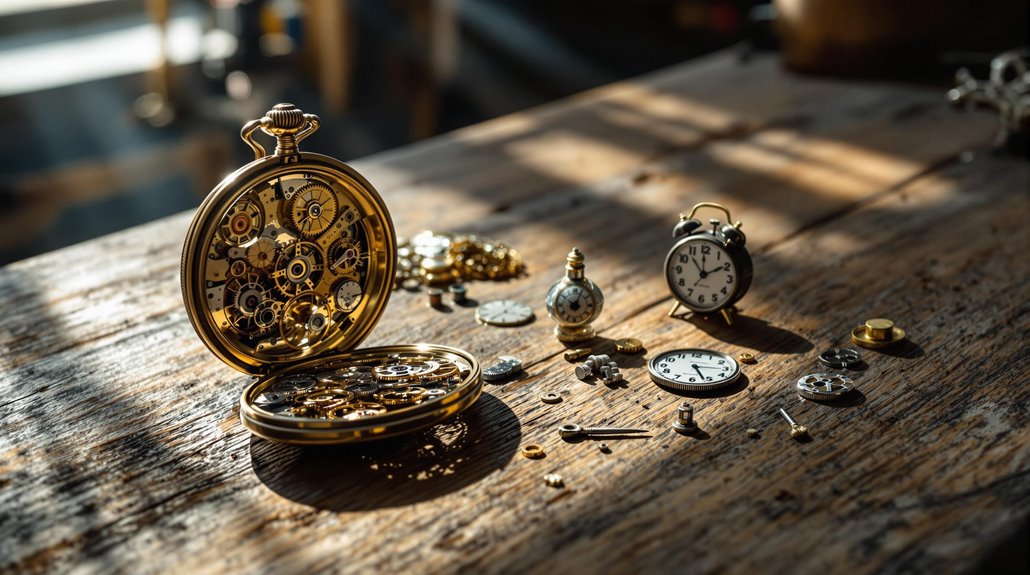
Precision altered timekeeping in ways that would astound medieval clockmakers. When Christiaan Huygens introduced the pendulum clock in the 17th century, his mechanical innovation improved accuracy dramatically. By combining the escapement mechanism with a pendulum, you'd find these timekeeping devices could maintain precision within seconds per day - a remarkable achievement for its era.
You'll notice an even greater leap forward with the development of quartz crystal technology in the mid-1900s. These quartz clocks revolutionized timekeeping by exploiting crystal vibrations, offering unparalleled accuracy that would make pendulum clocks seem primitive by comparison.
Today's atomic clocks, found in facilities like the National Physical Laboratory, represent the pinnacle of precision. You're looking at devices so accurate they'll only lose or gain a single second over 20 million years. The integration of GPS satellites has transformed how we synchronize time globally, affecting everything from your smartphone to international financial transactions.
You're witnessing another revolution as scientists develop optical and nuclear clocks, pushing the boundaries of precision even further. These advances aren't just about telling time - they're enabling breakthroughs in positioning, communication, and space exploration.
Transformative Impact of Quartz Technology
Throughout the mid-20th century, quartz technology sparked a seismic shift in how we measure time. Quartz clocks introduced a level of precision that you couldn't achieve with traditional mechanical timepieces, revolutionizing the way we track hours, minutes, and seconds. By channeling the vibration of quartz crystals to generate a precise electrical signal, these innovative devices delivered greater accuracy than their mechanical predecessors.
You'll find that quartz technology's impact extends far beyond its technical achievements. The widespread adoption of this technology made reliable timepieces more accessible than ever before. Whether you're checking your wristwatch or glancing at your bedside clock, you're likely benefiting from quartz technology that keeps time within mere seconds per month. This extraordinary precision transformed both personal timekeeping and professional time management.
The success of quartz clocks also laid the groundwork for even more advanced timekeeping methods. Today's atomic clocks, which evolved from this technology, offer unparalleled accuracy that you can depend on for millions of years. This progression from affordable quartz timepieces to ultra-precise atomic clocks represents one of horology's most significant technological leaps.
Atomic Clocks and Modern Applications
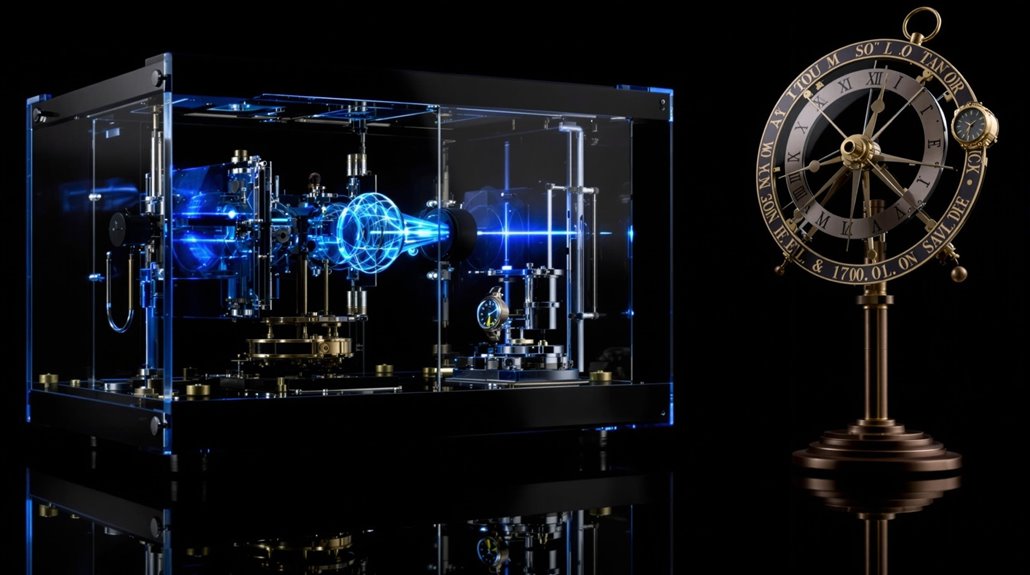
Modern atomic clocks stand out from all other timekeeping devices in both precision and reliability. Using the vibrations of atoms as their foundation, they've revolutionized accurate timekeeping, losing less than a second over millions of years. You'll find the caesium atomic clock maintaining official time standards worldwide, including at India's National Physical Laboratory in New Delhi.
Recent developments have brought even more precise technologies:
- Optical clocks using strontium or ytterbium atoms can maintain time for over 10 billion years without losing a second
- Nuclear clocks offer unparalleled stability by using atomic nuclei as resonators
- Global positioning systems rely on atomic clock precision for accurate location services
- Telecommunications networks depend on atomic time synchronization
- Scientific experiments requiring ultra-precise measurements use atomic clock technology
You're probably using atomic clock technology more often than you realize. These incredible timepieces have become essential to modern life, powering everything from your smartphone's GPS to international financial transactions. While optical clocks have pushed the boundaries of precision even further, emerging nuclear clock technology promises to deliver even greater accuracy, ensuring that our future timing needs will be met with exceptional reliability.