
The History of Time Zones and How They Shape Our World

Before the late 19th century, you'd find over 300 different local times across the United States alone, with each town following its own schedule based on the sun's position. The rise of railroads exposed this system's flaws, leading railroad companies to establish standardized time zones for efficient operations. In 1884, the International Meridian Conference established Greenwich, England as the prime meridian, dividing the world into 24 time zones. Today's global system, though imperfect with unique regional practices like China's single time zone, enables smooth worldwide commerce and communication. The story of how we measure time continues to evolve with our expanding civilization.
Early Local Time Systems
Chaos reigned in timekeeping before the late 19th century, as each town operated on its own local time schedule. If you lived in the United States during this period, you'd find yourself navigating through more than 300 different local times as you traveled across the country. Towns that were mere degrees of longitude apart could differ by several minutes in their timekeeping.
You'd notice impressive town clock towers serving as the central timekeeping authority in many communities. These towers weren't just structural features - they were essential tools for coordinating daily life. When the sun reached its highest point in the sky, it would determine that town's local noon. The towers' massive cast iron bells would ring out the hours, while smaller bells chimed to mark the quarter hours, helping you stay on schedule throughout your day.
This fragmented system became increasingly problematic as you'd try to coordinate train travel or communicate across distances. A town east of Greenwich might be operating on a completely different schedule than one west of Greenwich, making it nearly impossible to establish reliable timetables or meeting times across regions.
The Rise of Railroad Time
During the mid-1800s, the rapid expansion of railroads across continents exposed the serious flaws in local time systems. You couldn't rely on different towns keeping their own local time when trains needed to run on precise schedules across vast distances. The chaos of uncoordinated local times threatened to derail efficient railroad operations.
Railroad companies took matters into their own hands by establishing "railroad time" to guarantee their trains ran smoothly. They knew that coordinated timekeeping was essential for passenger safety and reliable freight delivery. You'd find that each company developed its own standardized schedule, but this still wasn't enough to solve the broader problem of time coordination across North America.
The breakthrough came in 1883 when railroad companies adopted a system of four standard time zones proposed by William F. Allen. This innovation transformed the way you'd travel and conduct business across the continent. The railroads' adoption of these time zones proved so practical that it became the foundation for the standardized time system you use today. What started as a solution for railroad scheduling ultimately reshaped how the entire world keeps time.
Birth of Global Time Standards

The momentum of global commerce and travel in the late 1800s demanded a more ambitious solution than regional railroad times. Sir Sandford Fleming, a Canadian railway engineer, championed the concept of worldwide time zones, recognizing that standardized timekeeping was essential for modern civilization's progress.
The International Prime Meridian Conference of 1884 marked a pivotal moment in timekeeping history. You'll find it fascinating that delegates from 25 countries gathered to establish Greenwich, England as the prime meridian (0 degrees longitude), creating the foundation for Greenwich Mean Time (GMT). This decision led to the division of the globe into 24 time zones, each separated by 15-degree intervals of longitude, with every zone representing a one-hour difference from its neighbors.
You're experiencing the lasting impact of these 19th-century decisions today. The establishment of global time standards revolutionized international trade, scientific collaboration, and communication. While some countries initially resisted this standardization, they gradually adopted these time zones. The success of this system demonstrated how international cooperation could solve complex logistical challenges, laying the groundwork for our modern interconnected world.
Greenwich Mean Time Establishment
Following the landmark 1884 International Meridian Conference, Britain's Royal Observatory in Greenwich emerged as the global timekeeper's headquarters. The selection of Greenwich as the prime meridian wasn't just a matter of chance - it reflected Britain's dominant naval power and the widespread use of nautical charts that already referenced Greenwich as their baseline.
When you look at a modern map, you'll notice how the world's time standard, Greenwich Mean Time (GMT), serves as the centerpiece of our global timekeeping system. The conference established a network of time zones that extend east and west from Greenwich in 15-degree increments. Each increment represents a one-hour difference, creating 24 global time zones that wrap around the Earth.
This standardization revolutionized how you track time across borders. Whether you're scheduling international business calls or coordinating travel plans, you're using a system that stems from this historic decision. The establishment of GMT brought order to what was previously a fragmented approach to timekeeping, enabling the smooth operation of global transportation networks, communication systems, and commerce that we rely on today.
Time Zones Around The World

Modern timekeeping's complexity reveals itself in the diverse array of time zones that span our globe. When you look at a time zone map today, you'll notice that while there are 24 primary zones based on longitude lines, the reality is far more intricate. These zones, originally established in relation to Greenwich Mean Time (GMT) and now referenced to Coordinated Universal Time, don't always follow straight lines on the world map.
You'll find fascinating variations in how different nations handle their time zones:
- China maintains a single time zone across its vast territory, despite crossing five geographical time zones
- Russia immerses itself in 11 distinct time zones, reflecting its immense east-to-west span
- Countries like India and Afghanistan use unconventional half-hour or quarter-hour offsets
The political nature of time zone boundaries often trumps geographical logic. You'll notice that while these zones theoretically should follow neat 15-degree longitude intervals, they frequently bend to accommodate national borders and regional preferences. This creates a complex embroidery of time differences, with the International Date Line serving as the point where one day shifts to the next.
Unique Regional Time Zone Practices
Numerous countries have adopted distinctive approaches to time zone management, often prioritizing political and cultural considerations over geographical logic. You'll find China's unique approach particularly fascinating, as it operates on a single China Standard Time even though the country spans five time zones. This means that when you're in western China, the position of the sun might not match your expected time of day.
Australia presents another intriguing case, where you'll encounter three different time zones with an unconventional half-hour offset between its central and western regions. This practice isn't unique to Australia - you'll find similar half-hour and even quarter-hour time zone variations in countries like India and Iran, breaking from the typical hourly divisions.
In polar regions, you'll uncover that traditional time zones become impractical. Scientists at research stations near the North and South Poles rely on UTC instead of Daylight Saving or standard regional times. Meanwhile, the United States maintains nine official time zones, including two unofficial ones in its Pacific territories, demonstrating how political boundaries and territorial management can influence time zone decisions.
Digital Age Time Management

With the advent of digital technology, time zone management has evolved from simple clock adjustments to sophisticated digital solutions that seamlessly connect our global society. You'll find that managing time zones in the digital age has become both easier and more complex, as your devices automatically sync to local times while coordinating with global networks.
In today's interconnected world, you're likely experiencing these critical developments in digital time management:
- Cloud-based calendars and meeting platforms that automatically convert UTC time to your local time zone, guaranteeing you never miss an important virtual meeting
- Global e-commerce and banking systems that process transactions with precise time zone differences, safeguarding your financial activities
- Smart devices and AI assistants that adjust their services based on your time zone, delivering personalized experiences around the clock
The rise of remote work has transformed how you handle global communication, making digital time management tools essential for daily operations. Whether you're scheduling international calls or managing distributed teams, these technologies guarantee smooth collaboration across multiple time zones. As digital solutions continue evolving, they're making it increasingly effortless to navigate our interconnected world.
Space Exploration Timekeeping Challenges
Space exploration introduces unparalleled timekeeping challenges that stretch far beyond Earth's familiar 24-hour cycles. When you're managing spacecraft operations, you'll find that traditional time zones and local times become nearly meaningless. Consider the International Space Station, where astronauts might witness up to 16 sunrises and sunsets daily. To maintain order amid this complexity, they've adopted Greenwich Mean Time (GMT) as their standard reference.
You'll observe that space exploration demands precise timekeeping coordination between mission control and spacecraft. Whether you're hours ahead or behind on Earth, you need a unified system that transcends conventional time zones. This becomes even more intricate when exploring other planets. On Mars, for instance, you're dealing with days that are 40 minutes longer than Earth's, requiring specialized timekeeping protocols.
Space agencies have developed sophisticated systems to address these unique challenges. They've created standardized methods that guarantee accurate synchronization between Earth-based operations and spacecraft activities. Without these carefully crafted timekeeping solutions, critical mission operations could fail, highlighting why precise time management remains fundamental to successful space exploration.
Modern Time Zone Controversies
Time zone management on Earth may seem simpler than space-based timekeeping, but you'll find it's riddled with its own set of modern controversies. While zero degrees longitude and Greenwich Mean Time (GMT) provide a foundation for global timekeeping, you'll notice significant deviations from traditional time zones based on the shape of the Earth.
Consider how China and India have taken drastically different approaches. China uses a single time zone across its vast territory, meaning the sun might rise two hours later in western regions than in the east. India, meanwhile, has opted for a half-hour offset, creating unique challenges for international coordination.
Here are three major ongoing time zone debates:
- The effectiveness of daylight saving time and whether it should be abolished
- The practicality of implementing a single global time standard
- The need to adjust existing time zones to match modern economic and political realities
These controversies highlight how time zones aren't just about geographical considerations anymore. They've become intertwined with political decisions, economic interests, and social preferences, making any proposed changes increasingly complex to implement.
Future of Time Standardization
Progress toward a more unified global timekeeping system represents one of the most significant challenges in modern standardization efforts. While we've come a long way since the 1884 Meridian Conference established Greenwich Mean Time (GMT) as the world's primary meridian, you'll find that achieving complete global time unity remains elusive.
Today's proposals for a single global time system build upon UTC (Coordinated Universal Time) standards, suggesting ways to divide the world into 24 time zones more efficiently. You'll notice that technological advancements have made these proposals more feasible than ever before, with satellite communications and internet connectivity enabling precise synchronization across borders. However, you'll find that implementing such changes faces considerable resistance from countries wanting to maintain their traditional time practices.
As you look to the future, it's becoming clear that rather than a complete overhaul of existing time zones, we're likely to see gradual improvements in coordination between regions. While the dream of a unified global time system remains alive, the practical approach focuses on enhancing interoperability while respecting local customs and practices that have evolved around current time zones.
Economic Impact of Time Zones
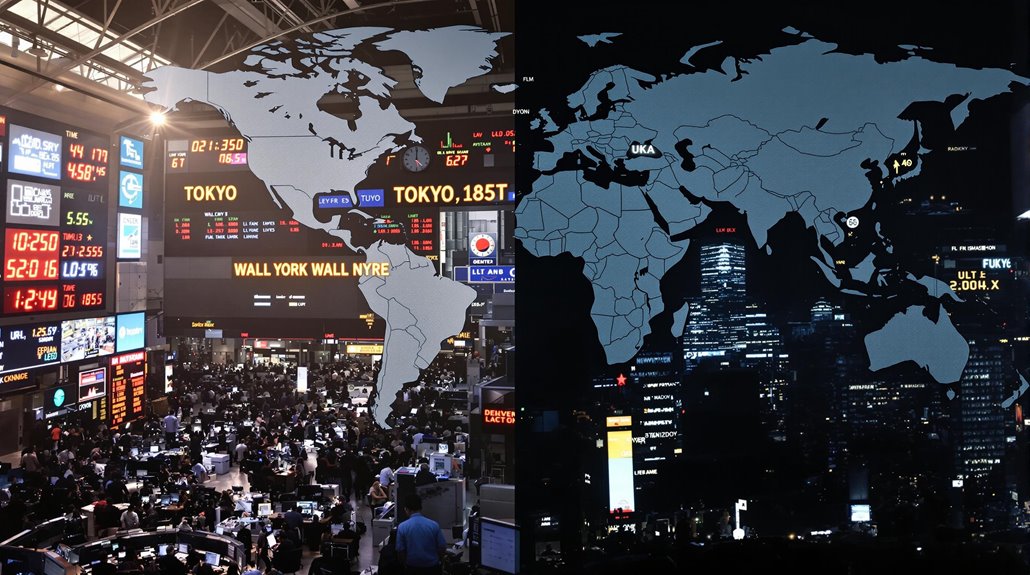
While standardization efforts continue to evolve, the global economy faces significant challenges due to time zone differences. When railroad companies began establishing time zones in the 19th century, they couldn't have predicted today's interconnected global economy. Now, businesses must traverse through five time zones or more just to conduct daily operations, with many choosing to use UTC (formerly GMT) as their reference point.
You'll find these impacts most pronounced in:
- Supply chain management, where coordinating shipments across degrees of longitude requires precise timing and careful planning
- Financial markets, where trading hours overlap creates both opportunities and challenges for global transactions
- International business operations, where companies must maintain 24/7 coverage across multiple time zones
Modern businesses are investing heavily in solutions to bridge these temporal gaps. You'll notice this especially in financial markets, where milliseconds can mean millions in profits or losses. The complexity doesn't end there - you're likely to encounter increased operational costs due to extended working hours, overtime pay, and the need for sophisticated scheduling systems. This temporal challenge continues to shape how companies structure their global operations and influences where they choose to establish new offices.