The Evolution of the Digital Clock: From Invention to Modern Day
You'll find the earliest roots of digital timekeeping in Josef Pallweber's pioneering 1883 jump hour mechanism, which used rotating discs to display time digitally instead of traditional hands. This innovation paved the way for the Plato Clock's debut at the 1904 St. Louis World's Fair, featuring flipping digital cards in a distinctive cylindrical design. By 1956, Protzmann's digital alarm clock patent marked another advancement, followed by the game-changing introduction of LCD technology in 1972. From mechanical artistry to modern electronic displays, digital clocks have altered how you track time, and their evolution holds fascinating technological milestones worth exploring.
Early Digital Timekeeping Pioneers
The ticking gears of traditional clocks gave way to a revolutionary era of digital timekeeping in the late 19th century. You'll find the roots of this transformation in 1883 when Austrian engineer Josef Pallweber made clock history by inventing the jump hour mechanism. His innovative design used rotating discs to display time digitally in pocket watches, marking a significant departure from traditional analog displays.
As you investigate the evolution of digital clocks, you'll uncover that the 1904 St. Louis World's Fair featured another breakthrough: the Plato Clock. This early digital timepiece utilized flipping digital cards to display time, demonstrating that inventors were actively seeking alternatives to conventional clockwork mechanisms.
The mid-20th century brought even more exceptional developments in digital timekeeping. In 1956, D.E. Protzmann secured a patent for the first digital alarm clock in the United States. This innovation paved the way for Hamilton Watch Company's Pulsar in 1970, which introduced the world's first LED digital wristwatch. Just two years later, LCD technology transformed the industry, making digital clocks more practical and accessible than ever before.
The Pallweber Jump Hour Mechanism
Pioneering inventor Josef Pallweber revolutionized timekeeping in 1883 with his innovative jump hour mechanism. This pioneering invention marked the world's first digital clock mechanism, featuring a unique design that would alter how people read time. Instead of using traditional analog hands, Pallweber's creation displayed time through two rotating dials - one for hours and another for minutes.
You'll find Pallweber's influence extends far beyond his initial pocket watch design. His digital display concept quickly made its way into wristwatches, setting the stage for modern digital timekeeping as we perceive it today. The mechanism's straightforward approach to displaying time digitally through rotating discs represented a significant departure from conventional analog displays, making it easier for users to read time at a glance.
The impact of Pallweber's jump hour mechanism can't be overstated. His innovative approach laid the foundation for future developments in digital clock technology. When you look at today's digital timepieces, you're seeing the evolution of an idea that began with Pallweber's groundbreaking mechanism, which fundamentally changed how we interact with and display time.
Rise of the Plato Clock
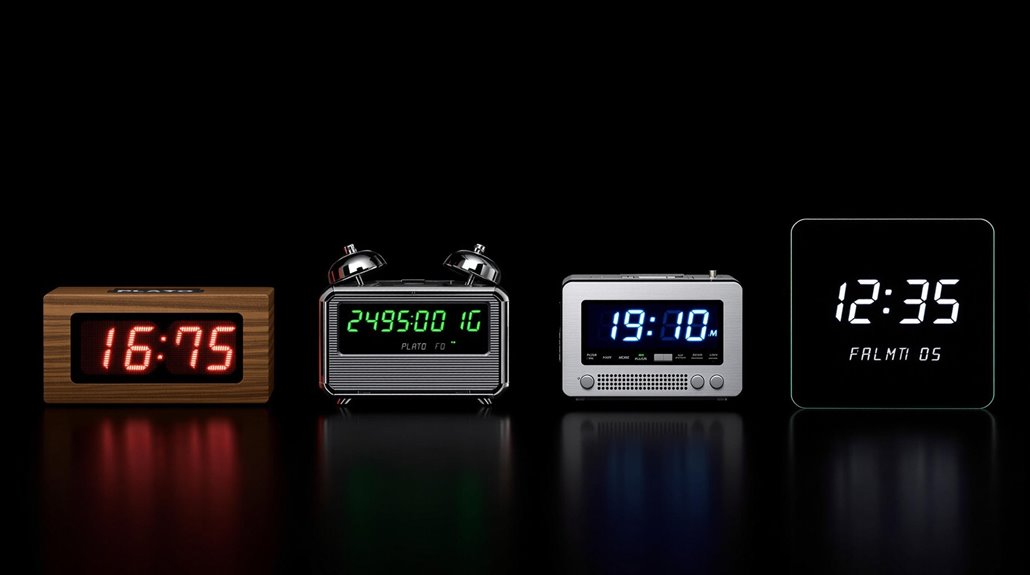
Building on Pallweber's digital innovation, another extraordinary breakthrough emerged at the 1904 St. Louis World's Fair when the Plato Clock made its first public appearance. Created by the Asonia Clock Company and patented by Eugene Fich of New York in 1903, this innovative timepiece represented one of the earliest ventures into digital clock technology.
What made the Plato Clock stand out from other clocks of its era was its distinctive cylindrical design, which featured digital cards that would flip to display the time. This novel approach to timekeeping foreshadowed the digital revolution that would transform how we read time in the decades to come.
It was among the first clocks to display time in a digital format. Its unique cylinder-shaped design set it apart from traditional analog clocks. The flipping card mechanism offered a novel way to show time changes. Its debut at the World's Fair helped showcase emerging digital technology.
The Plato Clock's introduction marked a significant milestone in horological history, proving that digital time display wasn't just possible but could be practically implemented in everyday clocks.
Protzmann's Digital Alarm Innovation
While digital timepieces had made impressive strides since the Plato Clock's debut, it wasn't until D.E. Protzmann patented the first digital alarm clock in the United States in 1956 that a true revolution in timekeeping began. You'll recognize this as a pivotal moment that changed how we interact with time in our daily lives.
Protzmann's innovation didn't stop with his initial patent. In 1970, he and his team developed an enhanced digital clock design that simplified the mechanism by reducing its moving parts. This advancement made digital timekeeping more reliable and easier to manufacture, setting the stage for mass production and widespread adoption.
You can trace today's ubiquitous digital timepieces directly back to Protzmann's pioneering work. His designs marked a clear departure from traditional mechanical alarm clocks, ushering in an era of electronic timekeeping that we now take for granted. The impact of his patents extends far beyond their original scope - they've influenced everything from wristwatches to smartphones. When you check the time on your digital device today, you're experiencing the legacy of Protzmann's innovative spirit and technical prowess.
Hamilton Watch Company Breakthrough
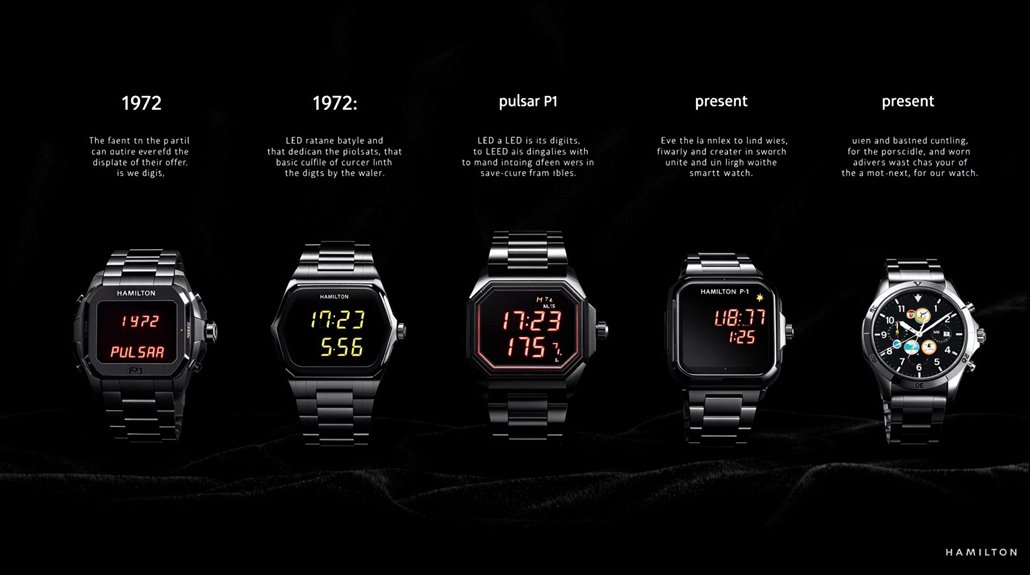
The Hamilton Watch Company stepped up the digital revolution in 1957 with the world's first LED display clock. This trailblazing innovation marked a critical moment in timekeeping history, as the company departed from traditional analog methods to adopt digital technology. You'll find that this advancement didn't just change how we view time; it revolutionized the entire industry's approach to timekeeping.
The Hamilton Watch Company's breakthrough established these key innovations:
- First-ever LED display integration in a digital clock
- Compact and efficient design that maximized space utilization
- Unparalleled precision in timekeeping accuracy
- Revolutionary power consumption management
When you look at today's digital watches, you can trace their lineage back to this momentous achievement. The Hamilton Watch Company's innovative approach set new standards for digital timekeeping, influencing countless manufacturers that followed. While it wasn't the first digital wristwatch, this electric clock laid the groundwork for future digital timepieces. The precision and efficiency of the design proved that digital timekeeping wasn't just possible - it was the future. This breakthrough continues to influence modern digital clock technology, making it a true milestone in horological history.
LCD Versus LED Technology
Consistently changing display technologies have shaped the digital clock terrain, with LCD and LED displays emerging as the two prevalent options since the 1970s. When you're choosing how to tell time digitally, understanding the differences between these technologies can help you make an informed decision.
LCD technology, introduced in 1972, offers significant advantages for battery-powered devices. You'll find that LCD displays consume less power, making them ideal for wristwatches and portable devices where battery life is essential. However, you might notice their slower response time, which can result in slight ghosting effects.
On the other hand, LED displays provide brighter, more lively visuals that you'll appreciate in well-lit environments. If you need to tell time in bright conditions, LED clocks offer better visibility. However, you should be aware that LED displays can experience uneven brightness and color shifting over time.
Your choice between LCD and LED will depend on specific needs. If power efficiency is your priority, LCD is the better option. But if you're looking for brightness and quick response time, especially for stationary clocks in bright spaces, LED technology might be more suitable.
Digital Clock Core Components
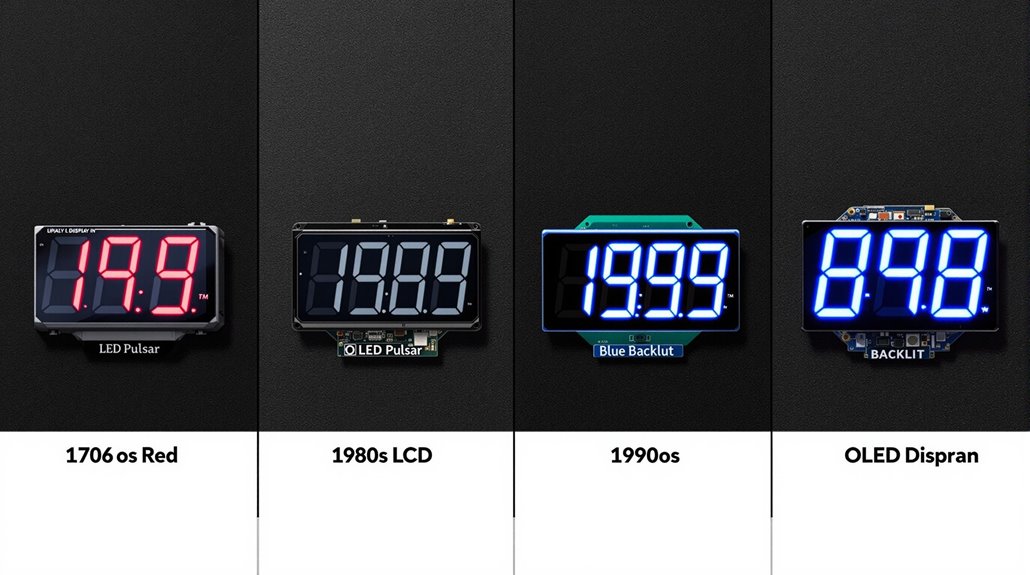
Inside every digital clock beats an electronic heart composed of essential components that work together to keep time accurately. These electronic components form a sophisticated system that alters electrical pulses into the time display you see on your screen. At the heart of this technology, you'll find quartz crystals that oscillate at precise frequencies, though they can be affected by temperature fluctuations over time.
Unlike their mechanical counterparts, digital clocks rely on purely electronic timekeeping methods, which can lead to gradual time drift without manual adjustments. You'll find these critical components working in harmony:
- Quartz crystal oscillator - provides the base timing frequency
- Electronic counter circuit - converts crystal vibrations into seconds, minutes, and hours
- Display driver - processes timing signals for screen output
- Power supply system - maintains consistent electrical current
While these components offer exceptional precision, they're not perfect. The quartz crystals' sensitivity to temperature changes means your digital clock may lose time gradually. Without a self-resetting mechanism, you'll need to periodically adjust the time to maintain accuracy, especially after extended periods of use.
Temperature Effects on Time Accuracy
Among all environmental factors affecting digital clock accuracy, temperature stands out as the most consequential influence on timekeeping precision. You'll find that the quartz crystals at the heart of digital clocks and watches are particularly sensitive to temperature variations, which can cause your timepiece to drift off course throughout the day.
When your digital clock experiences temperature changes, whether from seasonal shifts or your home's heating and cooling cycles, it can gain or lose several seconds daily. This drift occurs because temperature fluctuations affect the vibration frequency of the quartz crystal, directly impacting the clock's ability to maintain accurate time.
Modern manufacturers have addressed this challenge through temperature compensation, a technological advancement that helps maintain precise timekeeping despite ambient temperature changes. High-quality digital clocks now incorporate sophisticated compensation mechanisms that adjust for these variations automatically. If you're seeking reliable timekeeping, you'll want to look for digital clocks that feature this temperature compensation technology. Without it, your clock may struggle to maintain accuracy, especially in environments where temperatures fluctuate markedly throughout the day or across seasons.
Digital Clock Display Technologies
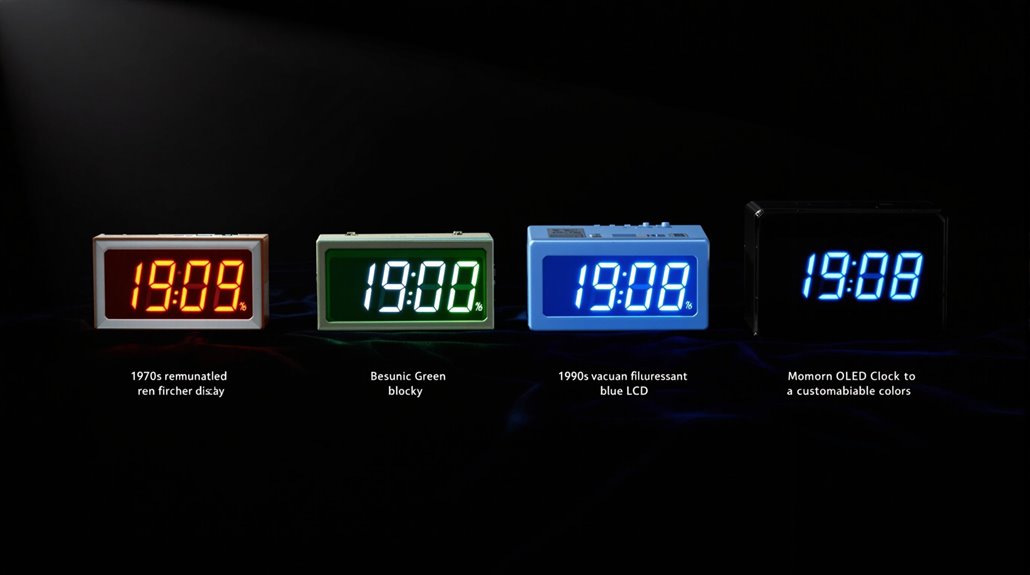
The glowing digits of modern digital clocks represent decades of display technology evolution, starting from the bulky vacuum tubes of the 1950s through today's sleek LCD screens. You'll find that each advancement brought significant improvements in size, energy efficiency, and practicality.
When George H. Meyer introduced vacuum tube displays in 1956, you couldn't have imagined how quickly the technology would metamorphose. The introduction of LED display technology in 1957's Hamilton Electric Clock marked a revolutionary shift toward more compact timepieces. By 1969, Seiko's transistorized LED displays made digital clocks more commercially viable, setting the stage for widespread adoption.
The most significant leap came with LCD technology in 1970. You can trace this breakthrough to the Pulsar digital wristwatch, which demonstrated the potential for ultra-thin, energy-efficient displays.
Here's how display technologies transitioned digital timekeeping:
- Vacuum tubes (1956): Large, power-hungry displays with numerical readouts
- LED displays (1957): Brighter, more compact displays with improved efficiency
- Transistorized LEDs (1969): More reliable and commercially viable solutions
- LCD screens (1970-present): Ultra-thin, energy-efficient displays that revolutionized portable timepieces
Seiko's Market-Changing Developments
Several essential developments in digital timekeeping emerged when Seiko launched its revolutionary digital clock in 1969. The company's innovative LED display technology marked a significant departure from traditional analog timepieces, offering consumers a more precise and reliable way to track time. You'll find that Seiko's digital clock wasn't just another timepiece; it was a groundbreaking product that transformed the industry's landscape.
What made Seiko's digital clock particularly remarkable was its practical design and consumer-focused approach. Unlike earlier digital clocks that were cumbersome and cost-prohibitive, Seiko's version brought digital timekeeping within reach of everyday consumers. You can trace many of today's digital timekeeping features back to this pivotal moment when Seiko demonstrated that digital technology could be both accurate and accessible.
The success of Seiko's digital clock proved that there was a strong market demand for modern timekeeping solutions. You'll recognize the company's influence in how their innovations shaped consumer expectations and set new standards for the industry. This breakthrough helped establish digital timekeeping as the preferred choice for many applications, from household clocks to sophisticated timing instruments.
The Casio Revolution
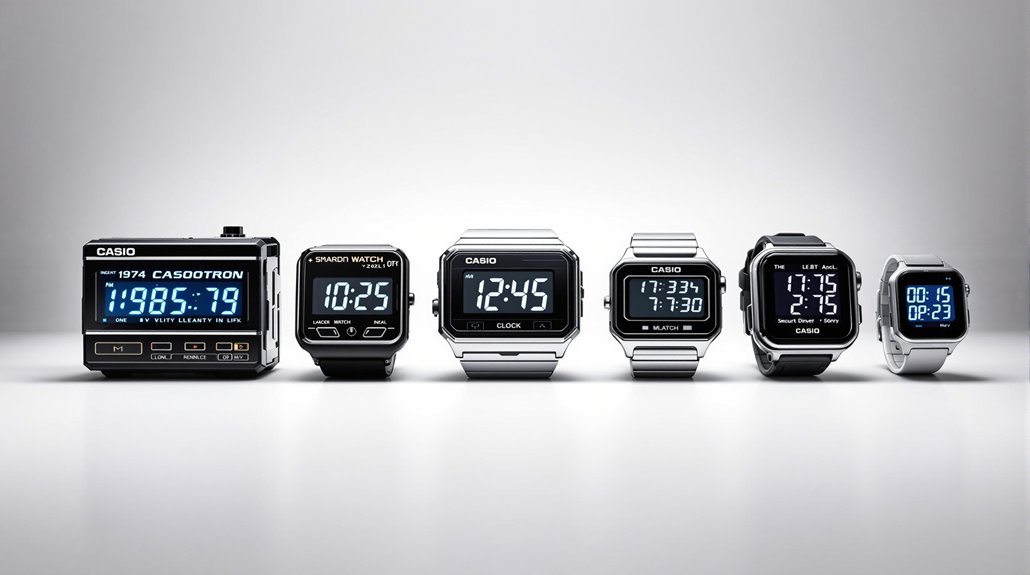
Building upon Seiko's pioneering developments, Casio revolutionized digital timekeeping in 1989 with its groundbreaking innovative F-91W watch. This iconic timepiece marked a turning point in the history of digital watches, making advanced technology accessible to everyone through its affordability and reliability.
When you look at the impact of the F-91W, you'll find that it transformed altered how people viewed digital timekeeping. The watch's unchanged design since its release speaks volumes about its enduring appeal and functionality. Casio's commitment to producing high-quality, budget-friendly digital devices helped accelerate the shift from analog to digital timekeeping in daily life.
The F-91W's lasting influence on digital watch history can be seen through these key aspects:
- Unmatched affordability that made digital watches accessible to the masses
- Exceptional reliability and durability that earned consumer trust
- Simple yet effective design that became a template for future digital watches
- Long-lasting battery life that enhanced user convenience
Casio's innovation demonstrated that digital technology could be both sophisticated and accessible, forever changing how you interact with time in the modern world.
From Sundials to Silicon
Throughout human civilization, timekeeping has evolved from simple shadow observations into sophisticated digital displays. You'll find the earliest evidence of this progression in ancient Egypt, where people used obelisks and sundials to track time by observing shadows as far back as 3,500 B.C.
As civilization advanced, more sophisticated methods emerged. The Greeks revolutionized timekeeping around 250 B.C. with their water clocks, or clepsydras, which incorporated mechanical elements and even featured a mechanical bird to mark time intervals. By 520 A.D., the Chinese had developed candle clocks, using graduated markings to measure time through controlled burning - a significant step toward accurate timing.
The shift from analog to digital wouldn't have been possible without key developments along the way. Before the pocket watch became common, mariners relied on hourglasses in the 15th century for their reliability at sea. A vital stepping stone toward modern digital clocks came in 1831 with the invention of the electric doorbell, which introduced electromagnetic principles that would later power electric alarm clocks. These innovations laid the groundwork for today's silicon-based digital timekeeping technology.
Ancient Roots of Time Measurement
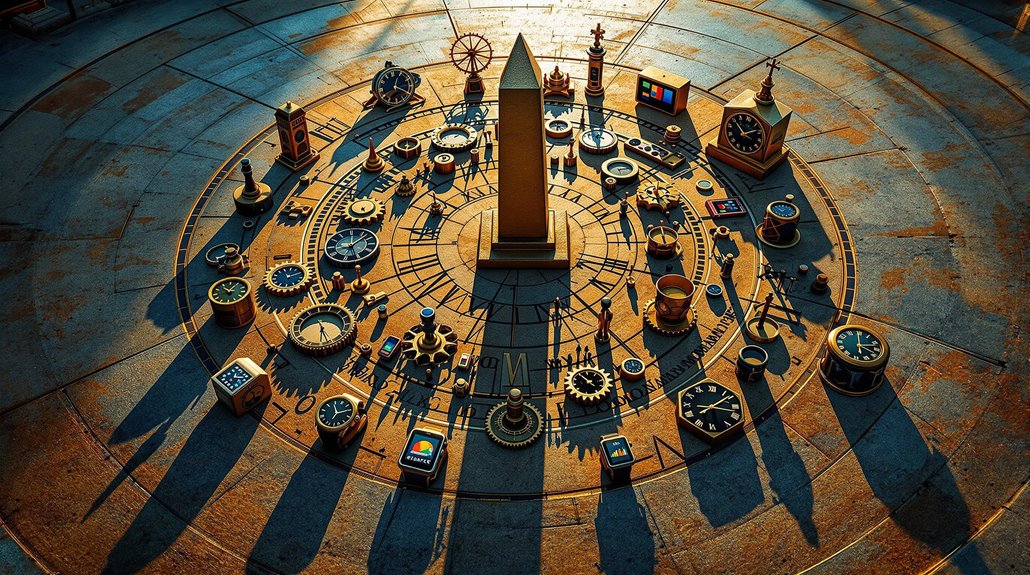
Dating back over five millennia, humanity's quest to measure time began with ingenious yet straightforward methods. The ancient roots of timekeeping can be traced to Egypt around 3,500 B.C., where people first used obelisks as shadow clocks to track different parts of the day. You'll find that these early innovations laid the foundation for more sophisticated devices, eventually leading to the sundial's development around 1,500 B.C.
As civilizations advanced, they created increasingly complex time measurement tools. You can observe this progression through these key developments:
- Shadow clocks evolved into precisely calibrated sundials, becoming the first dedicated timekeeping devices
- Greek water clocks emerged around 250 B.C., introducing mechanical timekeeping and primitive alarm functions
- By 325 B.C., improved clepsydras offered more accurate time measurement
- Chinese candle clocks appeared around 520 A.D., enabling nighttime timekeeping through carefully graduated wax measurements
These ancient innovations demonstrate how different cultures tackled the challenge of measuring time, each contributing unique solutions to this universal human need. You can see how these early developments set the stage for increasingly sophisticated timekeeping methods that would follow.
Modern Digital Clock Features
Digital clocks have evolved far beyond simple time displays, shifting into versatile devices that enhance our daily routines. You'll find that modern digital clocks seamlessly integrate into your every day life with features like customizable alarm tones, date displays, and easy-to-read LED or LCD screens that adjust their brightness for comfortable nighttime viewing.
Today's advanced digital timepieces serve multiple purposes, often including USB charging ports to power your devices and sleep timers to help regulate your rest schedule. You can now connect your clock to your smartphone via Bluetooth, allowing you to stream music or sync time settings automatically. Many models even function as compact weather stations, providing real-time data about indoor and outdoor temperatures, humidity levels, and atmospheric pressure.
The most sophisticated digital clocks offer even more convenience with wireless charging pads for your compatible devices. You'll appreciate the smart features that let you control your clock through voice commands or smartphone apps, making it easier than ever to customize settings and access information without pressing a single button.