Who Invented the Modern Clock? A Journey Through Timekeeping History
You'll discover that the modern clock wasn't invented by a single person but evolved through centuries of innovation. Ancient civilizations first used sundials and water clocks, while medieval artisans developed mechanical clocks in the 13th century. The real breakthrough came in 1656 when Dutch scientist Christiaan Huygens created the pendulum clock, dramatically improving accuracy over previous designs. His invention revolutionized timekeeping and remained the gold standard for nearly 300 years. From ancient sundials to Huygens' pendulum mechanism, the expedition of clock development reveals humanity's fascinating quest to command time measurement.
Ancient Methods of Time Measurement
Throughout human history, early civilizations developed ingenious methods to track time. You'll find that ancient civilizations like Egypt, Babylon, and China were particularly innovative in their timekeeping approaches, creating devices that revolutionized how people measured their days.
When you look at sundials, you'll uncover they were among the earliest tools, using the sun's shadow to mark time's passage. These devices served ancient civilizations well during daylight hours, but they needed alternative methods for cloudy days and nighttime. That's where water clocks, or clepsydras, came into play. These ingenious devices used water's consistent flow to track time, offering more reliability than their sun-dependent counterparts.
In ancient China, you'll find they developed unique timekeeping methods, including incense clocks around the 6th century. These clever devices measured time by burning incense at a predictable rate. Later, hourglasses emerged as a simple yet effective way to measure shorter time intervals using falling sand. While these ancient methods weren't as precise as today's clocks, they demonstrated exceptional creativity in solving the universal challenge of measuring time.
The Rise of Sundials
Of all ancient timekeeping methods, sundials emerged as the most widespread and influential tools for tracking daily time. Dating back to around 1500 BC in ancient Egypt, these ingenious devices spread across civilizations, including Babylonia and China, revolutionizing how people measured their days.
You'll find that the principle behind sundials was remarkably straightforward yet effective. A vertical rod or pillar called a gnomon would cast a shadow that moved as the sun traversed the sky. By observing the shadow's length and direction, you could determine the approximate time of day. This method proved more reliable than earlier time measurement techniques, though it wasn't without its limitations.
If you'd lived in ancient times, you'd have noticed that sundials weren't always dependable. They could only function during daylight hours, and their accuracy diminished markedly on cloudy or overcast days. Despite these drawbacks, sundials represented a pivotal advancement in humanity's quest to track time. They laid the groundwork for more sophisticated timekeeping technologies and remained the primary method of time measurement until the development of mechanical clocks many centuries later.
Water Clocks Across Civilizations
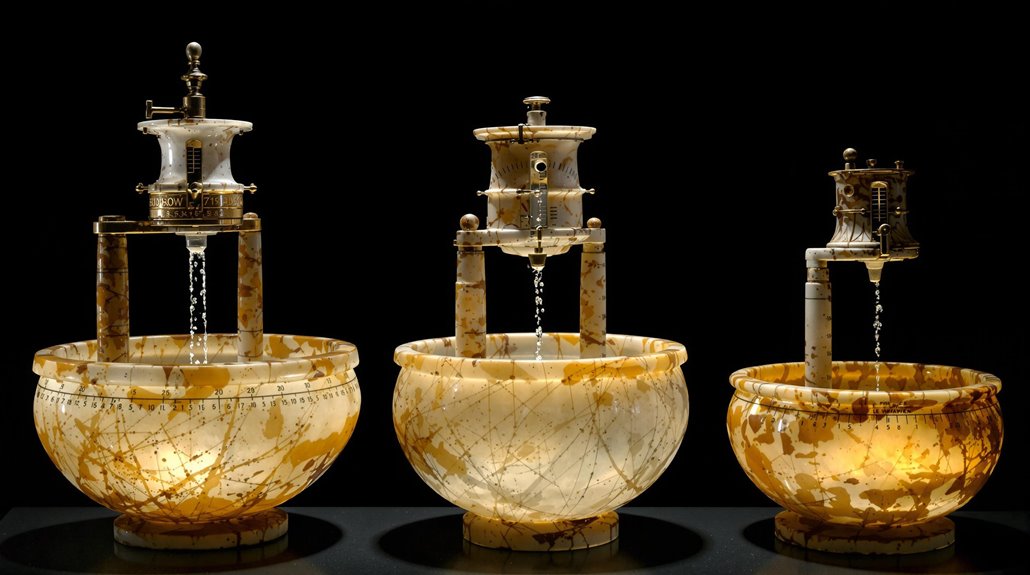
The evolution of water clocks marked a pivotal leap forward in humanity's ability to measure time both day and night. These ingenious devices, known as clepsydras, were first invented by ancient Egyptian and Chinese civilizations as early as 2000 BC. You'll find that water clocks served as reliable timekeeping instruments in regions where sundials couldn't be effectively used due to cloudy skies or darkness.
As time progressed, medieval Islamic scholars transformed these basic devices into sophisticated machines. They're credited with adding rotating displays and chiming mechanisms that made water clocks more precise and functional. One of History's most exceptional water-powered innovations came from Chinese engineer Su Song, who built an astronomical clock tower in 1088 featuring an endless chain drive system.
The impact of water clocks on timekeeping can't be understated. They provided ancient civilizations with the ability to measure time consistently in various weather conditions, something that wasn't possible with sundials alone. These early devices laid indispensable groundwork for the development of mechanical clocks that would later emerge in medieval Europe, forever changing how we track time.
Medieval Mechanical Clock Innovation
During the late 13th century, mechanical clocks revolutionized timekeeping with their innovative weight-driven systems and escapement mechanisms. The first known mechanical clock appeared in England's Dunstable Priory in 1283, marking a critical moment in horological history. You'll find that these early timekeeping devices relied on weight-driven mechanical clock systems, where falling weights powered the clock's movement.
The introduction of the escapement mechanism was particularly influential, as it controlled the oscillator's speed and improved accuracy. While Christiaan Huygens would later perfect timekeeping with his pendulum clock invention, these early mechanical innovations laid the essential groundwork for modern clockmaking.
You'll notice that churches and cathedrals were the primary users of mechanical clocks in the late 13th and early 14th centuries. They used these devices to accurately schedule prayer times, but the impact extended far beyond religious purposes. As mechanical clocks began appearing in town squares across Europe, they altered how society functioned, helping coordinate daily activities and establishing a more structured approach to time management in medieval communities.
The Pendulum Clock Revolution
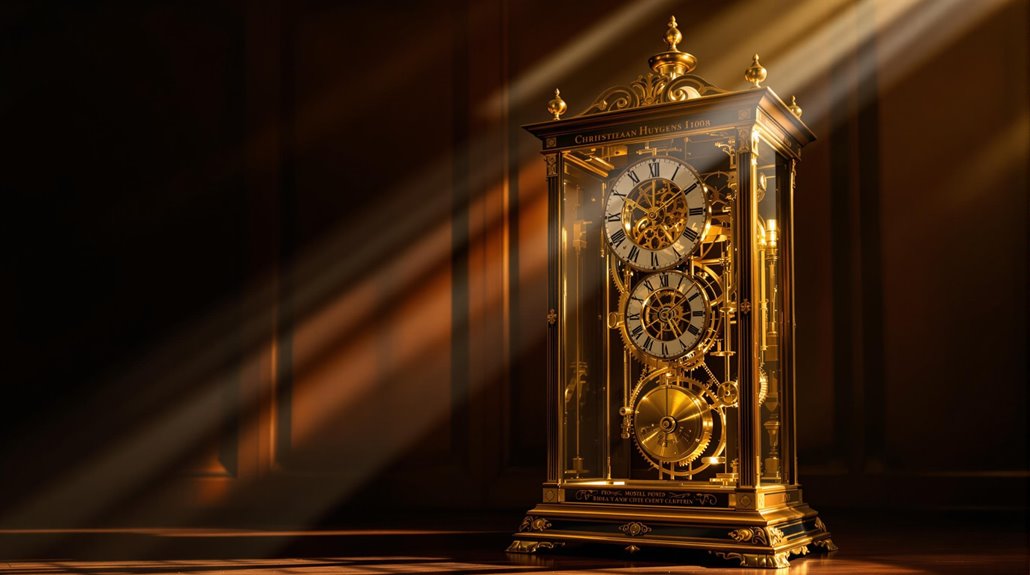
Revolutionary scientist Christiaan Huygens altered timekeeping forever in 1656 with his pendulum clock invention. His design marked a dramatic improvement over earlier mechanical clocks by introducing a swinging pendulum as the key timekeeping mechanism. You'll find it fascinating that this simple yet brilliant addition made clocks far more precise than ever before.
The impact of Huygens' innovation reached far beyond just telling time. His pendulum clock quickly replaced traditional mechanical clocks in churches and public spaces, becoming the new standard for accurate timekeeping. You can trace significant advancements in scientific research and wayfinding directly to this invention, as scientists and sailors finally had a reliable way to measure time intervals precisely.
The pendulum clock's influence on daily life was equally exceptional. You'd notice its effects in how people coordinated their activities, as communities could now synchronize their schedules with unparalleled accuracy. This revolutionary timekeeping device maintained its position as the most precise method of tracking time for nearly three centuries, until the emergence of quartz and atomic clocks in the 20th century reshaped timekeeping once again.
Notable Clockmakers Through History
Notable pioneers in clockmaking have shaped the evolution of timekeeping through their exceptional innovations and craftsmanship. From the first mechanical clocks to modern atomic clocks, you'll find remarkable individuals who've revolutionized how we measure time.
Thomas Tompion, known as the "Father of English Clockmaking," set the foundation for precision timekeeping devices in the 17th century. His contemporary, Robert Hooke, advanced clock technology by developing the balance spring, an essential component that's influenced clock design even into the era of quartz crystal timepieces.
In the 18th century, John Harrison's marine chronometers transformed maritime navigation, while George Graham's innovations improved clock accuracy well before the advent of vibrations of a quartz. Benjamin Banneker, a self-taught craftsman, demonstrated exceptional skill by creating a wooden clock that kept exact time for over five decades.
These clockmakers' contributions to the History of Clocks and Watches extend far beyond their eras. While today's timepieces may rely on different technologies, the principles these pioneers established continue to influence modern timekeeping, from basic wall clocks to sophisticated atomic timekeeping systems.
Maritime Navigation and Chronometers
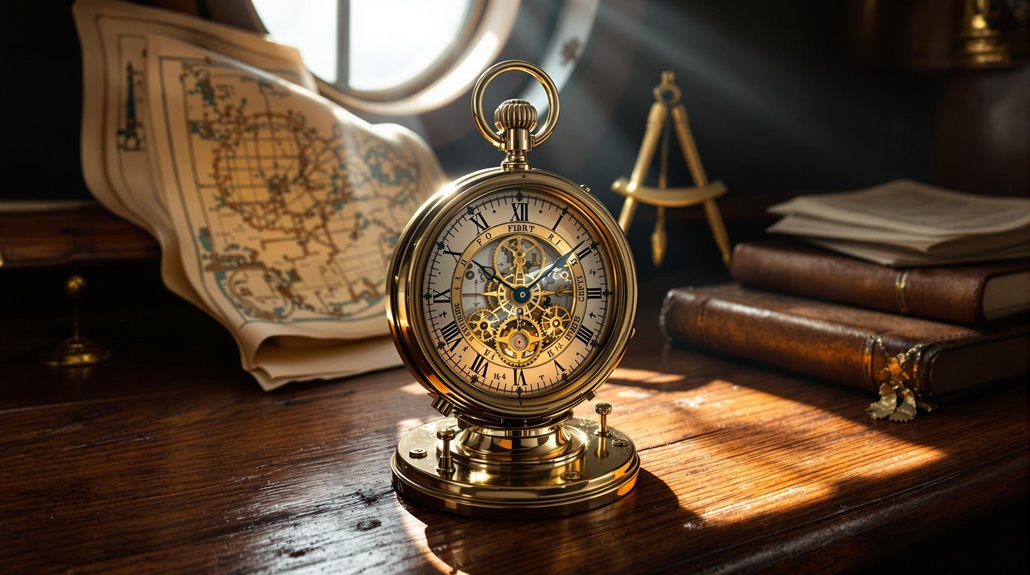
As ships ventured farther into uncharted waters during the Age of Exploration, the need for precise guidance became essential. The challenge of determining longitude at sea remained unsolved until John Harrison revolutionized maritime navigation with his transformative marine chronometers in the 18th century.
The British Board of Longitude's substantial prize motivated Harrison to develop increasingly accurate clocks that could withstand the harsh conditions at sea. His masterpiece, the H4 chronometer completed in 1759, achieved remarkable precision, losing only a few seconds per day. This groundbreaking innovation transformed how ships navigated the oceans.
They enabled sailors to calculate longitude by comparing local time with their port of departure. They maintained accurate timekeeping despite a ship's motion and varying temperatures. They reduced the risks of getting lost at sea, making ocean voyages safer. They accelerated global trade by enabling more reliable navigation.
The widespread adoption of chronometers in the 19th century marked a new era in maritime history. You'll find that this breakthrough in timekeeping technology played a pivotal role in expanding global exploration and commerce.
The Birth of Wristwatches
While pocket watches dominated personal timekeeping throughout most of history, the birth of wristwatches in the late 19th century marked a significant shift in how people tracked time. From ancient sundials to modern timepieces, you'll find that the evolution of clocks has constantly adapted to meet society's changing needs.
Unlike the stationary sundials and water clocks used in ancient Egypt, or the precision-focused Pendulum clocks developed after Galileo Galilei's revelations, wristwatches offered unparalleled portability. Swiss watchmakers pioneered this innovation in the 1880s, initially targeting military personnel who needed quick access to accurate time readings during operations.
The medieval period's reliance on town square clocks gave way to personal timekeeping, and wristwatches accelerated this overhaul. After World War I, you'd find these portable timepieces adorning both men's and women's wrists as fashion statements. The introduction of Quartz clocks use in the 1960s reimagined the industry, making accurate timekeeping more accessible than any English clockmaker could have envisioned. Today's wristwatches have evolved beyond simple timekeeping, incorporating digital technology that connects you to a world of information right from your wrist.
Quartz Technology Changes Everything
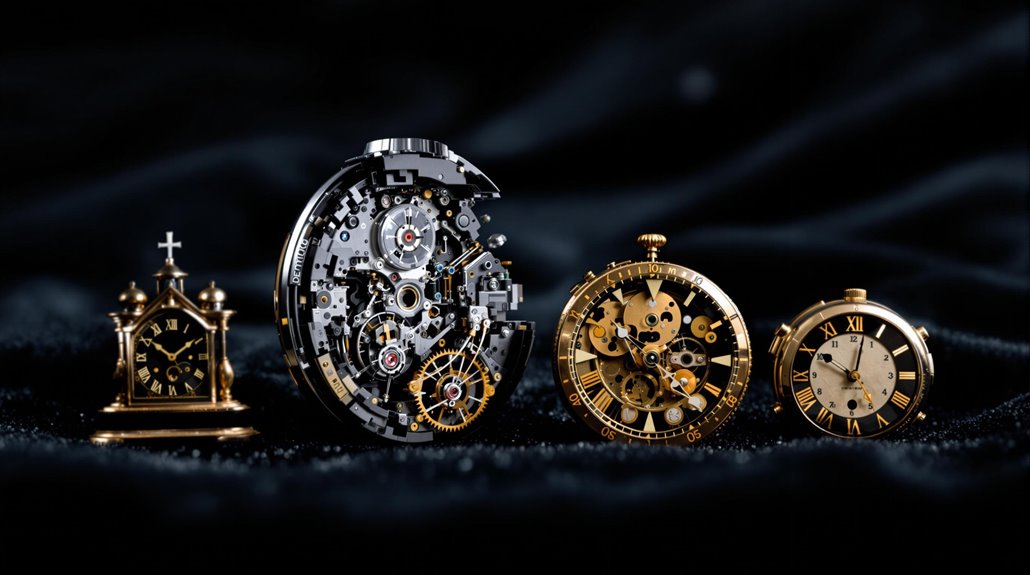
The unearthing of quartz timekeeping technology in the 1920s sparked a revolution that would reshape the entire watchmaking industry. Prior to this breakthrough, mechanical clocks relied on pendulums and balance wheels, which couldn't match the extraordinary precision that quartz crystals would bring to clock design.
You'll find that quartz clocks transformed timekeeping history by offering unparalleled advantages:
- They're remarkably accurate, losing only seconds per day compared to traditional mechanical clock systems
- They've made precise time accessible to everyone due to their low production costs
- They've become the foundation for digital timekeeping devices, from wristwatches to computers
- They've established a reliable time standard for global communications and guidance
When you look at your digital watch today, you're witnessing the legacy of this revolutionary technology. Quartz crystals generate steady electrical pulses that count time with incredible consistency, making them far more reliable than their mechanical predecessors. While modern atomic clocks have since achieved even greater precision, quartz timekeeping technology continues to serve as the backbone of everyday timekeeping, powering everything from wall clocks to sophisticated electronic systems.
Atomic Clock Precision
Modern atomic clocks represent the pinnacle of timekeeping precision, losing less than one second over millions of years. When you consider how these highly accurate devices keep time, you'll find they're fundamentally different from traditional clocks. Instead of relying on mechanical movements or quartz crystals, atomic clocks use the incredibly stable vibrations of cesium atoms to measure time.
Developed in the mid-20th century, this revolution in timekeeping technology has altered how we synchronize our world. You'll find atomic clocks at the heart of global communication networks, positioning systems, and scientific research facilities. They're so precise that they've become the foundation for defining standard time worldwide, including the official definition of a second in the International System of Units.
When you compare atomic clocks to previous timekeeping methods, you'll understand why they've become essential. Their unmatched stability in measuring time has made them the backbone of modern precision timing. You're experiencing their impact daily through GPS positioning, internet communications, and countless other technologies that depend on precise synchronization.
Cultural Impact of Timekeeping
Throughout human civilization, timekeeping devices have significantly shaped how societies function and people interact. In medieval Europe, you'd find mechanical clocks adorning church towers, serving as symbols of community esteem and technological progress. These clock towers didn't just tell time; they became central fixtures that united communities and marked substantial moments in daily life.
The cultural impact of timekeeping devices transformed society in several key ways:
- Clock towers established a shared sense of time, helping communities coordinate activities and religious observances
- The adoption of time zones and the 24-hour system revolutionized global coordination and communication
- Mechanical clocks in church towers served as technological marvels, showcasing human innovation
- The standardization of time enabled precise scheduling and improved workforce productivity
You'll find that timekeeping's influence extends far beyond mere functionality. It's reshaped how you think about and structure your day. From traditional clock towers to modern digital displays, these devices have created a universal language of time that crosses cultural boundaries. Today's interconnected world relies on this shared understanding of time, making global communication and coordination possible in ways that were unimaginable in earlier eras.
Art and Science Unite
From ancient sundials to modern atomic clocks, timekeeping has expertly blended artistic expression with scientific precision. When you look at the evolution of mechanical timekeepers, you'll see how the first devices used for tracking time weren't just functional tools - they were masterpieces of human ingenuity that merged technical excellence with visual appeal.
The invention of the mechanical clock marked a turning point where art and science became inseparable in horology. As centuries saw the development of increasingly sophisticated timepieces, craftsmen like Thomas Tompion elevated clockmaking to new heights, creating pocket watches and clocks that were both engineering marvels and works of art. You'll find that these expert horologists weren't just mechanics; they were artists who understood the importance of aesthetic appeal in their creations.
Today's pinnacle of timekeeping technology still reflects this dual nature. While modern clocks may rely more on electronic components than mechanical gears, the principles established by early clockmakers remain influential. You're witnessing a continuing tradition where precision engineering and artistic design work together, creating timepieces that are as much about beauty as they are about tracking the passing hours.
Future of Clock Technology
Advancing beyond traditional timekeeping methods, the future of clock technology promises unparalleled precision through quantum mechanics and atomic manipulation. You'll witness a revolution in timekeeping as quantum clocks and optical lattice clocks surpass the already impressive accuracy of atomic clocks, reshaping international timekeeping standards.
The miniaturization of advanced timekeeping technology is transforming everyday devices. You'll find miniature atomic clocks in your smartphones, enabling precise GPS location-finding and secure communications. The integration of these technologies into integrated circuits means you'll soon have access to unmatched accuracy in consumer electronics.
Quantum clocks achieving precision levels previously thought impossible
Optical lattice clocks becoming the new gold standard for global time measurement
Widespread adoption of miniature atomic clocks in portable devices
Mass production of high-precision timekeeping chips for everyday applications
You're about to experience a breakthrough in timekeeping that'll revolutionize industries from telecommunications to space exploration. As these technologies become more accessible, you'll see their impact across every aspect of modern life, from synchronizing global networks to enabling new scientific insights.
Related posts