
What Is Sidereal Time and Why Is It Important?

Sidereal time measures Earth's rotation relative to distant stars rather than the Sun. While you're familiar with the standard 24-hour solar day, a sidereal day is about 4 minutes shorter at 23 hours and 56 minutes. This difference occurs because Earth must rotate slightly more each day to keep up with its orbit around the Sun. Astronomers rely on sidereal time to accurately track and locate celestial objects in the night sky, making it essential for both professional research and amateur stargazing. Understanding this astronomical timekeeping system opens up a universe of precise celestial observations and revelations.
Understanding the Basics of Sidereal
Time itself takes on a different meaning when we look to the stars. When you're tracking celestial objects, you'll need to understand sidereal time, which is based on Earth's rotation relative to the fixed stars rather than the Sun. This system differs from the standard 24-hour solar day you're familiar with.
Think of sidereal time as Earth's position in relation to the celestial sphere. As Earth completes one full rotation on its axis, the stars appear to move across the sky. A sidereal day is approximately 23 hours and 56 minutes long, slightly shorter than a solar day because of Earth's orbit around the Sun.
Your local sidereal time depends on your location relative to the Prime meridian and tells you which stars are crossing the celestial equator at any moment. When you're using a telescope or planning astronomical observations, you'll find that sidereal time is indispensable for locating specific celestial objects. It helps you determine when particular stars will be visible from your location and at what position in the sky they'll appear, making it an essential tool for both amateur and professional astronomers.
Earth's Rotation and Star Movement
Looking up into the night sky, you'll notice the stars appear to march steadily from east to west across the celestial sphere. This apparent motion is actually caused by Earth's rotation, which creates a predictable pattern you can use to track celestial objects.
When you're observing the stars, it's important to understand the difference between a sidereal day and a solar day. A sidereal day measures Earth's rotation relative to the vernal equinox and distant stars, while a solar day is based on the Sun's position. Here's why this distinction matters:
- A sidereal day is about 4 minutes shorter than a solar day
- The difference occurs because Earth's orbit around the Sun causes our star to appear to shift eastward against the background stars
- Astronomers use sidereal time to precisely track celestial objects
- Equatorial mount telescopes rely on sidereal time for accurate star tracking
This relationship between Earth's rotation and star movement is fundamental to astronomical observation. When you're using equatorial mount telescopes, understanding sidereal time helps you locate and follow celestial objects as they move across the night sky.
Sidereal Versus Solar Days

The distinction between sidereal and solar days shapes how we measure time in astronomy. A sidereal day is the time it takes Earth to complete one full rotation on its axis relative to the background stars, which is approximately 23 hours and 56 minutes. In contrast, a solar day is the familiar 24-hour period that you experience between successive noons, when the Sun reaches its highest point in the sky.
You'll notice this four-minute difference exists because Earth isn't just rotating—it's also orbiting the Sun. As Earth spins, it must rotate slightly more than 360 degrees for the Sun to appear in the same position, accounting for Earth's orbital motion. This extra rotation creates the apparent motion of the Sun across the sky and results in our conventional 24-hour solar day.
When you're doing astronomical observations, understanding this difference becomes essential. While you might set your daily schedule by solar time, astronomers often work with sidereal time because it directly relates to when specific stars will appear in the same position in the sky, making it highly valuable for telescope pointing and celestial guidance.
Practical Uses in Modern Astronomy
Modern astronomers rely on sidereal time for precise telescope control and observation scheduling. Since stars are so far away, their positions relative to Earth remain nearly fixed as our planet completes its rotation. You'll find that sidereal time perfectly matches the time it takes for a distant star to rise in the east and set in the west, making it irreplaceable for tracking celestial objects across the night sky.
When you're planning astronomical observations, sidereal time helps you determine:
- The exact moment when a specific celestial object will cross your local meridian
- The best viewing windows for different astronomical targets
- The right ascension coordinates that are currently visible overhead
- The precise timing for automated telescope tracking systems
Tracking Celestial Objects With Precision
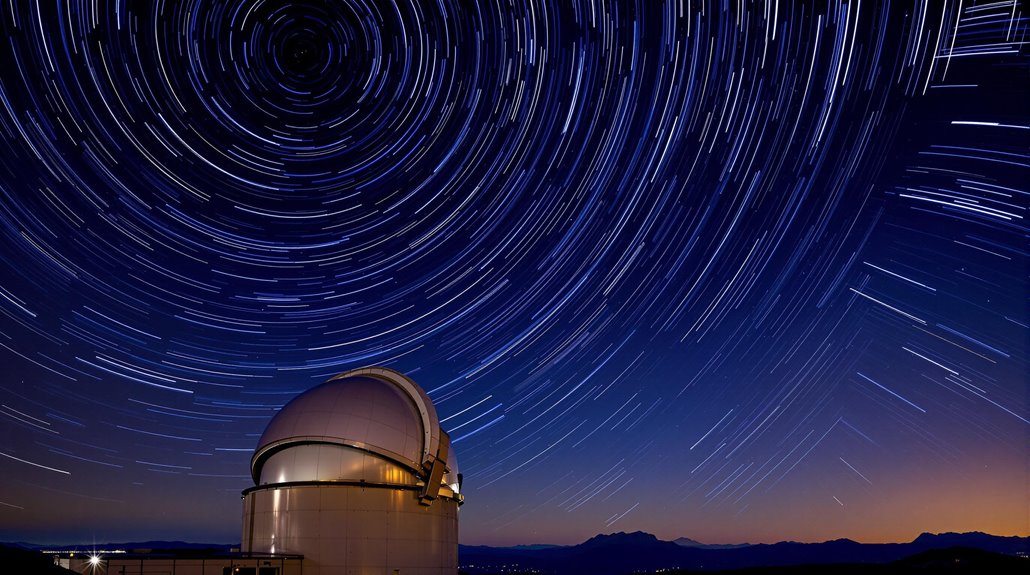
Building on these practical applications, precise celestial object tracking stands as a cornerstone of successful astronomical observation. When you're trying to locate and study specific celestial objects, you'll find that sidereal time offers significant advantages over solar time. This specialized timekeeping system accounts for both the rotation of the Earth and Earth's orbit around the Sun, allowing you to pinpoint objects with extraordinary accuracy.
The sidereal day, which runs about four minutes shorter than a standard solar day, provides you with a more precise template for tracking stars and distant galaxies. You won't need to adjust for the motion of the Sun or Earth's orbital position, as sidereal time is referenced to the fixed stars themselves. This means that any given point in sidereal time is the moment when specific celestial objects will appear at exactly the same position in the sky, night after night.
Using equatorial mount telescopes synchronized to sidereal time, you can automatically track objects across the night sky, maintaining consistent observation periods and collecting more accurate data for your astronomical research.
Historical Development of Sidereal Time
Development of sidereal time traces back to ancient civilizations, where astronomers first noticed that stellar positions repeated with astounding consistency. As you investigate the history, you'll find that early astronomers recognized the difference between solar time and sidereal time by observing the stars' apparent motion across the night sky.
Ancient cultures uncovered that Earth's rotation relative to distant stars provided a more precise way to measure time than using the Sun. They noticed four key aspects:
- Stars returned to the same positions every 23 hours, 56 minutes, and 4 seconds
- This regularity didn't match solar time's 24-hour cycle
- The difference occurred due to Earth's orbital period around the Sun
- Sidereal time proved more reliable for astronomical observations
Planetary Differences Across Solar System
While Earth's sidereal time measurements helped astronomers understand our planet's rotation, the concept takes on fascinating variations across other worlds in our solar system. You'll find extraordinary planetary differences in how sidereal day and solar day relate to each other, showcasing the diverse rotational behaviors throughout the Solar System.
Mercury demonstrates an unusual relationship between its axial rotation and orbital period, with its sidereal day lasting exactly two-thirds of its orbit. This creates a peculiar situation where Mercury's solar day actually lasts longer than its year. Venus presents an even more extraordinary case, as it's the only planet where the sidereal day exceeds the solar day. Due to its backwards rotation relative to Earth's rotation, Venus experiences just two sunrises during its entire year, with its solar day lasting 117 Earth days.
These variations highlight how the apparent motion of the Sun across each planet's sky differs dramatically based on the complex interplay between orbital period and axial rotation. Understanding these relationships helps you grasp how time measurement systems must adapt to each world's unique characteristics, far beyond Earth's familiar patterns.
Mathematical Calculations and Conversions
Precise mathematical calculations form the backbone of sidereal time measurements, allowing astronomers to convert between different time systems with accuracy. You'll find that converting between sidereal time and solar time requires understanding the relationship between Earth's rotation and the Julian date, using the equation: solar time = sidereal time + (24 hours - 0.9856 hours) × (Julian date - 2451545.0).
The fundamental difference between a sidereal day and a mean solar day shapes these calculations, with the sidereal day being roughly 0.997 times the length of a solar day. You can track celestial objects effectively using the International Celestial Reference Frame, which depends on accurate sidereal time measurements.
Here are the key components you'll need for accurate time conversion:
- The Earth Rotation Angle (ERA) for determining precise rotational position
- Julian date calculations for temporal reference points
- The 0.997 ratio between sidereal and solar days
- The 3-minute and 56-second daily difference between time systems
When you're working with astronomical observations, you can express sidereal time in various formats, including hours/minutes/seconds, degrees/minutes/seconds, or radians, depending on your specific needs.
Impact on Astronomical Observations

Sidereal time plays an indispensable role in modern astronomical observations, enabling you to accurately track and locate celestial objects throughout their nightly paths across the sky. When you're planning astronomical observations, understanding sidereal time helps you predict exactly when specific stars, planets, and other celestial objects will reach their highest point, making it easier to schedule ideal viewing times.
Unlike solar time, which is based on the Earth's rotation relative to the Sun, sidereal time follows the Earth's rotation relative to the fixed stars. This distinction is pivotal because a sidereal day is about 4 minutes shorter than a solar day. You'll find this particularly important when using an equatorial mount telescope, as it must rotate at the sidereal rate to compensate for Earth's rotation and keep your target centered in view.
The precision that sidereal time provides is fundamental to modern astronomy. It's integrated into the International Celestial Reference Frame, allowing you to confidently point your telescope at exact celestial coordinates. Whether you're conducting professional research or enjoying amateur astronomy, sidereal time guarantees your astronomical observations remain accurate and consistent night after night.