The History of the Lantern Festival in the Philippines: A Guide
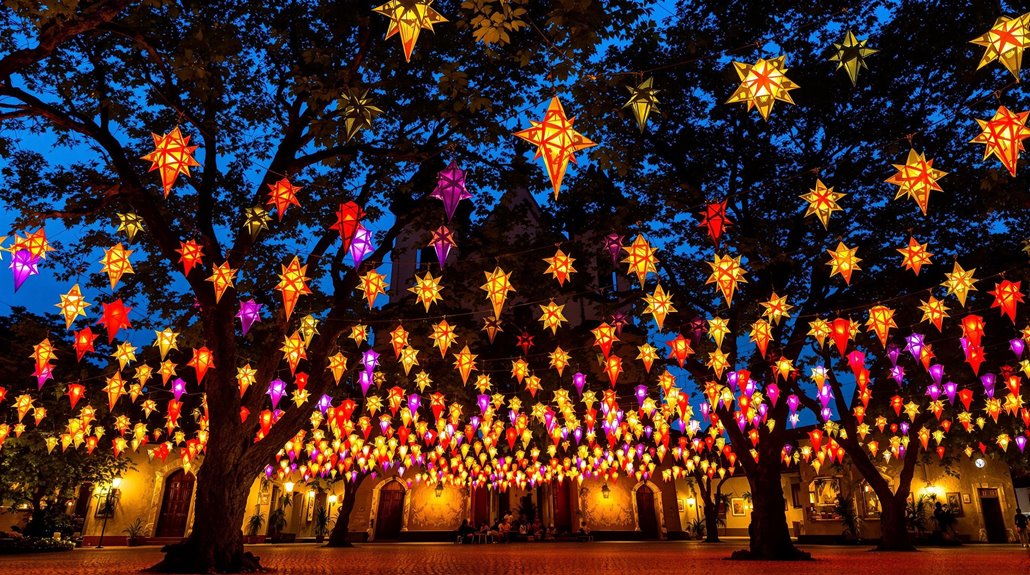
The Giant Lantern Festival you'll find in the Philippines today began in Bacolor, Pampanga, where Catholic devotees used simple "parul" lanterns to light their path during pre-dawn masses. When the provincial capital moved to San Fernando in 1908, the tradition evolved from humble religious processions into a grand celebration of light and artistry. You'll uncover how the festival metamorphosed dramatically in 1931 with the introduction of electricity, enabling craftsmen to create massive lanterns up to 20 feet wide with intricate light displays. The annual Ligligan Parul competition now showcases the pinnacle of Filipino innovation and cultural heritage, where each spectacular creation tells a deeper story.
Origins in Bacolor
Deep within the historic town of Bacolor, Pampanga, the Giant Lantern Festival's roots trace back to Catholic processions where "parul" lanterns lit the way during "lubenas" prayers. These nightly processions were an essential part of the Christmas season, as communities gathered to celebrate their faith through prayer and light.
You'll find that the "parul" tradition is deeply intertwined with the religious practices of "lubenas" and "simbang gabi," where lanterns weren't just decorative pieces but spiritual symbols. In Bacolor, each barangay would craft their own lantern, showcasing the community's dedication to preserving their cultural heritage through lantern-making traditions.
When the provincial capital moved to San Fernando in 1908, you'd see how the tradition evolved while maintaining its spiritual essence. The lantern-making craft that began in Bacolor laid the foundation for what would become a grand festival. Today, while the celebration has grown more elaborate with modern technology, you can still trace its humble beginnings to Bacolor's religious processions, where simple lanterns once illuminated the faithful's path during the Christmas season.
Religious Roots and Traditions
At its heart, the Giant Lantern Festival embodies deep Catholic traditions that have shaped Filipino Christmas celebrations for generations. You'll find its origins in the "lubenas," the traditional dawn masses where worshippers would make their way to chapels and hermitages in the early morning darkness. The parul lanterns weren't just decorative pieces - they served as essential guides, illuminating the paths for devoted Catholics attending these services.
When you investigate the festival's religious significance, you'll uncover how each barangay would craft their own distinctive lanterns, culminating in a grand competition on Christmas Eve. These lanterns symbolize the Star of Bethlehem, connecting modern celebrations to the ancient biblical story of Christ's birth.
Picture these scenes from the festival's rich traditions:
- Streams of faithful worshippers walking before dawn, their paruls casting warm glows along chapel paths
- Communities gathering to admire towering lanterns representing their barangays
- Intricate light displays dancing across massive lanterns, especially after 1931's electrification altered the craft
Today's festival continues to honor these religious roots while embracing technological advances, creating a unique blend of faith and artistry.
From Candlelight to Electricity
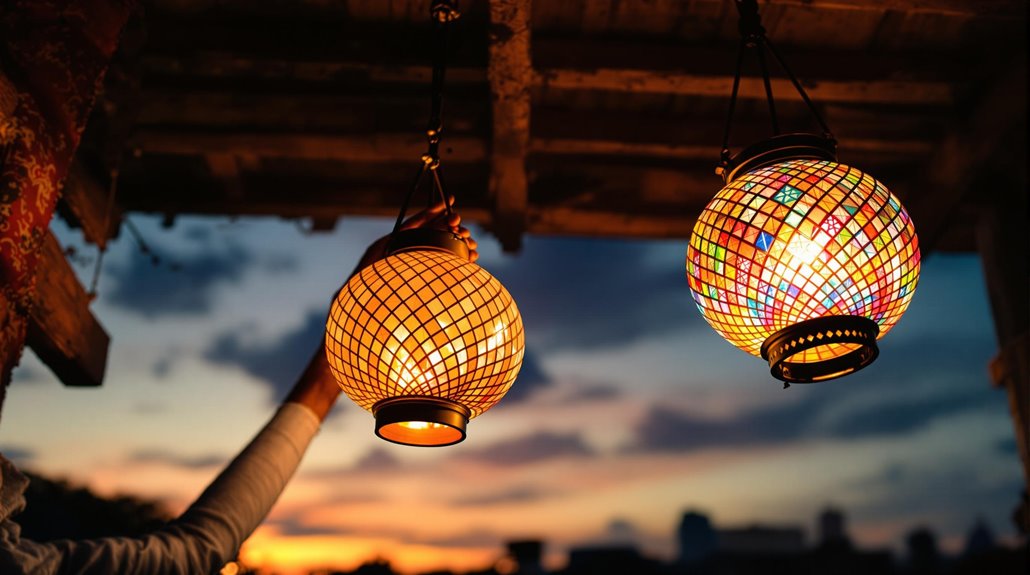
Through the waves of modernization, 1931 marked a revolutionary turning point for the Giant Lantern Festival when electricity first illuminated San Fernando, Pampanga. You'll find that this technological advancement adopted what was once a simple Christmas tradition into a dazzling cultural spectacle, enabling craftsmen to create larger and more elaborate lanterns than ever before.
The introduction of electricity didn't just brighten the festival; it completely revolutionized the way lanterns were designed and operated. Craftsmen began incorporating rotor systems with insulators to create perfectly timed light patterns, turning each lantern into a mesmerizing display of synchronized illumination. As the competition grew more sophisticated, you'd see the festival accept even more technological innovations, particularly with the integration of computerized controls that allowed for precise manipulation of light sequences.
Today, when you visit the festival, you'll witness how electricity has enabled these giant lanterns to showcase intricate designs that were once impossible with traditional candlelight. This technological evolution has preserved the festival's religious essence while elevating it into a world-renowned celebration of Filipino craftsmanship and innovation.
Evolution of Lantern Design
Inside San Fernando's lantern-making tradition, you'll witness a notable change from humble origins to architectural wonders. The evolution of lantern design has created a lively competition among local craftsmen, who've elevated these Christmas lanterns from simple illuminated decorations to spectacular works of art.
You'll find that modern lantern makers incorporate intricate designs using locally available materials, while embracing technological advances like LED lights and computerized systems. The fundamental elements - tambur, siku-siku, palimbun, and putentas - work together to create mesmerizing patterns that define these cultural festivities.
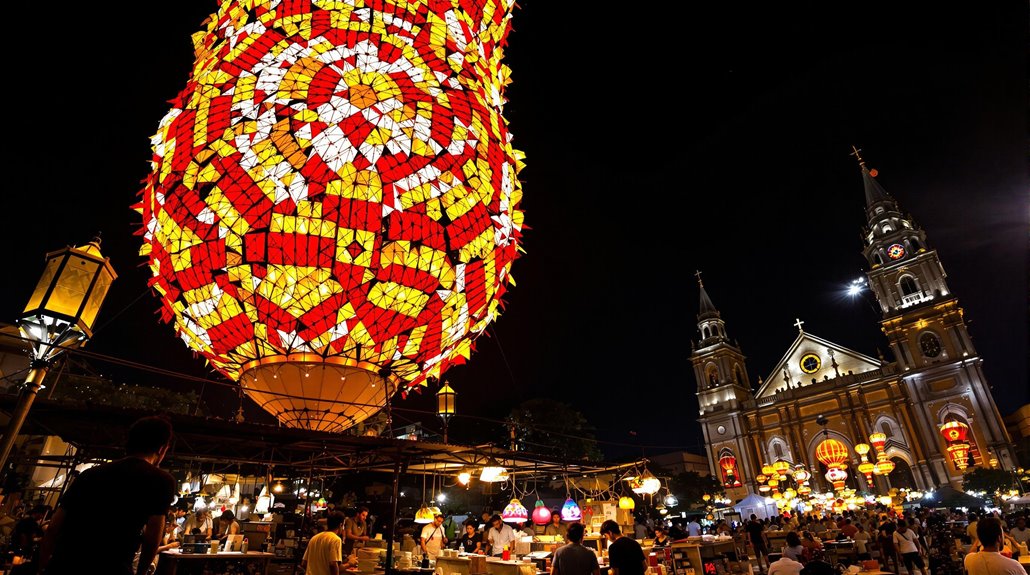
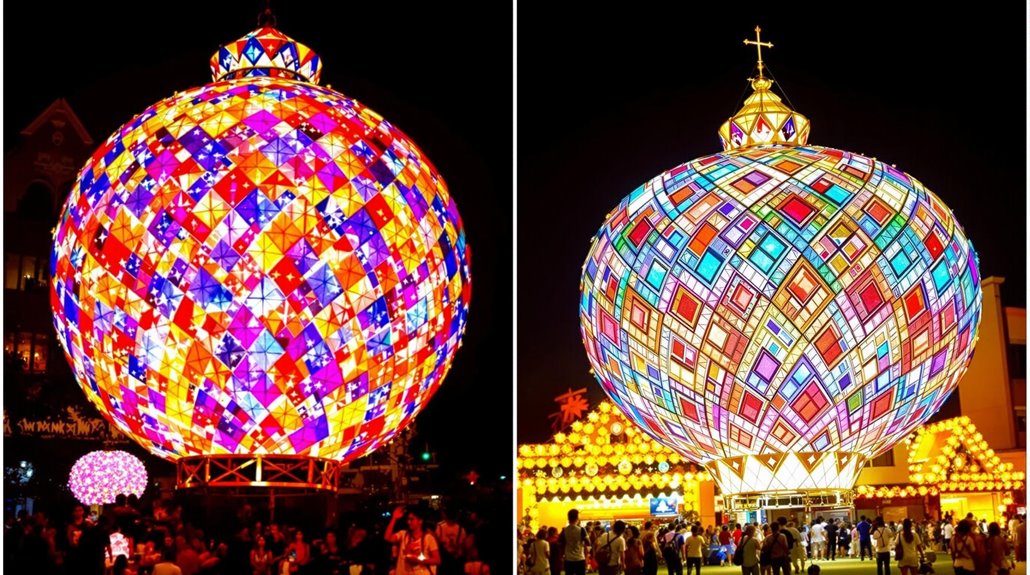
- Massive structures reaching 20 feet in diameter that sparkle with thousands of multi-colored bulbs, creating a cathedral-like presence in the night sky
- Complex lighting techniques that synchronize movement and color, transforming static displays into dancing symphonies of light
- Geometric patterns that blend traditional Filipino motifs with contemporary designs, showcasing generations of artistic innovation
These spectacular creations have become the heart of Pampanga's artistic identity, with family-owned workshops passing down their craftsmanship through generations. You'll notice how each lantern tells a story of innovation while preserving the timeless essence of Filipino Christmas traditions.
The Ligligan Parul Competition
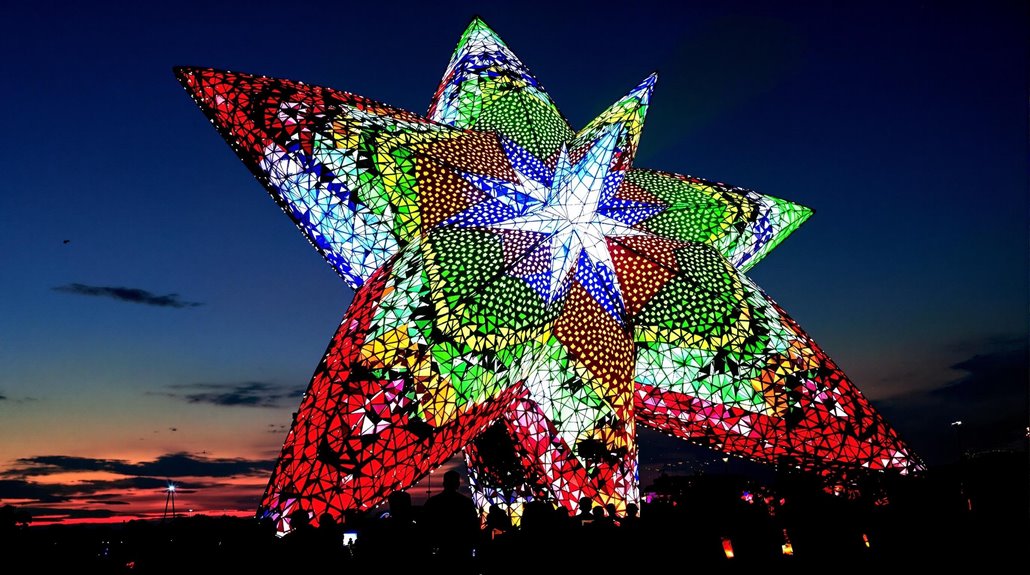
The Ligligan Parul competition stands as the crowning jewel of San Fernando's Giant Lantern Festival, where barangays vie for recognition of their spectacular parol creations. You'll witness massive lanterns up to 20 feet in diameter, adorned with thousands of light bulbs that create mesmerizing intricate patterns, showcasing the pinnacle of Filipino craftsmanship.
When you attend this lantern competition in the City of San Fernando, you'll see how each participating barangay pushes the boundaries of innovation. The competition's judging criteria emphasize creativity, originality, and technical prowess, with modern elements like LED technology and computerized systems playing vital roles in the displays.
You'll notice how the Ligligan Parul has evolved dramatically over time, as craftsmen continuously incorporate new materials and techniques to enhance their designs. The event's cultural significance extends beyond mere competition - it's a powerful demonstration of community spirit and artistic heritage. As you watch these illuminated creations, you're witnessing more than just a display of lights; you're experiencing a tradition that exemplifies Filipino ingenuity and collaborative creativity.
Traditional Parol Making Techniques
From humble bamboo frames to delicate papel de hapon coverings, traditional parol making embodies generations of Filipino artistic proficiency. You'll find that skilled parol artisans, particularly in Pampanga, carefully construct these Christmas lanterns using either bamboo or metal frame foundations. They'll painstakingly cut and arrange the papel de hapon to create intricate patterns that tell stories of cultural heritage through religious symbols and cultural motifs.
View this post on Instagram
When you investigate the Giant Lantern Festival in San Fernando, you'll witness more than just dazzling lights - you'll experience a century-old tradition that has shaped Filipino cultural identity. Known locally as Ligligan Parul, this Filipino tradition held in San Fernando every December showcases the community's dedication to preserving its heritage while embracing innovation. As the Christmas Capital of the Philippines, San Fernando's festival brings together generations of artisans and spectators, nurturing a deep sense of bayanihan among its people. You'll find yourself immersed in a celebration that transcends mere competition, as the festival serves as a living legacy to Pampanga's cultural resilience and artistic excellence. The Giant Lantern Festival's impact extends far beyond its local borders, attracting visitors worldwide who come to witness this extraordinary display of Filipino craftsmanship. The festival continues to strengthen cultural bonds while adapting to modern times, proving that traditions can evolve while maintaining their cultural essence. The Giant Lantern Festival's rich history spans three extraordinary metamorphoses in community participation. What began in the early 1900s as a modest religious procession has evolved into a grand celebration that showcases the competitive spirit and community esteem of San Fernando's barangays. You'll find that local artisans and communities have altered their roles from simple participants to dedicated collaborators. The festival's expansion from a few local barangays to numerous participating communities reflects the growing sense of community that defines this cherished tradition. When electricity was introduced in 1931, you could see how it revolutionized the way communities approached their craft, leading to more ambitious and technically sophisticated displays. Today, you'll witness how the bayanihan spirit thrives as entire neighborhoods work together to create spectacular lantern displays at venues like the Paskuhan Village and Bren Z. Guiao Convention Center. The festive spirit has become deeply woven into the local culture, with communities incorporating modern technology like computerized controls and LED displays. This blend of tradition and innovation continues to strengthen community bonds while preserving their cultural heritage. Since its humble beginnings in Bacolor, Pampanga, the Giant Lantern Festival has evolved into a magnificent spectacle that draws thousands of visitors to San Fernando each year. The event's transformation became most apparent after 1931 when electricity revolutionized lantern-making, allowing craftsmen to create stunning displays with dancing lights and intricate patterns. As the festival grew, it couldn't be held in San Fernando's town center anymore. The competition moved to larger venues like Paskuhan Village and Bren Z. Guiao Convention Center to accommodate the increasing number of participants and spectators. Today's lanterns showcase astonishing technological advancement, featuring: Even during the COVID-19 pandemic, the festival proved its resilience by adapting to virtual formats. This shift helped preserve Pampanga's cherished tradition while maintaining the competitive spirit that's been central to the event since its early days. The competition's criteria have expanded beyond traditional craftsmanship to incorporate innovation and creative excellence, making today's festival a perfect blend of cultural heritage and modern technology. Beyond its cultural significance, Pampanga's Giant Lantern Festival serves as a powerful economic engine for the region. The Ligligan Parul, as it's locally known, draws thousands of visitors to San Fernando each year, creating substantial revenue streams for the local economy. You'll find that the festival has given rise to a flourishing lantern-making industry in Pampanga, providing steady employment for skilled artisans and craftspeople. These local makers don't just create festival pieces; they've developed year-round businesses that contribute to the region's economic stability. When you visit during the festival season, you'll notice how local businesses thrive. Hotels reach peak occupancy, restaurants serve more customers, and souvenir shops see increased sales. The city's reputation as the "Christmas Capital of the Philippines" has turned this cultural celebration into a major tourist attraction, bringing in visitors from across the country and abroad. The festival's success hasn't stopped at lanterns. It's sparked the development of related events and festivals throughout Pampanga, creating a multiplier effect that's expanded the economic impact beyond San Fernando and throughout the province. Throughout the festival's history, expert craftsmen have shaped the artistry and innovation of Pampanga's lantern-making tradition. You'll find legendary artisans like Ernesto Quiambao, known as the "Lantern King of Pampanga," who's revolutionized the Ligligan Parul with his pioneering designs. The skilled Gaudencio Pamittan, a third-generation craftsman, continues to preserve traditional parol-making techniques, ensuring these skills aren't lost to time. The festival's legacy lives on through families like the Lazaros of San Fernando, who've consistently produced award-winning giant lanterns, while the Ortaleza family of Barangay Del Pilar has dominated competitions with their spectacular visual displays. You'll also find innovators like Noel Cuaresma, who's earned recognition for seamlessly blending traditional and modern elements in his designs. When you visit the festival, you'll witness these crafting dynasties' exceptional work in the form of: The proficient work of Pampanga's artisans has helped catapult the Giant Lantern Festival onto the world stage. Known locally as Ligligan Parul, the festival now draws thousands of visitors from around the globe who come to witness the spectacular display of giant lanterns and immerse themselves in Filipino culture. You'll find the festival's prominence enhanced by its media coverage, including features on popular shows like "Where's Waldo?" and "Kapuso Mo, Jessica Soho." The event's growing popularity has led to infrastructure developments, with venues like the Paskuhan Village and Bren Z. Guiao Convention Center serving as dedicated spaces for the celebrations. When you visit San Fernando, dubbed the "Christmas Capital of the Philippines," you'll experience more than just the dazzling light displays at Robinsons Starmills. The festival offers a complete cultural heritage experience, where you can savor local cuisine specialties like sisig and halo-halo while enjoying the innovative lantern presentations. The unique combination of technological advancement in lantern-making and traditional craftsmanship has secured the festival's position as a must-see cultural event, drawing acclaim from both domestic and international audiences. Modern preservation efforts for the Giant Lantern Festival combine innovative sustainability with cultural heritage protection. You'll find that the city of San Fernando and the Giant Lantern Festival Foundation work hand-in-hand to guarantee the Ligligan Parul maintains its cultural significance while adapting to environmental concerns. When you visit the festival held annually, you'll witness how the lantern contest has evolved to embrace eco-friendly practices, with 2024's competition requiring 30% LED materials in all entries. The lantern industry's commitment to sustainability is evident in these festival features: The festival's cultural heritage remains strong despite challenges through history, including the Martial Law period. Today, you'll see how San Fernando's identity as the "Christmas Capital of the Philippines" draws visitors worldwide, while its first all-LED rotor-operated lantern, created with Firefly Electric, demonstrates how tradition and innovation can coexist to preserve this beloved cultural practice.Modern Technological Advancements
Cultural Impact and Heritage
Community Participation Through Time
Festival Growth and Development
Economic Significance for Pampanga
Notable Artisans and Craftsmen
Global Recognition and Tourism
Preservation Efforts and Legacy
Related posts