The History of Greenwich Mean Time: The World’s First Time Standard
Greenwich Mean Time's story begins at London's Royal Observatory in 1675, where you'll find its origins as a solution to maritime navigational obstacles. You'll uncover how British railways played a pivotal role in its adoption, as they needed harmonized schedules across the country. By 1884, GMT earned international recognition when 25 nations chose the Greenwich meridian as the global Prime Meridian. While modern timekeeping now relies on atomic clocks and UTC (Coordinated Universal Time), GMT's legacy continues as the foundation of how we coordinate time worldwide. The path to global time standardization holds captivating revelations about human innovation and cooperation.
Early Timekeeping at Greenwich Observatory
In the late 17th century, King Charles II established the Greenwich Observatory to tackle one of maritime guidance's greatest challenges: determining longitude at sea. The Royal Observatory Greenwich, under the direction of John Flamsteed, began creating detailed star catalogues to help sailors traverse more accurately across the oceans.
You'll find that the observatory's main contribution was developing the Lunar Distance Method, which allowed sailors to calculate their position by measuring the Moon's location relative to specific stars. These calculations were later published in the Nautical Almanac, giving mariners a reliable way to determine Greenwich Time while at sea. However, the devastating Scilly naval disaster of 1707, which claimed over 1,400 lives, highlighted that more precise methods were still needed.
As a response, you'd see Parliament create the Board of Longitude in 1714, offering a substantial £20,000 prize to anyone who could solve the longitude problem. This challenge would eventually lead to John Harrison's pioneering chronometer, though the observatory continued its essential role in astronomical observations and timekeeping, forming the foundation for what would become Greenwich Mean Time.
The Quest for Accurate Navigation
How did seafaring nations tackle one of history's greatest maritime challenges? Between the 16th and 19th centuries, ships faced a critical problem: they couldn't accurately determine their longitude at sea. Without a reliable time standard, navigators struggled to calculate their east-west position, leading to numerous maritime disasters that claimed countless lives and precious cargo.
The British Parliament took decisive action in 1714 by establishing the Board of Longitude, offering a substantial prize of £20,000 to anyone who could solve this pressing navigation challenge. The key breakthrough came from John Harrison, who developed the marine chronometer - a precise timekeeper that could maintain accuracy even during long ocean voyages. This invention revolutionized maritime navigation by allowing ships to determine their longitude with unparalleled precision.
The Royal Observatory at Greenwich played a pivotal role in this quest for accurate navigation. Established in 1675, it became the central hub for astronomical observations and time measurements. You'll find it fascinating that Greenwich's role in providing a standardized time reference would eventually lead to its selection as the prime meridian, making it the world's primary time standard for centuries to come.
Railways and British Time Standardization
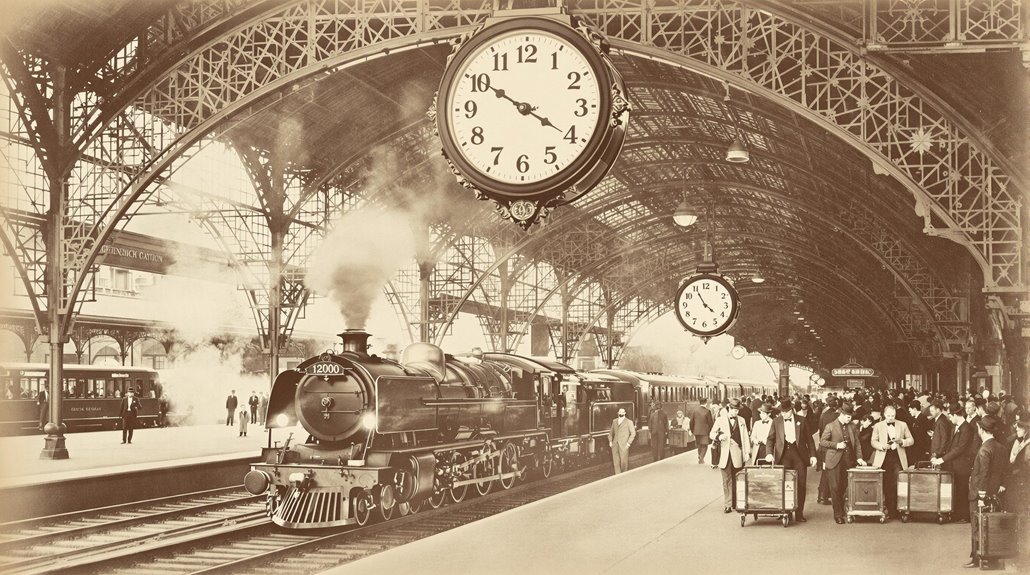
Nearly every British town once kept its own local time, leading to widespread confusion as the Industrial Revolution gathered steam. Before railways connected Britain's cities, each location based its time on the sun's position relative to their local meridian, resulting in a patchwork of different times across the nation.
The expansion of Britain's railway network in the 19th century made this time-keeping chaos unsustainable. You couldn't run a reliable train service when every station along the route operated on different local times. The Great Western Railway took the first bold step in 1840 by adopting Greenwich Mean Time (GMT) as their standard time. This decision proved revolutionary, as other railway companies quickly followed suit to coordinate their schedules effectively.
The Railway Clearing House, established in 1842, played an essential role in promoting GMT's adoption across Britain's rail network. What began as a practical solution for railway companies eventually transformed into the nation's official standard time. By the 1880s, local time had given way to GMT throughout Britain, and the Royal Observatory in Greenwich became the definitive source of what would later become Universal Time.
International Meridian Conference of 1884
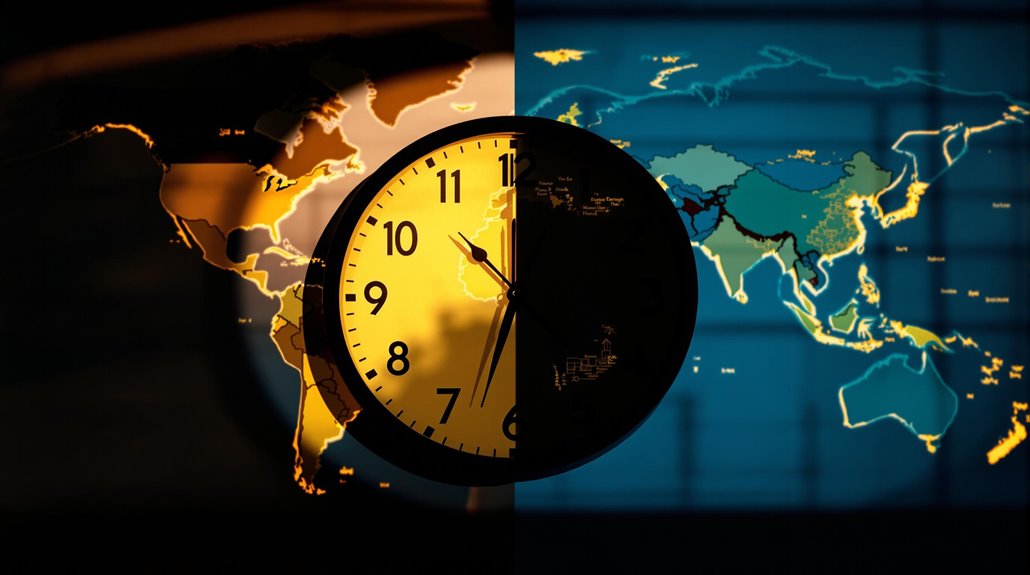
The world's quest for a unified global time standard culminated in the International Meridian Conference of 1884. In Washington, D.C., 25 nations gathered to make a decision that would revolutionize how we measure time and location across the globe. They needed to establish a single reference point - 0° longitude - from which all other meridians would be measured.
With an overwhelming majority of 22 to 1, the delegates chose the Greenwich meridian, which runs through the Royal Observatory in Greenwich, England, as the Prime Meridian of the World. This historic decision wasn't just about picking a line on a map; it was about creating a foundation for modern global cooperation. By establishing Greenwich as the Prime Meridian, the conference provided a universal reference point that would steer international trade, orientation, and communication.
You'll find that this standardization made it much easier for ships to chart accurately, for businesses to coordinate across time zones, and for people to communicate across borders. The selection of the Prime meridian at Greenwich marked a turning point in human history, setting the stage for the global timekeeping system we still use today.
GMT Becomes Global Standard
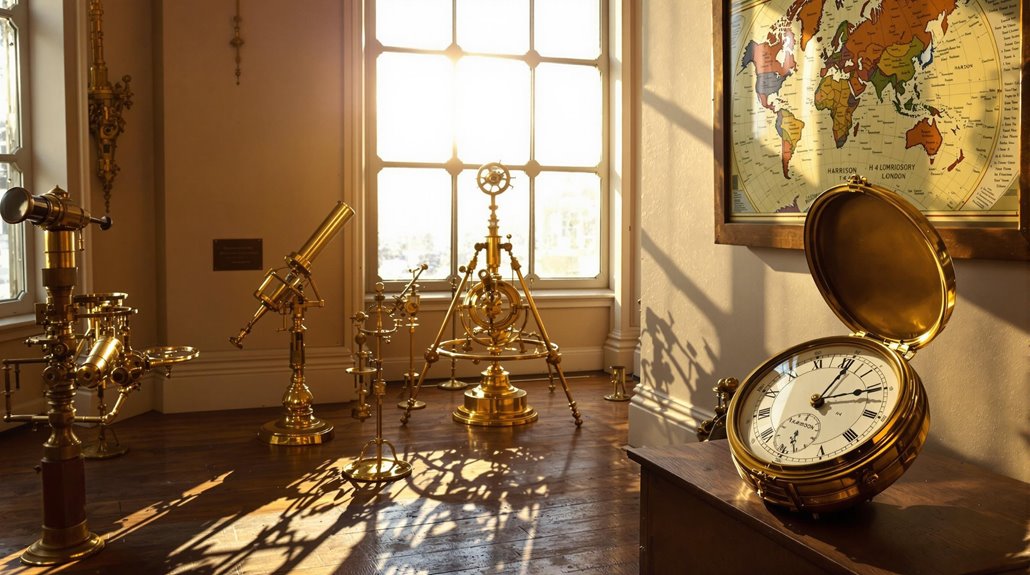
Following the landmark 1884 conference, Greenwich Mean Time gradually emerged as the world's primary time standard over the next several decades. You'll find that GMT's adoption was largely driven by Britain's global maritime dominance and the Royal Greenwich Observatory's established reputation for precise timekeeping.
As you investigate this period, you'll see that the Railway Clearing House had already adopted GMT across Britain's rail network, setting a practical precedent for standardized time. This system proved so effective that other nations began following suit. By the early 1900s, you'd find most major countries using time zones based on their longitudinal distance from Greenwich's prime meridian.
What you might not know is that GMT's influence extended beyond simple timekeeping. It became fundamental to international commerce, travel, and communication. When countries needed a Universal time standard for coordinating activities across borders, they turned to GMT. You'll notice that even as new timekeeping systems emerged, GMT remained the basis for time zone calculations worldwide. By the mid-20th century, you couldn't find a major nation that hadn't aligned its time standard with GMT in some way.
Rise of Atomic Clock Technology
Atomic clock technology revolutionized global timekeeping in the 1950s, marking a significant departure from traditional astronomical methods. You'll find that atomic clocks, which measure cesium atom vibrations, can maintain accuracy within one second over millions of years - a level of precision that the Observatory at Greenwich could never have imagined.
This breakthrough led to the establishment of Coordinated Universal Time (UTC) in 1960, which you'll recognize as today's primary time system. While UTC maintains its connection to Greenwich Mean Time (GMT), it's enhanced by atomic clock precision. The United States and other nations quickly adopted this new standard, recognizing its importance for modern technologies like satellite positioning and telecommunications.
When you visit the Royal Museums at Greenwich today, you'll see how time signals have evolved from astronomical observations to atomic exactitude. UTC hasn't replaced GMT entirely - instead, it's created a perfect blend of historical significance and scientific advancement. This combination guarantees that while we're using state-of-the-art technology for precise timekeeping across time zones, we haven't lost our connection to the original time at Greenwich that helped standardize global timekeeping.
Legacy in Modern Timekeeping
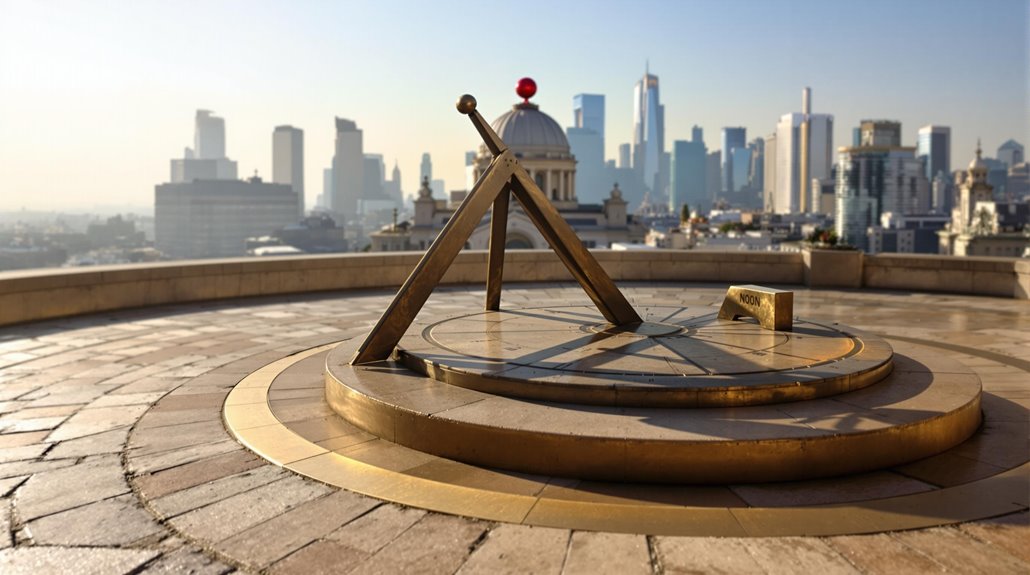
Modern timekeeping stands firmly on Greenwich Mean Time's enduring foundation, even as atomic clocks tick away in laboratories worldwide. You'll find GMT's influence in almost every aspect of global time coordination, serving as the historical backbone of Coordinated Universal Time (UTC), today's primary time standard.
When you tune into the BBC World Service or check international flight schedules, you're experiencing GMT's lasting legacy. While many countries have adopted their own civil time based on UTC, GMT remains the legal time in Britain during winter months, before switching to British Summer Time. You'll notice that GMT's role as a reference point hasn't diminished – it continues to mark the start of the Universal Day and helps coordinate everything from financial markets to satellite communications.
Whether you're dealing with national or international time zones, you're using a system that traces back to Greenwich's meridian. Even though atomic clocks now provide unparalleled accuracy, GMT's conceptual framework still shapes how we arrange time globally. It's transformed from a British innovation into a universal language that helps you explore our interconnected world.