The Feast of Anastenaria in Greece: Walking on Fire With Faith
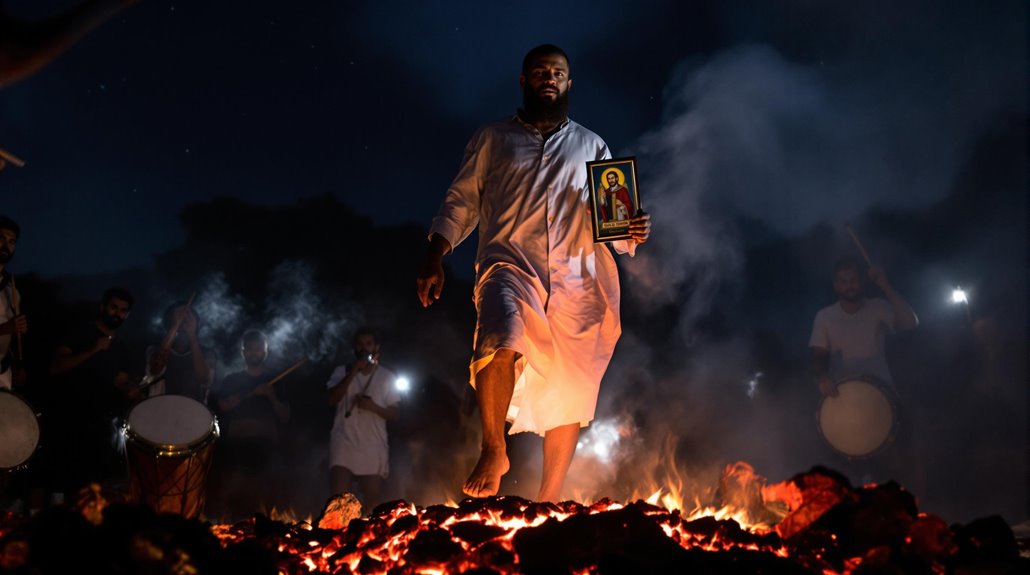
You'll find the ancient Anastenaria ritual still practiced today in northern Greece, where devoted participants walk barefoot across burning coals during a three-day festival in May. This UNESCO-recognized ceremony honors Saints Constantine and Helen through processions, feasts, and the dramatic fire-walking ritual. You'll witness participants enter trance-like states as they dance across hot embers, protected by their deep faith and divine guidance. While science suggests physiological factors help fire-walkers endure extreme temperatures, the true magic lies in the ceremony's spiritual dimension and centuries-old traditions that continue to mystify and inspire.
Ancient Origins and Sacred Traditions
How did a medieval church fire give rise to one of Greece's most enigmatic religious traditions? You'll find the answer in the small Greek village of Lagadas, where the Anastenaria ritual continues to captivate observers. According to myth, when a 13th-century church in Kosti caught fire, villagers braved the flames to rescue sacred icons, emerging mysteriously unharmed. This legendary event shaped what would become an exceptional Greek Orthodox tradition.
Today, you'll witness participants honoring saints Constantine and Helen through fire-walking and ecstatic dancing while holding religious icons. Though some ethnographers have linked the practice to ancient Dionysus cults, scholars now challenge this theory as an oversimplified and historically inaccurate interpretation. What's certain is that this three-day festival, celebrated each May, represents a unique fusion of faith and ritual that's earned recognition as UNESCO cultural heritage.
When you investigate the Anastenaria ritual, you're experiencing more than just a spectacle of devotees walking on burning coals. You're witnessing a living tradition that's survived centuries, embodying the enduring spiritual connection between Orthodox Christians and their sacred customs.
The Three-Day Ritual Cycle
The sacred rhythm of the Anastenaria unfolds through a carefully orchestrated three-day ritual cycle, taking place from May 21-23 each year. During these days, you'll witness a unique blend of Greek Orthodox traditions centered around Saint Constantine and Saint Helen, whose icons play a central role in the ceremonies.
The fire-walking ritual stands as the most dramatic element of the Anastenaria, where you'll see participants carrying sacred icons while walking barefoot across burning coals. This practice traces its roots to refugees from Thrace who settled in Greece following the Balkan Wars, bringing with them a tradition that's said to have originated after a fire at the church of Saint Constantine in medieval times.
Each day follows a precise sequence of events, beginning with processions and religious ceremonies. You'll observe traditional music accompanying ecstatic dancing, leading up to the climactic fire-walking ceremony. The cycle also includes animal sacrifices and communal feasts, demonstrating how the Anastenaria combines spiritual devotion with community celebration. This ancient practice continues to thrive, earning recognition from UNESCO as a precious piece of Greek cultural heritage.
Saints Constantine and Helen
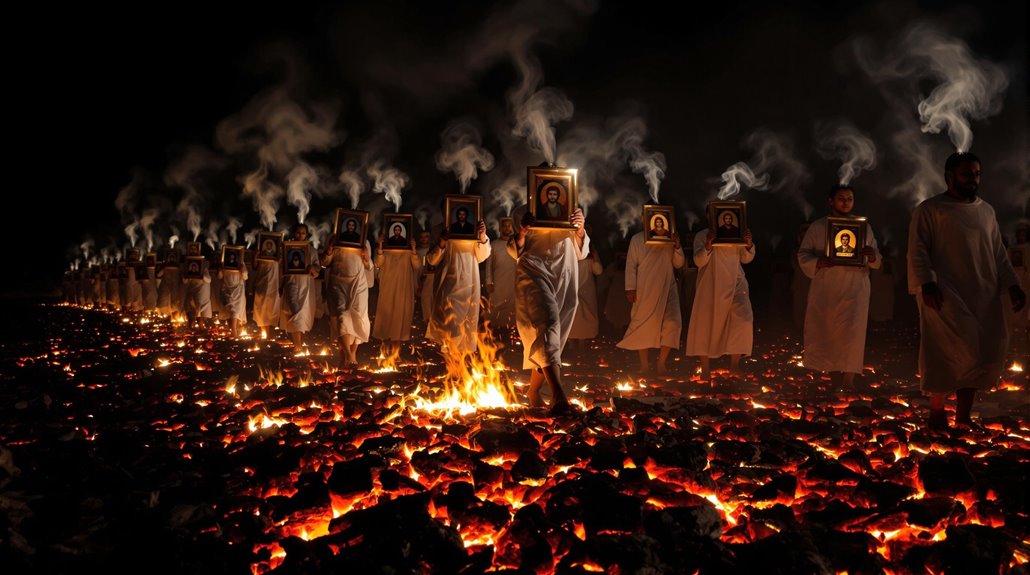
Deeply woven into the spiritual fabric of the Anastenaria ritual, Saints Constantine and Helen serve as divine guardians who equip participants to perform seemingly impossible feats of faith. In Greek Orthodox tradition, these revered saints play a crucial role in the annual fire-walking ceremonies that take place across villages in Greece.
You'll find that participants won't dare step onto burning coals without first receiving a spiritual "sign" or "mark" from Saints Constantine and Helen. This divine permission is considered essential for protection during the ritual, reflecting the deep connection between the Anastenaria's fire-walking tradition and Greek Orthodox Christianity.
During the three-day celebration in late May, you'll witness how these saints guide practitioners into what they describe as "another dimension" - a state where fear dissolves through steadfast faith. The spiritual bond between the fire-walkers and these saints has endured for generations, particularly among Greek refugees who brought these traditions to their new communities. The icons of Constantine and Saint Helen remain central fixtures in the Anastenaria celebrations, embodying the ritual's sacred essence and its continued significance in modern Greece.
Fire Walking Ceremony Details
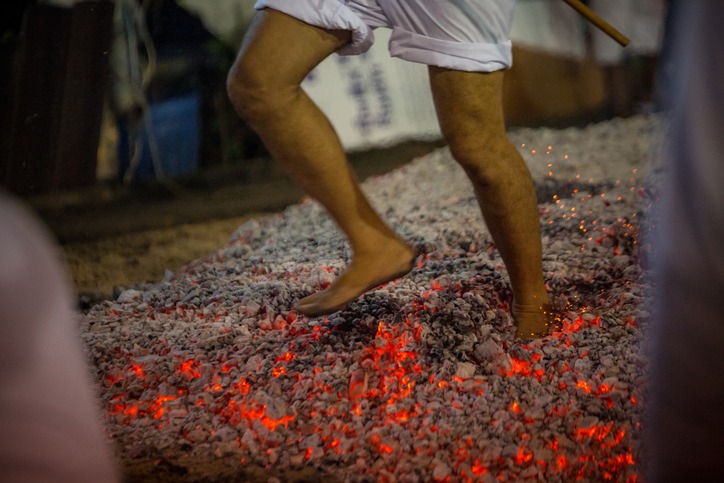
Each year, fire-walking participants gather in Greek villages to perform a captivating ritual that combines sacred dance, traditional music, and an extraordinary display of faith.
The Anastenaria fire walking ritual honors Greek Orthodox saints and commemorates the heroic actions of refugees from Eastern Thrace who rescued sacred icons from an ancient church fire. You'll witness performers entering a trance-like state as they dance to the haunting sounds of lyra and tambourine music while holding these cherished icons. The ceremony reaches its climax when participants, known as anastenarides, walk barefoot across beds of burning coals.
What's extraordinary about this saints' day celebration in Greece isn't just the spectacle - it's the performers' steadfast belief that their faith protects them from burns. While scientists point to factors like brief coal contact and careful technique as explanations for their safety, participants attribute their protection to divine intervention and an intense spiritual connection. The ritual's significance has earned it recognition from UNESCO as an Intangible Cultural Heritage event, preserving this unique blend of Orthodox Christian tradition and cultural expression for future generations.
Cultural Preservation and Heritage
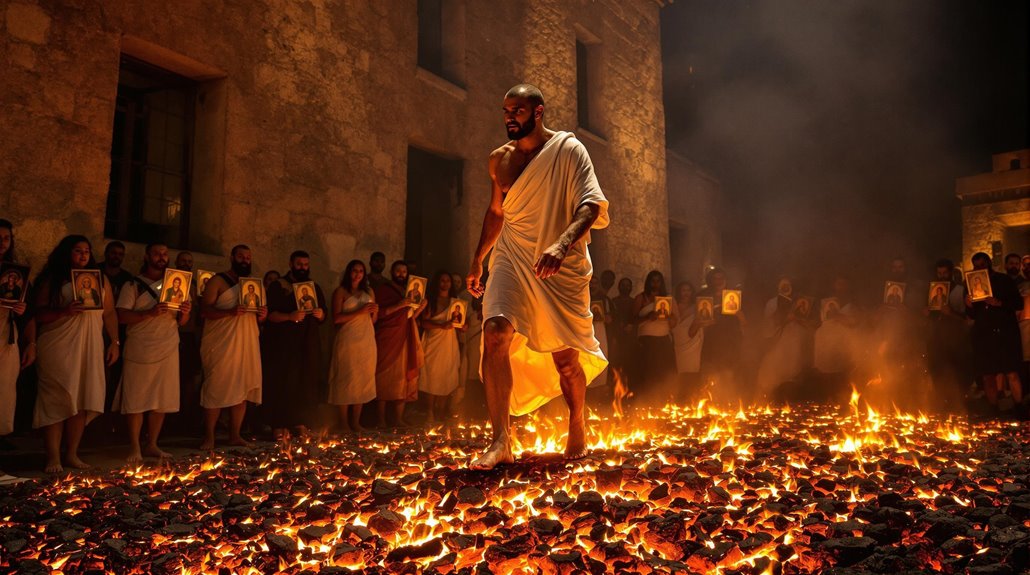
Receiving UNESCO World Heritage status in 2009 marked a pivotal moment for the Anastenaria ritual, cementing its place among humanity's most prized cultural traditions. The fire-walking ritual continues to thrive in both Northern Greece and Southern Bulgaria, where descendants of Greek Orthodox refugees from Eastern Thrace settled following the Balkan Wars. Today, you'll find the Anastenaria practiced in five Greek villages and six Bulgarian villages, showcasing extraordinary cultural preservation across borders.
The ritual's significance extends beyond regional boundaries, as evidenced by these impactful developments:
- The Regional historical museum Burgas's initiative to include the ritual on Bulgaria's National Representative List of Living Human Treasures
- Antarctica's Nestinari Nunataks being named after this ancient tradition, symbolizing its global cultural impact
- Extensive ethnographic studies and academic documentation ensuring the ritual's authentic preservation for future generations
Despite commercialization challenges in the 20th century, the cultural heritage of the Anastenaria remains protected through dedicated community efforts. You're witnessing a living tradition that's successfully adapted to modern times while maintaining its sacred essence, proving that ancient practices can survive and thrive in our contemporary world.
Scientific Understanding of Fire Walking
Modern science has demystified the seemingly miraculous act of firewalking through careful study of its physical and physiological mechanisms. When you examine the process closely, you'll find that the low thermal conductivity of wood charcoal plays an essential role in preventing severe heat transfer to your feet during the brief contact.
Your body's physiological factors are equally important in successful firewalking. Relaxed muscles and increased blood flow help protect your feet from potential injury. Meanwhile, your psychological state significantly influences the outcome - maintaining focus and belief in your ability helps you execute the proper technique that physicists have studied extensively.
While supernatural claims often surround firewalking rituals, science explains how it's possible to walk across hot coals without harm. The combination of psychological factors, including mental preparation and concentration, works alongside physical principles to enable safe passage. Research has shown that when you understand and apply these scientific principles correctly, you can minimize the risk of burns. This scientific understanding doesn't diminish the cultural significance of firewalking but rather explains how human bodies can achieve this exceptional feat.
Modern Practice and Tourism
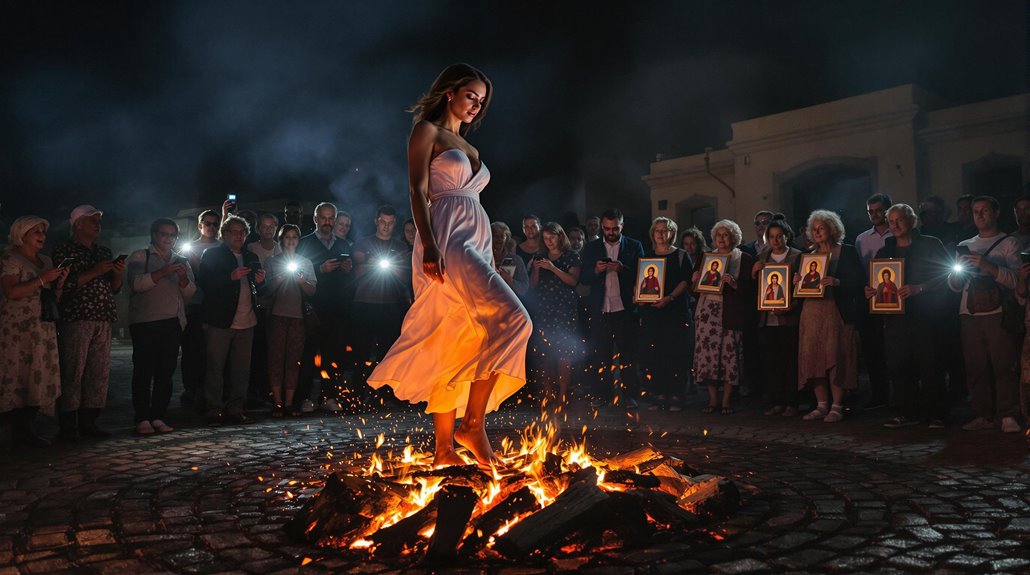
Tourism's growing influence has altered the ancient Anastenaria ritual in contrasting ways. You'll find the fire-walking ritual's authentic form surviving in just five Greek villages and six Bulgarian villages, where descendants of Greek Orthodox refugees from Greece and Turkey maintain their cultural heritage. However, along Bulgaria's Black Sea coast, you can now witness commercialized performances customized for tourists, shifting the ritual's sacred nature toward entertainment.
The ritual's global recognition has brought both preservation and challenges:
- UNESCO's 2009 recognition of Anastenaria as Intangible Cultural Heritage has helped protect its traditional practices in Northern Greece and Southern Bulgaria
- Social media's influence has led to misappropriation, as seen in iShowSpeed's 2024 livestream attempt to perform the sacred ritual
- The ritual's significance has reached Antarctica, where the Nestinari Nunataks stand named after the Bulgarian version of the ceremony
While tourism has increased awareness of this ancient tradition, you'll notice a delicate balance between preserving the ritual's authenticity and meeting modern tourism demands. The challenge lies in maintaining the ceremony's spiritual essence while adapting to contemporary interests.