New Year’s Traditions Around the World: How Cultures Welcome the Year
You'll find fascinating New Year's traditions across the globe, from noisy celebrations to quiet customs that welcome good fortune. In Thailand, people shoot guns into the air to frighten demons, while the Chinese light dramatic firecrackers to chase away darkness. Many cultures share special foods for luck - Spaniards eat 12 grapes at midnight, Germans enjoy marzipan pigs, and Southern Americans serve black-eyed peas with pork. Scotland's Hogmanay festivities feature the unique "first footer" tradition, where the first person to cross your threshold after midnight influences your year's fortune. These rich cultural practices offer just a glimpse into humanity's cherished ways of embracing new beginnings.
Noisemaking and Spirit Banishing Customs
Why do so many cultures make noise or create spectacles to ring in the new year? The answer lies in ancient beliefs about warding off evil spirits and bad luck as one year plunges into the next.
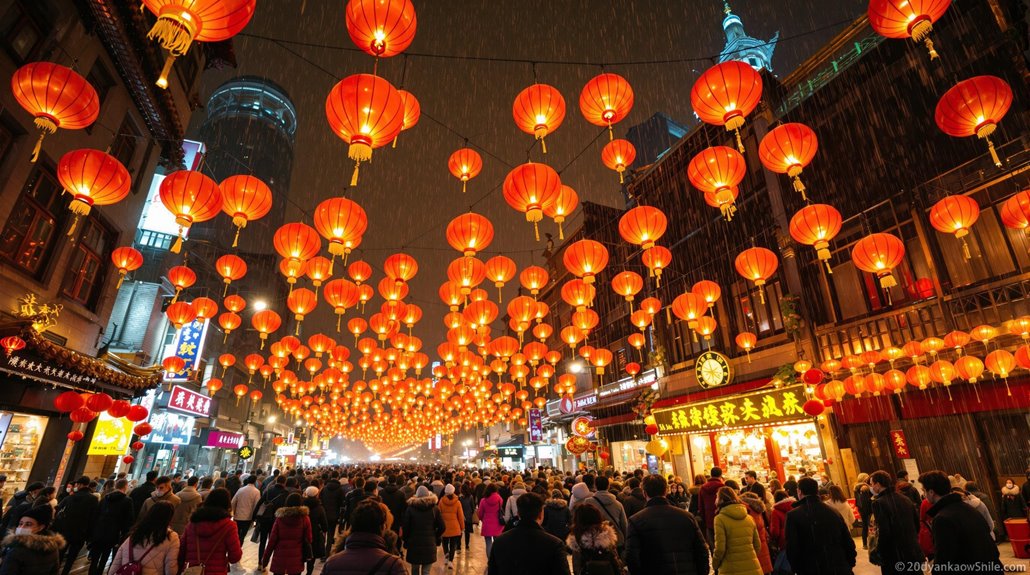
Across the globe, you'll find fascinating traditions centered around creating noise and commotion. In Thailand, you'll hear the sharp crack of gunfire as locals shoot into the air to frighten away demons that might bring misfortune. Chinese customs include the dramatic explosion of firecrackers, which serve to drive away forces of darkness lurking at year's end. The Danes take a more personal approach - they'll throw plates and glasses against their neighbors' doors, believing the shattered ceramics will chase away negative spirits.
These spirit-banishing customs don't always involve noise. In Ecuador, you'll witness the burning of effigies representing famous figures, a ritual meant to destroy any lingering bad luck from the previous year. Even the famous Times Square ball drop, though less focused on spirits, continues this global pattern of creating spectacles to mark the year's changeover. These diverse cultures share a common thread: using dramatic displays to guarantee a fresh, positive start to the new year.
Lucky Foods Across Continents
Food plays a central role in how cultures welcome the new year, with specific ingredients and dishes believed to attract prosperity, luck, and abundance. Whether you're in Europe, Latin America, or the United States, you'll find unique traditions centered around what people eat as the clock strikes midnight.
If you want to adopt these good luck traditions, you can try these popular customs from around the world:
- In Spain and Latin America, you'll want to eat 12 grapes at new year's eve midnight - one grape for each month of good fortune
- French households celebrate by making crêpes, stacking these delicate pancakes high as a symbol of financial success
- Germans ring in the year with marzipan pigs, while Italians combine lentils and pork for a double dose of prosperity
- In the American South, you can't start the year without black-eyed peas and pork on your plate
These culinary traditions have been passed down through generations, each reflecting cultural beliefs about what brings good fortune. While ingredients vary by region, they all share a common thread: the hope that specific foods can help manifest a prosperous year ahead.
Global Toasting and Drinking Rituals

Celebration spirits flow freely around the globe as the new year approaches, with each culture embracing its own unique toasting traditions. In England, you'll find locals sharing wassail, a festive punch that warms both body and spirit on New Year's Eve. Just north in Scotland, revelers celebrate Hogmanay with their own variation - a spiced hot pint that's similar to wassail but with distinct Scottish flair.
If you're in Spain when the clock strikes midnight, you'll likely have a glass of Cava in hand. This sparkling white wine has become the go-to choice for Spanish new year celebrations, creating a moment of effervescent joy as everyone raises their glasses to welcome the coming year.
These drinking traditions have deep historical roots, much like the ancient gift-giving customs that accompanied them. The Romans would exchange gilded nuts and coins as symbols of prosperity, while in ancient Persia, you'd have received eggs as tokens of fertility and new beginnings. Today's toasting rituals maintain that spirit of sharing and connection, though the gifts have largely given way to the shared experience of clinking glasses and offering good wishes.
First Footer Traditions
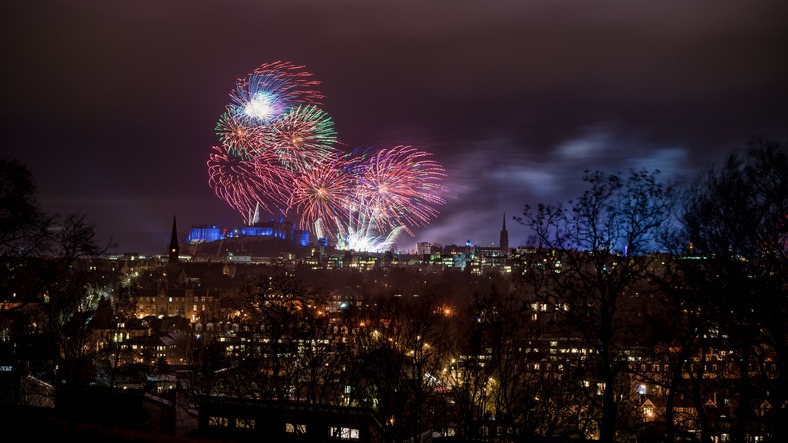
Throughout the British Isles, the identity of your first house guest in the new year carries more weight than you might expect. In Scotland, during the famous Hogmanay celebrations spanning from December 30th to January 1st, you'll find the fascinating tradition of the "first footer" - the first person to cross your threshold after New Year's Eve midnight.
For centuries, Scots have believed that your first footer's characteristics will determine your household's fortune for the entire year. The ideal first footer should be a tall, dark-haired male who arrives bearing specific gifts:
- Coal for warmth and comfort
- Shortbread and black bun for sustenance
- Salt for seasoning and flavor
- Whisky for good cheer and hospitality
You'll notice similar customs across the region, like England's wassailing tradition, where people welcome New Year's Day visitors with spiced drinks and songs. During Hogmanay, Scotland's tradition extends beyond simple visitation - it's a time when both friends and strangers are welcomed with warm hospitality and celebratory kisses, making the first footer tradition a cornerstone of their New Year celebrations.
Scotland's Hogmanay Celebrations
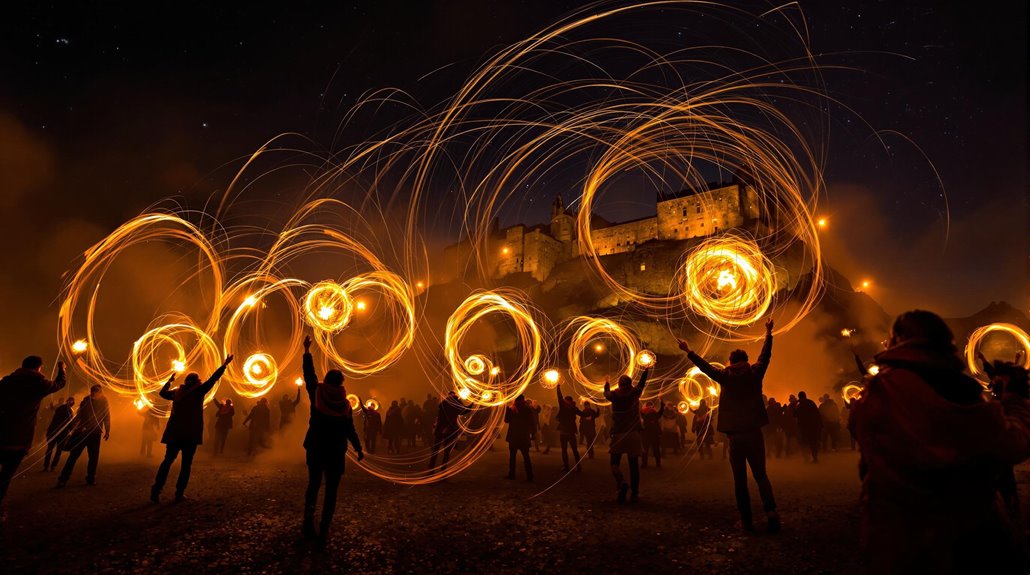
The jubilant spirit of Hogmanay alters Scotland into a festive wonderland each winter, as cities and villages buzz with age-old traditions that mark the year's end. You'll find this Scottish New Year's Eve celebration extends beyond a single night, running from December 30th through January 1st, creating three days of revelry and customs.
Before the festivities begin, you'll notice Scots engaging in the "redding of the house," a thorough cleaning ritual from cabinets to doorsteps, ensuring they'll start the new year with a pristine home. As darkness falls, you can witness spectacular bonfire ceremonies where locals parade through streets swinging massive fireballs on poles, illuminating the night sky with their ancient ritual.
At midnight, you'll hear the familiar melody of "Auld Lang Syne," Robert Burns' beloved poem turned traditional song, echoing through streets and homes. The celebration continues with first footing, where you might participate in the cherished custom of visiting neighbors. If you're a tall, dark-haired man, you'll be especially welcome as the first footer, considered a bearer of good fortune for the coming year.
Brazilian Beach and Ocean Customs
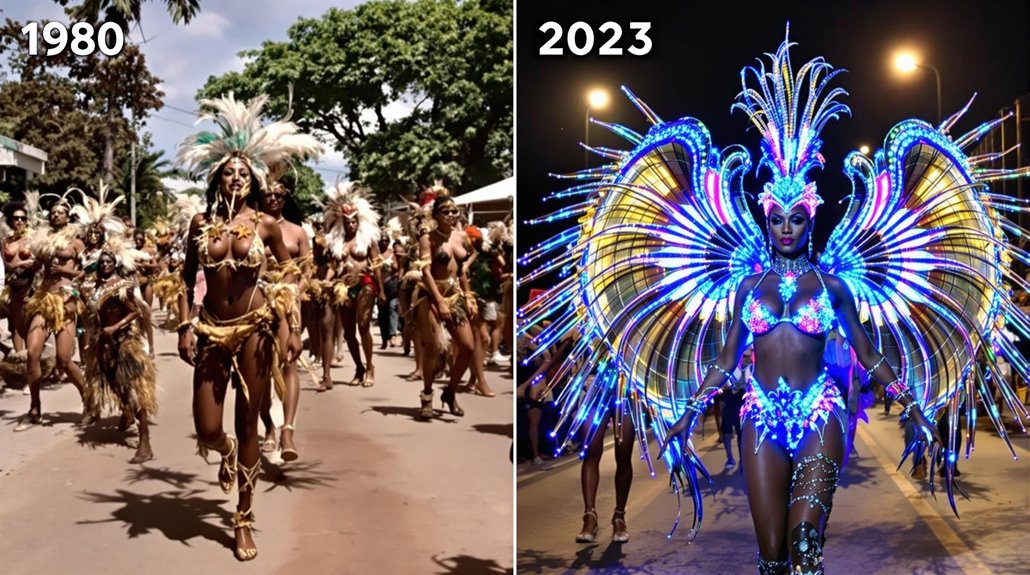
While Scotland envelops fire in winter, Brazil's New Year's traditions immerse you in waves and white-clad revelry along its coastal shores. The celebration, known as Festa de Lemanjá, honors Yemanja, the goddess of the sea, through a lively blend of spiritual customs and festive gatherings.
You'll notice crowds of people wearing all white, symbolizing purity as they prepare to participate in the ocean rituals. The tradition invites you to jump over seven waves while making seven wishes, connecting you to centuries of African-influenced spiritual practices that have shaped Brazilian culture.
To fully engage with these beach celebrations, you'll experience:
- Live music and dancing that fills the shoreline with infectious energy
- The beautiful sight of flowers and candles being offered to Yemanja
- Traditional feasts featuring black-eyed peas for good luck
- Festival-goers dressed in white gathering to honor the sea goddess
As midnight approaches, you'll find yourself surrounded by thousands of others, all unified in their hopes for the coming year. These ocean-centric customs reflect Brazil's deep connection to its African heritage and the enduring influence of Yemanja worship in modern celebrations.
Asian Temple Bell Ceremonies
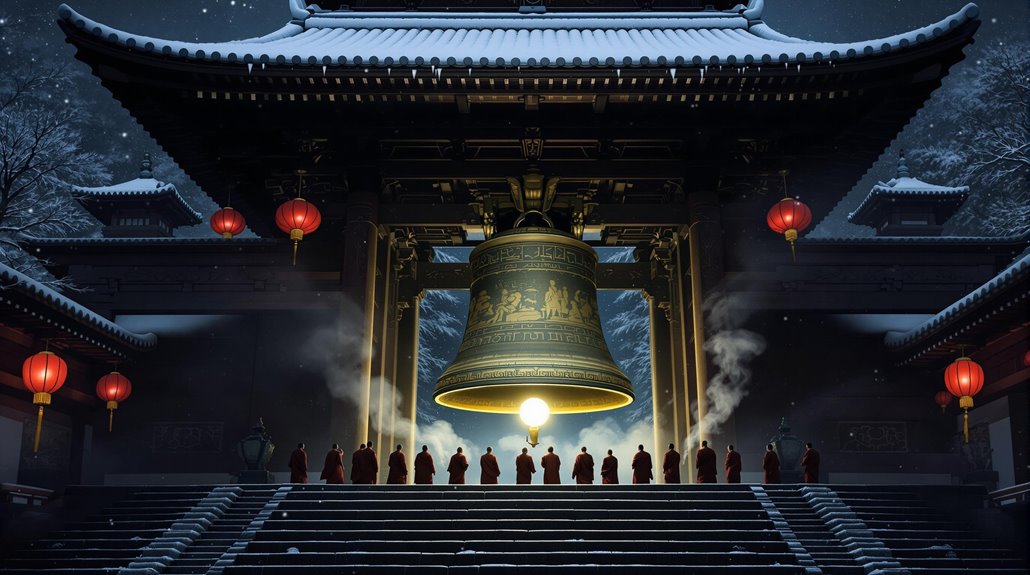
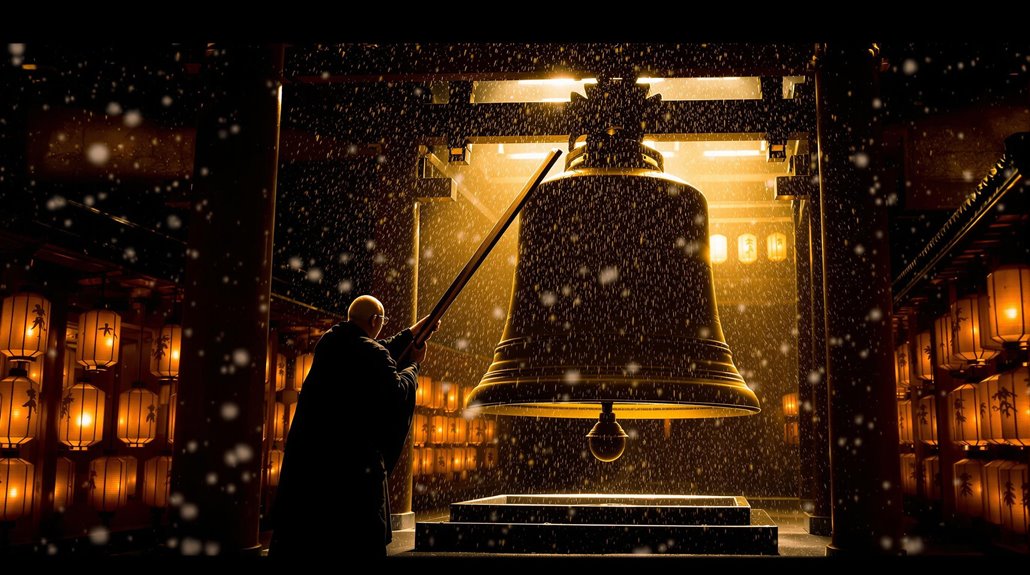
Sacred bells pierce the midnight air as Buddhist temples across Asia welcome the new year with powerful impact. In Japan, you'll witness one of the most profound temple bell ceremonies, known as Joya no Kane, where monks toll the bells exactly 108 times. Each ring represents an earthly desire that you must overcome to achieve spiritual clarity, making the ceremony both a symbolic and spiritual cleansing of the soul.
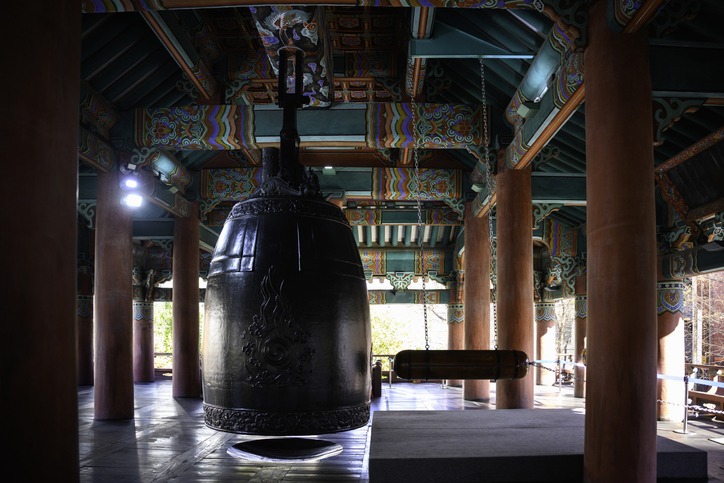
As you investigate New Year's Eve celebrations across East Asia, you'll find that temple bells play a central role in marking the shift from old to new. In South Korea's capital, Seoul, thousands gather at the historic Bosingak Pavilion to watch the ceremonial ringing of the Peace Bell, while similar traditions unfold in temples throughout China and Vietnam.
These bell-ringing ceremonies aren't just about making noise - they're deeply rooted in the belief that the sound waves can purify your spirit and provide a fresh start. Whether you're in Tokyo, Seoul, or Beijing, you'll experience how these ancient traditions continue to resonate with modern celebrants seeking renewal and spiritual connection as they step into the new year.
Mediterranean Red Clothing Beliefs
Moving from spiritual resonance to sartorial symbolism, Mediterranean New Year's customs highlight a lively splash of red. You'll find this vivid tradition particularly alive in Italy, where red underwear isn't just a fashion choice - it's a potent symbol of good luck for the year ahead. Across the Mediterranean region, from Spain to Greece, you'll notice people incorporating red clothing and accessories into their New Year's celebrations.
The color red holds deep significance in Mediterranean cultural beliefs, serving multiple symbolic purposes:
- Attracts prosperity and abundance in the coming year
- Wards off negative energies and bad spirits
- Represents passion and vigor for fresh beginnings
- Symbolizes good fortune and positive energy
When you're celebrating New Year's in Mediterranean countries, don't be surprised to see red garments and accessories everywhere. Whether it's the subtle presence of red undergarments in Italy or more visible red clothing items throughout the region, this tradition reflects the Mediterranean people's deep-rooted belief in the power of color to influence destiny. You're witnessing a cultural practice that alters a simple color choice into a powerful ritual for welcoming prosperity in the new year.
Latin American Travel Superstitions
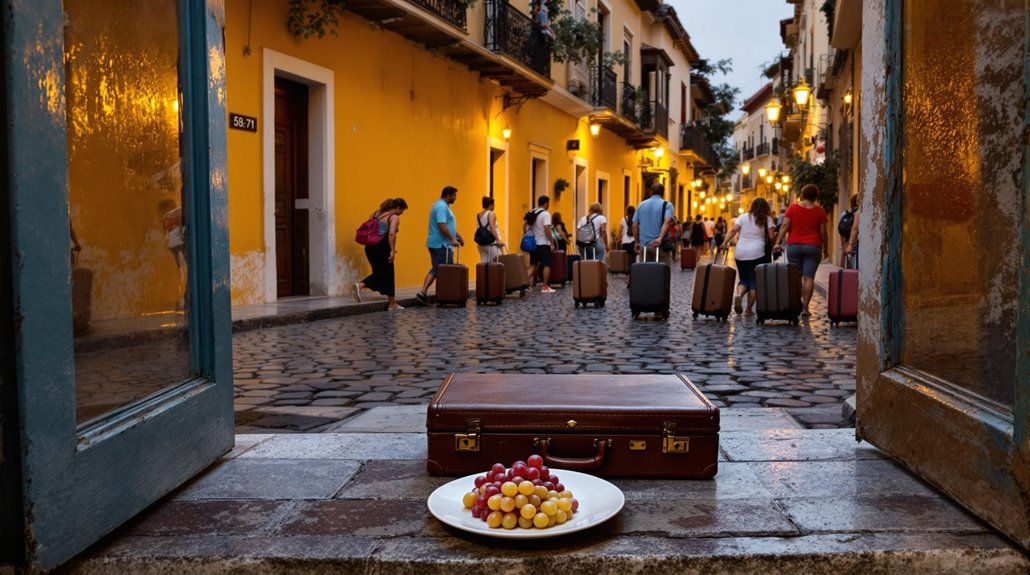
Latin American cultures infuse the New Year's celebration with unique travel-focused superstitions that'll have you packing your bags before midnight strikes. One of the most peculiar traditions involves carrying an empty suitcase around your neighborhood on New Year's Eve - a practice believed to manifest travel opportunities and escapades in the coming year.
If you're heading to the beach to welcome the new year, you'll want to try jumping over seven waves at midnight. This ritual, practiced in several Latin American countries, lets you make wishes while paying respect to the sea goddess. To invigorate your chances of prosperity, don't forget to fill your pockets with coins and wear red underwear - two widespread traditions across Latin America that locals swear will attract wealth and love.
In Colombia, you'll find an intriguing way to peek into your financial future. Place three potatoes under your bed: one peeled, one unpeeled, and one partially peeled. The potato you blindly grab at midnight is said to predict your financial situation - fully peeled suggests scarcity, unpeeled indicates abundance, and partially peeled points to a moderate year ahead.
Nordic Plate Breaking Practices
Breaking plates might sound chaotic, but in Nordic countries, it's a cherished New Year's tradition that symbolizes good fortune. You'll find that Nordic families collect their broken plates and glasses throughout the year, saving them for this special occasion. As midnight approaches on New Year's Eve, they'll throw old dishes against their friends' and neighbors' doors, believing this practice wards off evil spirits and cleanses the home of bad spirits from the old year.
The more broken pieces you find on your doorstep, the more prosperity you're believed to receive in the coming year. This tradition pairs with other Nordic customs, including the tradition to burn old items and notes containing negative memories from the past year.
Here's what you need to know about participating:
- Save chipped or cracked plates throughout the year - never use new ones
- Aim for doorsteps, not windows or people (safety first!)
- Cleanup happens on New Year's Day as a community activity
- Keep the broken pieces until sunrise for maximum luck
The practice continues to thrive in many Nordic communities, though some modern households now opt for less messy alternatives.
Filipino Round Fruit Customs

In the Philippines, the circular symbolism of good fortune takes center stage during New Year's celebrations. As the clock approaches midnight on New Year's Eve, you'll find Filipino families gathering around tables adorned with exactly twelve round fruits - a practice deeply rooted in their belief system. Each fruit, whether it's grapes, oranges, or watermelon, represents prosperity and completeness for each month of the coming year.
You'll notice this circular theme extends beyond just the fruits. Look around, and you'll see people sporting polka dot clothing, their patterns echoing the shape of coins to attract wealth and fertility. Don't be surprised to find Filipinos with coins jingling in their pockets or purses - it's another way they invite abundance into their lives. The roundness in these traditions symbolizes the continuous cycle of life and the smooth flow of good fortune they hope to experience. When midnight strikes, you'll witness an entertaining sight as people jump as high as they can, believing this will help them grow taller and reach greater achievements in the new year ahead.
German Future Telling Methods
View this post on Instagram
Molten metal flows like liquid fortune as Germans practice their unique New Year's divination traditions. While Times Square drops its famous ball, you'll find Germans engaging in a more mystical way of welcoming the new year. This fascinating fortune-telling custom, known as Bleigießen, involves melting small pieces of lead or tin and dropping them into cold water.
You'll be amazed at how the metal instantly solidifies into peculiar shapes, each holding potential predictions for the coming year. Modern New Year's traditions in Germany have adapted to use tin figurines instead of lead, making the practice safer while maintaining its charm. But the future-gazing doesn't stop there. Here's what else you'll experience during German New Year's Eve celebrations:
- Setting off spectacular fireworks at midnight to ward off evil spirits
- Watching the beloved "Dinner for One" TV special, a must-see tradition
- Decorating homes with mistletoe sprigs for good luck
- Interpreting the mysterious metal shapes with friends and family
These German fortune-telling customs blend perfectly with modern celebrations, creating a unique mix of mysticism and festivity that makes New Year's in Germany truly special.
Slavic Midnight Silence Rituals
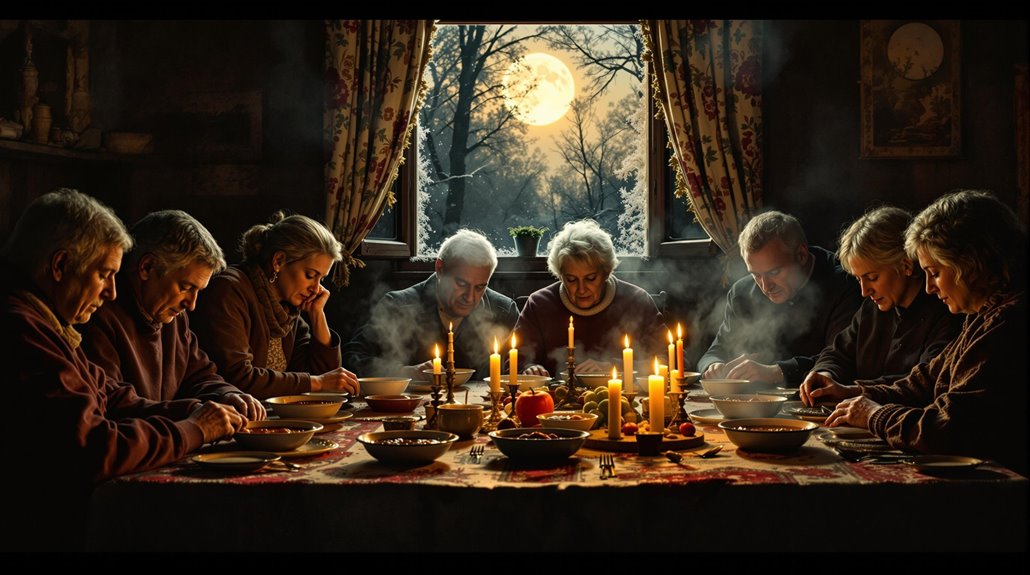
Silence descends across Slavic households as the clock approaches midnight on New Year's Eve, marking the beginning of an ancient divination ritual.
During this tradition, you'll notice family members stopping all conversation and sitting perfectly still about five minutes before the stroke of midnight. It's believed that in these sacred moments, you can hear whispers from the spirit world revealing your destiny for the coming year. You're encouraged to clear your mind and focus on the sounds around you - each one might carry special meaning for your future.
In some Slavic regions, you'll participate in ceremonies where everyone writes their wishes on small pieces of paper during this quiet time. As midnight approaches, you'll place these papers in a circle, and the first one that moves with the night breeze is said to be the first wish granted in the New Year. The silence continues until the first toll of midnight, when you'll break into celebration. Many believe that maintaining complete quiet during these final moments brings good luck and clarity for the year ahead. If you speak or move during this time, tradition says you'll disrupt the flow of positive energy entering your home.
Celtic House Blessing Traditions
Celtic families' age-old traditions of blessing their homes during New Year's carry deep spiritual significance throughout Scotland and Ireland. As you welcome the year ahead, you'll find these customs deeply rooted in bringing good fortune and protecting households from evil spirits.
In Scotland, you'll want to participate in "redding the house," a thorough New Year's Eve cleaning ritual from chimney to doorstep, ensuring you're starting fresh. The practice of first footing remains essential - after midnight, it's considered especially lucky when a dark-haired man crosses your threshold first.
Here's what a proper first footer should bring to guarantee good fortune:
- Coal for warmth throughout the year
- Shortbread for sustenance and prosperity
- Salt for life's flavor
- Whisky for good cheer
You'll witness spectacular bonfire ceremonies across Scotland, where locals parade with flaming poles to purify the coming year. Meanwhile, in Ireland, you might hear the rhythmic thumping of Christmas bread against walls and doors as families perform their traditional ritual to ward off evil spirits. These practices, while distinct, share the common thread of cleansing spaces and welcoming prosperity for the year ahead.