Magpie Festival in China: A Romantic Celebration of Love and Folklore
The Magpie Festival, also known as Qixi Festival, celebrates China's most enchanting love story between a mortal cowherd and a heavenly weaver princess. You'll uncover a 2,600-year-old tradition where stars Altair and Vega symbolize the separated lovers across the Milky Way. Each year, on the seventh day of the seventh lunar month, Chinese families honor this tale with needle-threading competitions, special pastries, and floating lanterns. Young couples pay tribute to the celestial lovers while seeking blessings for their own relationships. This magical blend of romance, stargazing, and ancient customs holds countless more secrets within its celestial fabric.
The Legend of Star-Crossed Lovers
At the heart of China's Magpie Festival lies a poignant tale of forbidden love between Zhinü, the seventh daughter of the Jade Emperor, and Niulang, a humble mortal cowherd. These star-crossed lovers met on Earth, where their romance blossomed after Niulang cleverly stole Zhinü's celestial garments to prevent her return to the heavens.
You'll find that their story, also known as the tale of the Cowherd and the Weaver, takes a dramatic turn when the Jade Emperor discovers their secret union. Despite their happiness on Earth, he demands his daughter's return to the skies. Determined to reunite with his beloved, Niulang uses his magical ox to create a bridge to the celestial domain. However, the Queen Mother of the West intervenes by creating the River of Heaven to keep them apart eternally.
Today, you can celebrate their love during the Qixi Festival, when the two lovers, represented by the stars Vega and Altair, finally meet once a year on the seventh day of the seventh lunar month. This celestial reunion has become one of China's most treasured folk traditions, symbolizing eternal devotion against all odds.
Ancient Origins and Cultural Heritage

Delving into the rich fabric of Chinese folklore, the Magpie Festival stands as one of China's most enduring cultural treasures, with roots stretching back over 2,600 years. As one of the four great folktales in Chinese cultural heritage, this festival's origins are deeply intertwined with the timeless story of Zhinü and Niulang, whose tale of romantic love continues to captivate generations.
You'll find that the festival's significance extends far beyond its mythological beginnings. The celestial narrative, featuring the Jade Emperor's decree to separate the lovers across the Milky Way, has profoundly shaped Chinese viewpoints on love and relationships. The symbolism of magpies, which form a bridge for the lovers' annual reunion, represents hope and the triumph of love over adversity.
When you investigate the festival's heritage, you'll uncover how it has evolved while maintaining its core values of devotion and familial bonds. Through traditions like needle-threading competitions and special pastries, the Magpie Festival continues to bridge ancient wisdom with contemporary celebrations, preserving a cultural legacy that resonates with both traditional and modern sensibilities.
Celestial Symbolism and Stargazing

The magical romance between Niulang and Zhinü comes alive in China's night sky during the Qixi Festival, where the stars Altair and Vega shine brilliantly on opposite sides of the Milky Way. As you gaze upward on this special night, you'll witness the celestial representation of one of China's most cherished love stories, where two bright stars symbolize the separated lovers who reunite once a year.
When you participate in stargazing during the Qixi Festival, you're connecting with centuries of tradition and cultural significance. The astronomical elements of this festival highlight why it's also known as Chinese Valentine's Day:
- Altair represents Niulang, the humble cowherd
- Vega symbolizes Zhinü, the ethereal weaver fairy
- The Milky Way serves as the celestial river separating the lovers
- Both stars are among the brightest in the summer sky
- Their positioning creates a visual representation of the legend
The celestial display isn't just about astronomy - it's a powerful reminder of eternal love that transcends physical boundaries. By observing these stars, you're participating in a tradition that has enthralled generations of stargazers and romantic souls.
Traditional Festival Customs

Rich traditions define the Qixi Festival celebrations, where young women showcase their skills and honor the legendary lovers through meaningful customs. During this Chinese Festival, you'll find young women participating in threading competitions under dim lighting, demonstrating their dexterity while praying to the Weaver Girl (Zhinü) for enhanced needlework abilities.
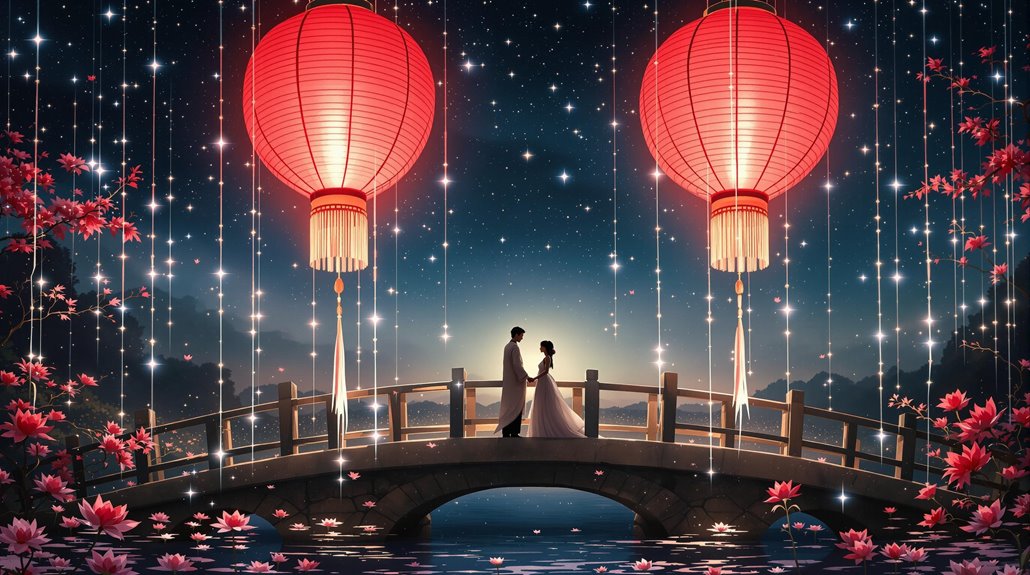
As darkness falls, you'll observe people gathering to spot the stars representing the Weaver Girl and Cowherd (Niulang) in the night sky. Newlyweds pay special tribute to these celestial lovers, seeking blessings for their own marriage. You'll notice the magical atmosphere as paper lanterns float down rivers, symbolically lighting the path across the magpie bridge where the lovers meet.
The festival's culinary traditions include enjoying Qiao Guo, a special crunchy candy, along with seasonal fruits. These Qiao foods hold cultural significance during the celebrations. State ceremonies are performed to honor this ancient love story, which has been passed down through generations. The Mother of the West's role in the lovers' annual reunion is remembered through these ceremonial observations, making the Qixi Festival a significant celebration of love and tradition.
Art Through the Ages

Throughout Chinese history, artistic depictions of the Qixi Festival have evolved from ancient pottery and silk paintings to modern digital illustrations. You'll find this romantic legend captured in countless forms, as artists through generations have been inspired by the tale of The Cowherd and Weaver Girl.
When you investigate Chinese art through the ages, you'll uncover how this love story from Chinese mythology has been interpreted in various mediums. Today's artists continue to reimagine this Festival's essence using contemporary techniques while honoring traditional elements.
Key artistic representations of the Qixi Festival include:
- Han Dynasty bronze mirrors featuring the celestial lovers
- Tang Dynasty poetry scrolls with detailed illustrations
- Song Dynasty silk paintings depicting the magpie bridge
- Ming Dynasty porcelain vases showing the couple's reunion
- Contemporary digital art blending modern and traditional elements
You'll notice how each era's artistic style reflects its cultural values, with earlier works emphasizing the cosmic and spiritual aspects of the tale, while modern interpretations often focus on the romantic elements. The evolution of these artworks demonstrates how this cherished Festival continues to inspire creative expression in Chinese culture.
Modern Celebrations and Adaptations
Modern celebrations of the Qixi Festival blend ancient traditions with contemporary romance, as young couples across China exchange gifts and plan special dates on the seventh day of the seventh lunar month. Often called Chinese Valentine's Day, you'll find shopping malls and restaurants teeming with lovers seeking the perfect way to celebrate their relationships.
While Chinese traditional elements remain important, people celebrate differently today than in centuries past. You'll see couples exchanging gifts like chocolates, flowers, and jewelry rather than offering fruit and incense to the celestial lovers. Many modern celebrations include romantic dinners at upscale restaurants, movie dates, and even elaborate marriage proposals planned for this auspicious day.
Social media has transformed how lovers forever commemorate the festival, with many sharing their Qixi moments online through photos and love declarations. Some cities organize modern cultural events, including outdoor movie screenings of romance films, stargazing parties, and craft workshops where couples can make traditional items like silk sachets together. Though the festival's character has evolved, it continues to allure young people while maintaining its connection to China's rich cultural heritage.
Culinary Traditions and Offerings

Beyond the romantic gestures and social celebrations, the Qixi Festival features distinct culinary customs that tell their own love story. On the seventh day of the seventh lunar month, you'll find families across China preparing special tributes to honor the celestial lovers' reunion.
Traditional customs of Qixi involve preparing specific dishes that symbolize prosperity and a happy life. You'll often see mothers teaching their daughters how to create zhiqiao, traditional pastries shaped like magpies that carry wishes back to the heavens. The tributes typically include:
- Sweet dumplings filled with dates and nuts, representing the sweetness of love
- Seven-colored rice balls symbolizing the seven colors of the bridge of magpies
- Seasonal fruits arranged in the shape of stars
- Wine cups filled with osmanthus tea for the lovers' toast
- Lotus-shaped pastries representing purity and devotion
As you participate in these culinary traditions, you're not just preparing food - you're connecting with centuries of Chinese culture. Many families still gather to make these special dishes together, passing down recipes that have traveled through generations, keeping the Mother of the Western Heavens' blessings alive through food.
Regional Variations Across China

As you travel across China during the Qixi Festival, you'll uncover that each region celebrates this romantic holiday in its own distinctive way. The story of two lovers separated by the Silver River (Milky Way), who can only meet once a year when a flock of magpies forms a bridge, echoes differently across China's diverse provinces.
In Guangdong, you'll witness exciting dragon boat races that add a lively energy to the celebration, while Sichuan locals honor the Weaver and her love by preparing qiaoguo, a special festival pastry. The women of Fujian continue their centuries-old tradition of floating delicate willow and paper boats down rivers, hoping to secure a good marriage, while in Shanxi, they demonstrate their skills through needle-threading competitions.
Zhejiang province changes into a spectacular display of illuminated artistry, where lanterns light up the night sky and visitors test their wit with traditional riddles. Meanwhile, in Shandong, you'll find beautifully embroidered artwork depicting the legendary love story hanging in homes and public spaces. These regional variations showcase China's rich cultural diversity, proving that while the core story remains the same, each area adds its own unique touch to this beloved festival.
Global Impact and Recognition

While these regional celebrations depict a colorful rendition of China's cultural mosaic, the Qixi Festival's influence extends far beyond national borders. This Chinese love story, also known as the Double Seventh Festival, has woven itself into the cultural fabric of East Asia and gained international recognition. You'll find UNESCO has acknowledged it as an intangible cultural heritage, highlighting its significance in shaping romantic relationships across cultures.
The global impact of the Qixi Festival can be seen through its various adaptations and influences:
- Japan's Tanabata festival draws direct inspiration from the Chinese celebration
- Korea's Chilseok festival shares similar themes and customs
- Google has featured the festival in its Doodles since 2009
- International theater productions regularly adapt the tale
- Modern artists worldwide incorporate the story in contemporary works
You'll notice how this ancient Chinese narrative has shifted into a universal symbol of love and devotion. The story of Niulang and Zhinü continues to speak to modern audiences, transcending cultural boundaries and inspiring similar celebrations worldwide. It's become an example of how traditional folklore can bridge cultural gaps and create shared experiences across continents.
Preserving Ancestral Wisdom
Through the carefully preserved rituals of the Qixi Festival, each generation safeguards China's rich ancestral wisdom. When you participate in this ancient celebration, you're connecting with a timeless tale that dates back to the Han dynasty, when two celestial lovers were deeply in love but separated by the Queen Mother of the West, who ordered the Weaver Girl back to Heaven.
You'll find that this day is celebrated through meaningful customs that preserve essential cultural values. As you thread needles under moonlight or gaze at the stars, you're not just participating in entertaining activities - you're keeping alive the skills and traditions your ancestors held dear. The festival's enduring narrative serves as a bridge between past and present, allowing you to experience the same emotional resonance that has moved Chinese families for generations.