Interesting Facts About Time That Will Surprise You
Time shapes your world in ways you've never considered. Your native language influences how you perceive time's flow, while your brain can manipulate time during intense moments, creating matrix-like slow-motion effects. You're actually living through multiple centuries - your great-grandparents likely knew people born in the 1800s, creating an unbroken chain to the past. Even with atomic clocks, perfect timekeeping remains impossible, and diverse cultures still use ancient calendar systems, like Nepal's unique 15-minute time zone offset. The more you investigate time's mysteries, the stranger and more fascinating they become.
Time Shapes Your Native Language
Have you ever wondered how your native language influences your perception of time? Research reveals that the language you speak plays an important role in shaping how you experience the passage of time. Your native tongue's conceptual representation of time can determine whether you view it flowing horizontally (like reading from left to right) or vertically (like viewing a timeline from top to bottom).
The way your language expresses time affects more than just your mental imagery. It can actually alter your perception of how quickly or slowly time progresses. For example, if your language uses spatial metaphors to describe time, you might experience time differently than someone whose language represents it through other means. This linguistic influence runs deep, affecting everything from how you organize your daily schedule to how you reflect on past years.
Your language's temporal structure creates a unique lens through which you view the progression of events. It's not just about vocabulary - it's about how your brain processes and interprets the experience of time itself. This relationship between language and time perception demonstrates how deeply our native tongues shape our understanding of the world.
The Illusion of Perfect Timekeeping
Despite our best technological efforts, perfect timekeeping remains an elusive goal. Even as you read these facts about time measurement, you'll find it fascinating that no single clock on Earth can perfectly track how time passes. While atomic clocks are incredibly precise, they still need regular calibration against a global network to maintain accuracy.
You might think that keeping time is a straightforward process in our modern age, but the truth is more complex. Every day, scientists work to synchronize clocks worldwide, yet perfect accuracy remains impossible. This reality reflects how time measurement, throughout human history, has been a constant challenge. Just as DAYS ARE GETTING LONGER since a billion years ago, our understanding of time's complexity continues to evolve. What started as simple sundials million years ago has progressed to atomic clocks that can measure time to within millionths of a second. However, these sophisticated instruments still drift and require adjustments. The pursuit of flawless timekeeping continues, driven by modern technology's demands, but we must accept that absolute perfection in measuring time remains beyond our grasp.
Living Through Multiple Centuries
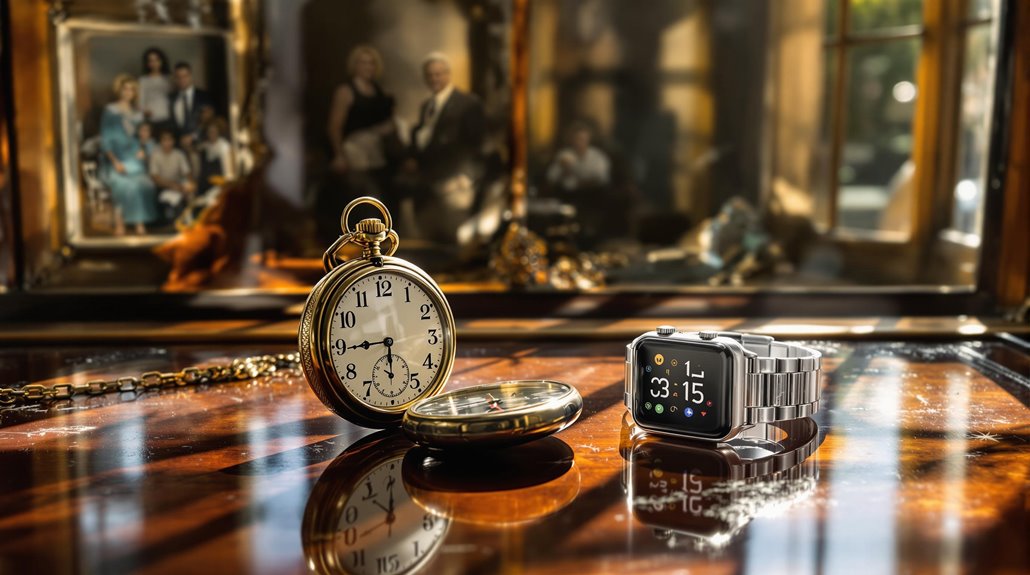
Time's astounding continuity allows ordinary people to become witnesses of multiple centuries. When you consider that a child born today will be around 77 years old when the clock strikes midnight on New Years Eve 2099, you'll realize we're getting years closer to the next century than you might think. Millions of people alive today will experience life in both the 21st and 22nd centuries, without the need for time machines or science fiction scenarios.
This connection to multiple time periods is more tangible than you'd expect. Just as we can trace our family histories back to the era of the French Revolution or the construction of the Eiffel Tower, future generations will connect to us in the same way. It's fascinating to think that your great-grandparents who passed away might have known people who were born in the 1800s, creating a human chain that stretches across centuries. While we can't personally witness events from the Cretaceous period, we're all part of an unbroken line of generations that links the distant past to the far future.
Your Brain's Time Machine
Our brains are remarkably sophisticated time machines, capable of warping our perception of reality during pivotal moments. Just as the first fax machine by Alexander Bain revolutionized communication, your brain's ability to manipulate time perception is one of the most fascinating facts about consciousness. Like the Wright Brothers defying gravity, your mind can defy time itself, especially during high-stress situations when milliseconds per moment seem to stretch indefinitely.
Your neural time-warping abilities rival the impact of the Moon's gravity on Earth, creating significant effects on your experience of reality. From the Big Bang until now, humans have evolved this extraordinary capacity to process information faster when it matters most. During life-threatening situations, your brain creates a matrix-like slow-motion effect. Athletes can consciously induce time dilation during crucial moments of performance. Novel experiences feel longer than routine ones, which is why two years of childhood seem longer than two years of adulthood.
These time-perception abilities aren't just fascinating facts – they're essential survival mechanisms that have evolved over millions of years.
Ancient Calendars Still Exist Today
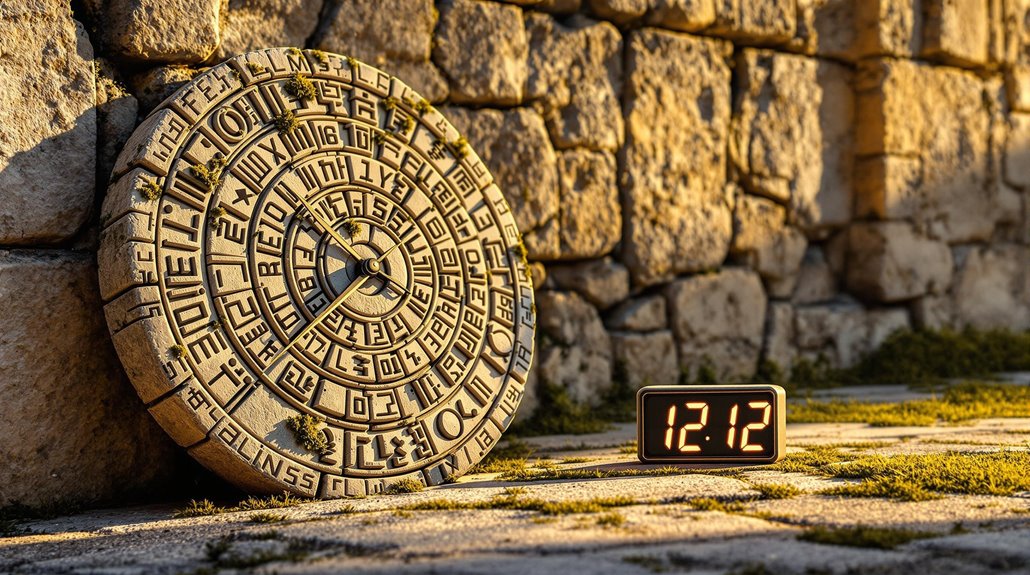
While your brain warps time perception, various cultures have developed their own unique ways of measuring and tracking time. Just like how Bowhead whales still traverse ancient migration routes from the Ice Age, traditional calendars continue to thrive alongside the modern Gregorian system.
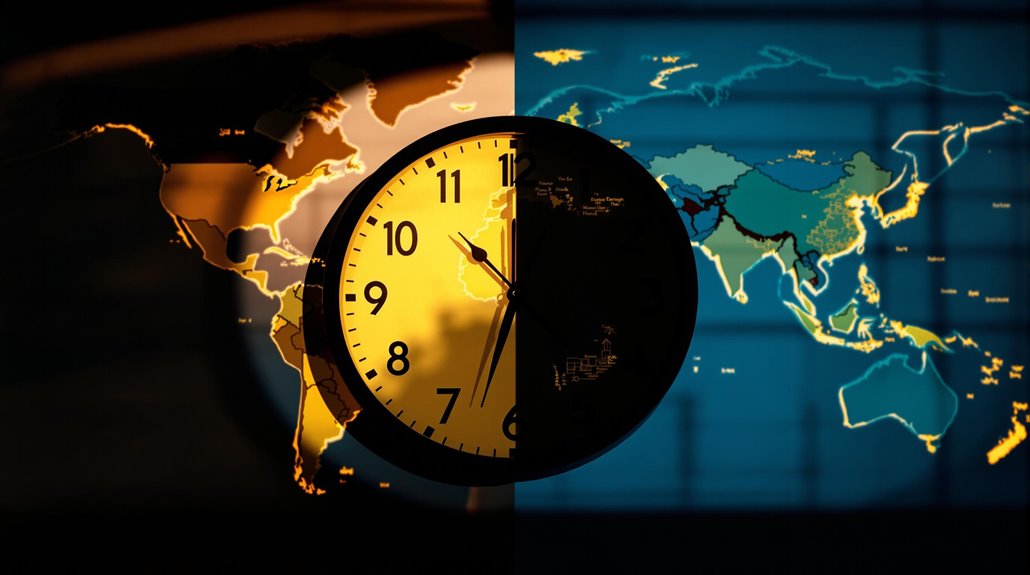
You'll find fascinating examples around the world, as distinct as the Late Jurassic Period fossils uncovered on Wrangel Island. In Nepal, different ethnic groups use at least four calendars simultaneously, and they've even set their time zone 15 minutes out of sync - something a Scottish inventor would find quite peculiar. Myanmar operates in year 1384, while just next door, Thailand's counting 2566. It's like having a company in Kyoto marking time differently from when their university was founded.
Perhaps most intriguingly, Ethiopia follows a 13-month calendar, currently in year 2016. THERE'S NO SUCH THING as a universally accepted way of tracking time - it's still traveling through diverse cultural pathways. These parallel time-keeping systems remind us that measuring time isn't just about counting days; it's about preserving cultural identity and traditional ways of understanding our world.
Time Without Consciousness Impossible
The relationship between time and consciousness forms an inseparable bond - you can't have one without the other. While it might surprise you, this connection goes deeper than you'd think. Just as Earth revolves around the Sun marking years, your internal clock keeps ticking even in complete darkness, shaping who you are next week and five years from now.
It's easy to assume that time simply passes like it did when mammoths were still roaming and the Tyrannosaurus Rex ruled the Earth. However, your consciousness depends on time's passage to build your personal identity. From the moment a movie hit theaters to memories of World War events, time weaves the fabric of your existence.
- Your memories create the unique story of who you are, impossible without time's forward march
- Your internal rhythms continue their dance even when you lose track of external time
- Your very sense of self emerges from the accumulation of moments and experiences
Without time's invisible heartbeat, consciousness as you know it couldn't exist. Your identity is constantly being shaped by time's flow, making each moment indispensable to who you are and who you'll become.