
How to Sleep Better When Traveling Between Time Zones

When traveling across time zones, you'll need strategic sleep management to minimize jet lag. Start adjusting your sleep schedule several days before departure by shifting bedtime 15-30 minutes closer to your destination's time. During travel, avoid naps longer than 20 minutes and seek natural light exposure at the right times - morning light for eastward travel, evening light for westward travel. Upon arrival, immediately align with local time and maintain a consistent sleep routine. Your body typically needs one day per time zone crossed to fully adjust, but these proven strategies can help accelerate your adaptation.
Understanding Time Zone Effects
Nearly every traveler has experienced the frustrating effects of crossing time zones. When you travel across multiple time zones, your body's circadian rhythm becomes disrupted, throwing off your internal clock and triggering jet lag symptoms. These symptoms can include difficulty sleeping, daytime fatigue, and reduced mental sharpness.
Your body needs approximately one day per time zone crossed to fully adjust to the new time zone. If you're heading east, you'll likely face more severe jet lag symptoms because you're losing time, making it harder for your body to adapt. Westward travel, while still challenging, tends to be easier on your system.
Light exposure plays a pivotal role in how quickly your body can sync with your destination's schedule. Your circadian rhythm responds strongly to natural light signals, which can either help or hinder your adjustment. If you frequently cross time zones, you should be aware that chronic disruption of your body's natural rhythm may lead to more serious health concerns, including metabolic issues and mood changes. Understanding these effects can help you better prepare for time zone adjustments and manage your sleep schedule more effectively during travel.
Pre-Travel Sleep Adjustments
Taking proactive steps before your expedition can markedly reduce the impact of time zone changes on your sleep patterns. By gradually adjusting your sleep schedule before traveling across different time zones, you'll help your body's circadian rhythm adapt more smoothly to the new environment.
Start by shifting your bedtime and wake-up times in small increments of 15-30 minutes per time zone each day leading up to your trip. This gradual adjustment helps minimize jet lag symptoms when you arrive at your destination. While making these changes, expose yourself to light at strategic times that align with your new schedule, as light exposure plays a vital role in regulating your sleep-wake cycle.
As you prepare for the new time zone, maintain a consistent sleep environment and avoid naps close to your target bedtime. If you're traveling east, try going to bed earlier and waking up earlier; if heading west, do the opposite. Remember that your body needs time to adjust, so begin these modifications several days before departure. This proactive approach will help you arrive at your destination better prepared to handle the time difference.
Light Exposure Strategies
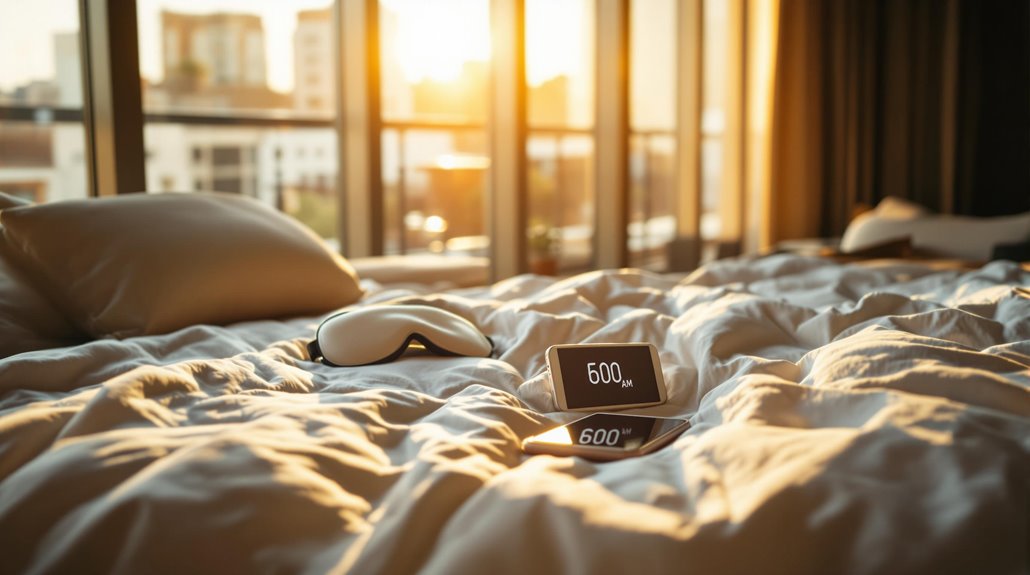
Strategic light exposure serves as one of the most powerful tools for managing jet lag and resetting your body's internal clock when crossing time zones. By carefully timing your exposure to light and darkness, you can effectively help your body adapt to your new schedule.
When you're Switching Time zones, make it a priority to get direct sunlight as soon as possible after arriving at your destination. This exposure helps reset your body's sense of day and night, particularly during morning hours. If you're traveling east, you'll want to advance your internal clock by seeking bright light in the morning and avoiding it in the evening. Conversely, when heading west, you can delay your internal clock by exposing yourself to light in the evening.
Start adjusting your bedtime and light exposure patterns several days before your trip. Consider using light-blocking glasses in the evening to help you fall asleep earlier, or bright light therapy devices in the morning to wake up your system. Remember to maximize daylight exposure during your destination's daytime hours while minimizing artificial light exposure when it's time to wind down.
Managing Sleep During Travel
During travel across time zones, managing your sleep effectively requires a proactive approach that begins before your expedition. Start adjusting to a new time zone by gradually shifting your bedtime and wake times a few days before departure. This pre-emptive strategy helps minimize travel fatigue and reduces the impact of jet lag on your circadian rhythms.
When you arrive at your destination, resist the urge to nap immediately. Instead, stay awake until the local bedtime to hasten your body's adjustment. Seek natural light exposure during the day, particularly in the morning, as it's one of the most powerful tools for resetting your internal clock. Consider using melatonin supplements strategically to support your sleep schedule adaptation.
- Create a calming pre-sleep ritual that signals to your body it's time to rest, even in unfamiliar surroundings
- Transform your temporary sleeping space into a sleep-friendly environment by controlling light, temperature, and noise
- Maintain consistent sleep hygiene practices, just as you would at home, to preserve your quality of rest
Remember to prioritize your sleep schedule throughout your excursion, as proper rest will enhance your travel experience greatly.
Recovery After Time Zone Changes

Readjusting to your home time zone demands patience and a structured approach, much like adapting to a new destination. The effects of jet lag when returning home can be just as challenging as traveling to a different time zone initially. You'll need approximately one day per time zone crossed to fully adjust to the new schedule and overcome symptoms of jet lag.
To minimize lag results and speed up your recovery, try to eat breakfast outside shortly after waking. This exposure to natural daylight helps reset your circadian rhythm. The American Academy of Sleep Medicine recommends maintaining consistent sleep patterns, even if you're tempted to nap during the day. When traveling to a new time zone, you might need to force yourself to go to bed earlier or later than usual to realign your internal clock.
Consider using melatonin supplements strategically to help regulate your sleep cycle, but always consult your healthcare provider first. Create a calming bedtime routine that signals to your body it's time to wind down. This might include reading, gentle stretching, or meditation. These practices will help you adjust to the new schedule more effectively and minimize disruption to your sleep patterns.