
How Olympic Timing Systems Work: A Detailed Breakdown
Olympic timing systems combine multiple high-tech components to measure athletic performances with incredible precision. You'll find electronic starting systems, touch plates, and photo-finish cameras that capture up to 2,000 frames per second. RFID transponders in athletes' equipment send continuous signals to timing antennas, while ScanOVision cameras track exact finish times down to one-millionth of a second. For swimming events, touch plates and radio transmitters guarantee accurate splits and final times. OMEGA's certified systems eliminate human error through dual-redundant Quantum Timers and real-time synchronization. The technology behind these precision measurements reveals an fascinating world of Olympic innovation.
The Evolution of Olympic Timekeeping
Throughout the history of the Olympic Games, timekeeping has migrated from basic handheld stopwatches into sophisticated electronic systems that can measure results down to the millisecond. You'll find that this evolution began in earnest in 1932, when manual stopwatches were still the standard, but the real alteration took hold in 1948 with the introduction of photocells and photo-finish cameras.
The push for more accurate timekeeping intensified after controversial timing issues in 1960, when human error highlighted the need for automated solutions. Since then, you've seen the implementation of electronic starting guns, motion sensors, and positioning systems that deliver instant, precise results. As the official timekeeper for nearly a century, Omega has led this technological revolution, developing innovative solutions for each Olympic sport's unique challenges.
Before any new timing technology makes it to the Olympic stage, it's rigorously tested at local events. This careful approach guarantees that when you're watching the Olympics, every second is measured with absolute precision, and athletes can trust that their performances are being recorded fairly and accurately.
Electronic Starting Systems
Modern Olympic races begin with a distinctive electronic crack rather than the traditional gunpowder blast. This shift to electronic starting systems has revolutionized how races commence, ensuring absolute fairness for all athletes at the starting line.
You'll find sophisticated speakers built into the starting blocks, which emit a standardized gunshot sound when the official triggers the electronic starting gun. The system simultaneously produces a flash of light and sends an electronic pulse to the timekeeping equipment. This integration with electronic timekeeping allows for precise measurement of reaction times, helping officials detect false starts and ensuring no athlete gains an unfair advantage.
OMEGA's involvement as the Olympic timekeeper has further refined these systems, connecting them to their "Magic Eye" technology that measures finishes to the thousandth of a second. When you watch Olympic races today, you're witnessing a perfectly synchronized system where the starter's signal instantly triggers the timing mechanism. The electronic starting system's precision eliminates variables like sound travel time and human error, which could previously give some athletes slight advantages depending on their position in the starting blocks.
Track and Field Timing Technology
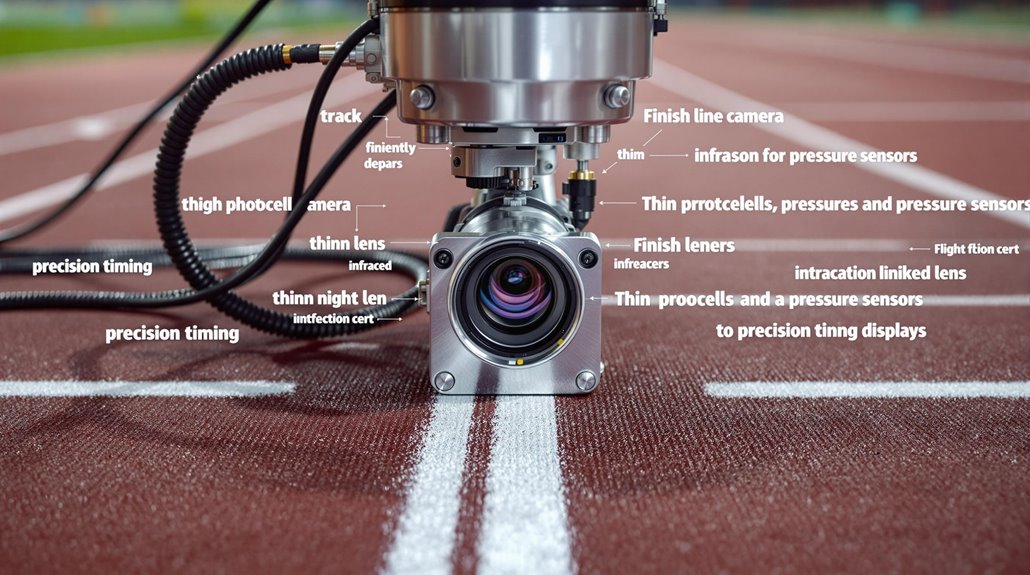
Precision dominates every aspect of Olympic track and field timing technology. In track events, you'll find sophisticated timing systems that combine multiple technologies to guarantee accuracy down to the thousandth of a second. The start of the race triggers electronic starting guns that instantly activate Quantum Timers, synchronizing with various tracking mechanisms throughout the course.
You'll see an intricate network of photoelectric cells and laser beams positioned at the finish line, which detect when athletes cross. The most impressive component is the ScanOVision camera system, capturing an astounding 2,000 frames per second to create detailed photo-finish images. These images display vertical cursors marking each runner's position, eliminating any doubt about finishing time and placement.
RFID technology plays an indispensable role too. Each athlete's shoe contains a small tag that communicates with antennas at various points along the track. This system records not only the final times but also tracks progress throughout the race. When combined with the photo-finish system, you've got multiple layers of verification guaranteeing that every athlete's performance is measured with unparalleled accuracy.
Swimming Pool Timing Methods
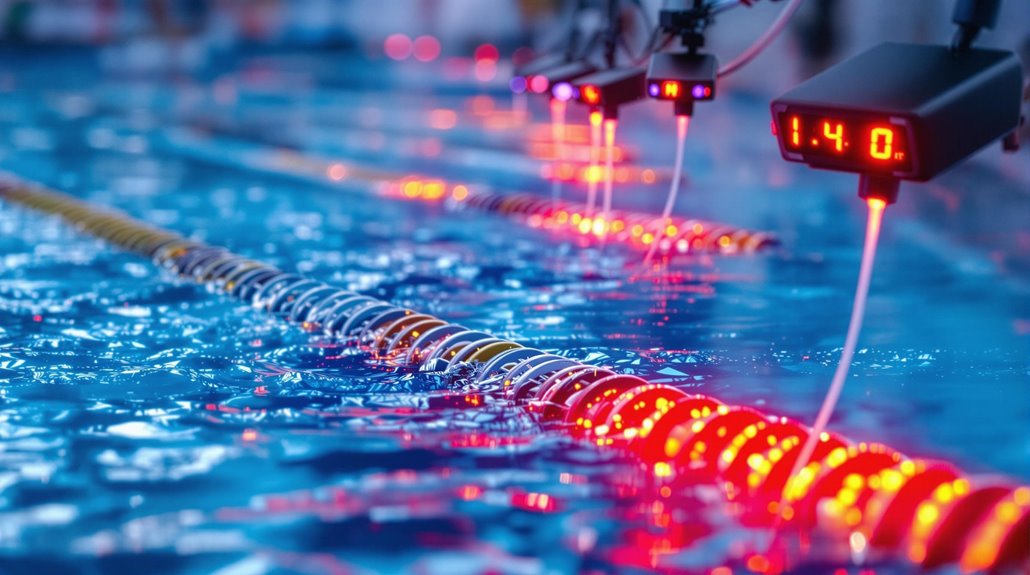
Olympic swimming relies on sophisticated timing systems that merge start block technology with pressure-sensitive touch pads. When you watch the Olympics, you'll notice that each starting block contains speakers that trigger the timing clock the moment the starting gun fires, verifying all competitors times begin simultaneously.
At the finish line, swimmers hit specialized touch pads that are engineering marvels. These pads require just 3.3 pounds of force to activate, making them sensitive enough to detect a swimmer's hand touch while ignoring water pressure from waves. The Quantum Timer instantly processes this information, sending the official times to the timing console with incredible precision - down to a hundredth or even a thousandth of a second.
This level of accuracy mirrors what you'll find in track and field events, where similar electronic systems guarantee fair competition. The touch pad technology has revolutionized Olympic swimming by eliminating the human error that once plagued manual timing. When you see those incredibly close races decided by a tenth of a second, you can trust that the results are accurate thanks to these advanced timing methods.
Winter Sports Timing Challenges
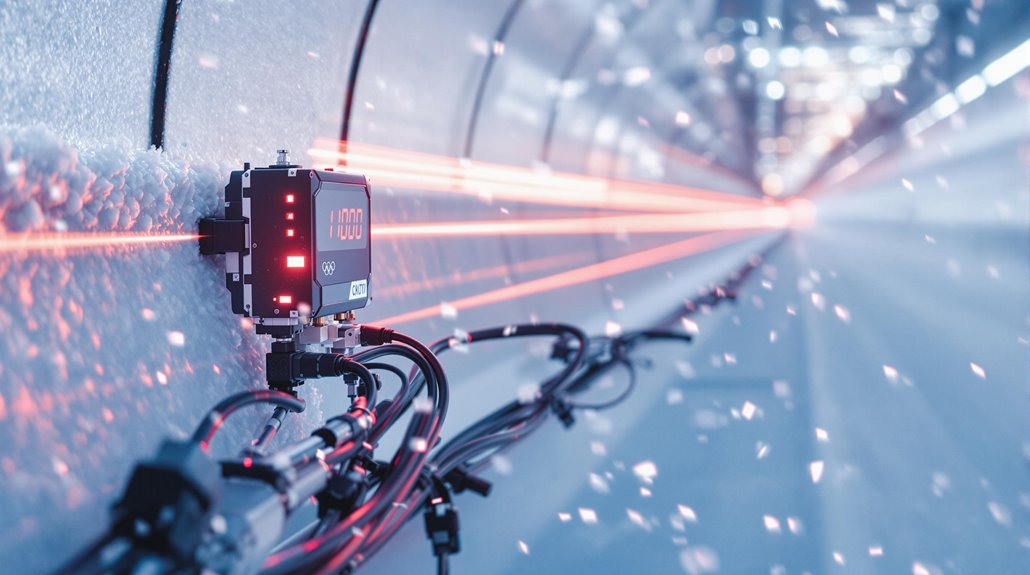
Unlike swimming's controlled environment, winter sports face unique timing challenges due to unpredictable weather and varied terrain conditions. You'll find that every second counts in these events, where timing accuracy can be affected by snow, wind, and changing course conditions. Omega, the official Olympic timekeeper, has developed specialized timekeeping technology to address these specific challenges.
When you're watching winter sports, you'll notice multiple timing systems working together. Photoelectric cells detect athletes at start and finish lines, while transponders and RFID chips track their progress throughout the course. In events like biathlon and cross-country skiing, you'll see averaged times being used to account for terrain variations across different laps. Radio transmitters and antennas positioned along the course provide essential mid-race split times.
For close finishes, photo-finish cameras play a pivotal role in determining winners, while instant video replay systems help officials review contentious moments. These sophisticated tools certify that despite the challenging outdoor conditions, you're getting accurate results that reflect the true performance of winter sports athletes at the Olympic level.
Cycling Race Measurement Systems
Modern cycling races rely on a sophisticated blend of timing technologies to capture critical race data down to thousandths of a second. When you're watching an Olympic cycling event, you'll find RFID tags embedded in bicycle frames, constantly emitting identification codes that are picked up by strategically placed antennas at the start and finish lines.
You'll notice photo-finish cameras positioned along the finish line, capturing high-speed sequential images that prove crucial in determining winners during close finishes. These cameras work in tandem with vertical cursors placed on front tires, allowing officials to precisely analyze the exact moment cyclists cross the finish line. The same electronic timing technology that you'd see in marathon events has been adapted for cycling, guaranteeing accurate tracking throughout the race.
To confirm precise results, you'll find redundant timing systems working simultaneously at every major cycling event. This includes a combination of RFID tags, photoelectric cells, and transponders that provide multiple data points for verification. This multi-layered approach eliminates timing errors and certifies that every cyclist's performance is recorded with absolute accuracy.
Photo Finish Technology
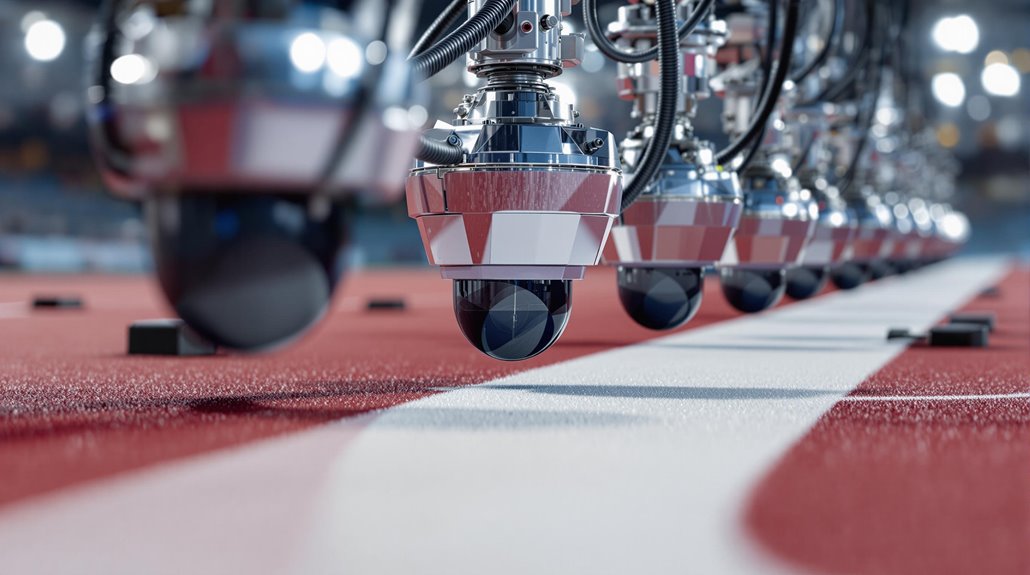
When athletes cross the finish line within fractions of a second of each other, photo-finish technology becomes the definitive judge of Olympic victories. Omega, the official Olympic timekeeper, has revolutionized timing at the Olympic Games with systems that can measure up to one-millionth of a second, guaranteeing no gained or lost time goes unnoticed when two athletes are neck-and-neck.
The ScanOVision camera captures an incredible 2,000 frames per second, creating detailed composite images that leave no room for doubt. You'll find this technology adapted across various Olympic sports:
- In track events, vertical cursors mark each runner's leading edge, allowing officials to determine precise finishing order
- For cycling competitions, the system tracks the front tire of each bicycle with vertical markers
- In swimming events, touch plates on pool walls detect a minimum force of 3.3 lbs from competitors' hands
- For sports like Open Water events and winter competitions, timing splits use radio transmitters and antennas for accurate mid-course measurements
These sophisticated systems safeguard fair competition across all Olympic disciplines, providing definitive results even when the human eye can't separate competitors.
RFID and Transponder Systems
Countless Olympic events now rely on RFID and transponder systems to deliver split-second timing accuracy that was impossible just decades ago. You'll find these sophisticated tracking systems embedded in athletes' shoes, bikes, skis, and other equipment, each emitting unique identification codes that antennas detect at indispensable points along the course.
When you watch Olympic events like cycling, biathlon, or cross-country skiing, you're seeing these systems in action. Transponders attached to equipment continuously transmit signals to strategically placed timing antennas, capturing not just start and finish times, but also intermediate splits throughout the competition. This gives you real-time access to detailed performance data as athletes progress through their events.
What makes these systems particularly irreplaceable is their ability to eliminate human error from the timing process. You won't see officials with stopwatches anymore - instead, RFID technology automatically records and processes timing data with unparalleled accuracy. This advancement guarantees that every Olympic record and result you witness is measured with absolute precision, giving athletes and spectators complete confidence in the recorded times.
Precision and Accuracy Standards
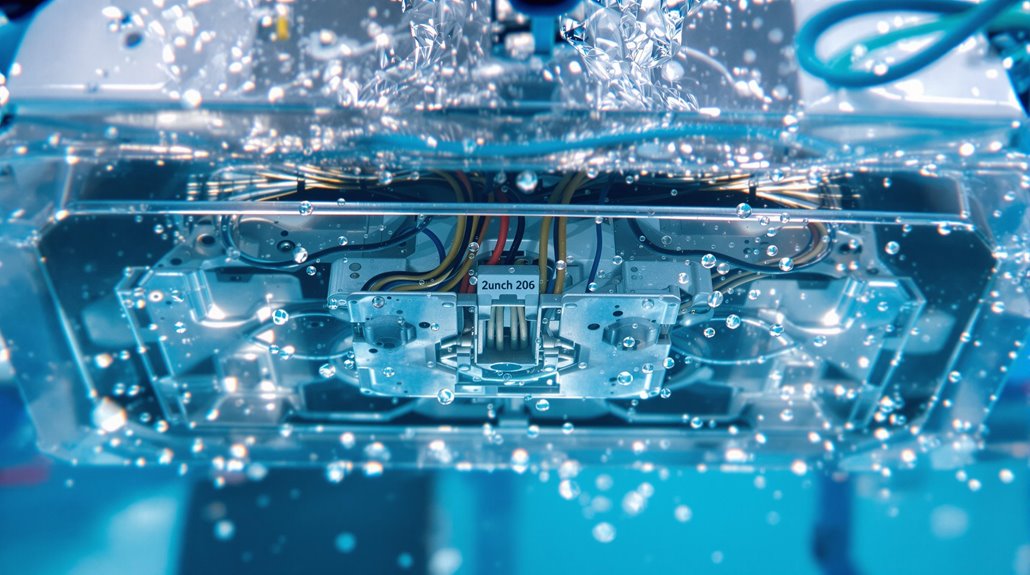
Olympic timekeeping demands a level of precision that borders on obsession. As the official timekeeper of the Olympics, Omega secures accuracy within one-millionth of a second through METAS certification - a standard that would've seemed impossible years ago. You'll find this precision reflected in every aspect of their timing systems, from the dual-redundant Quantum Timer to the high-speed cameras capturing thousands of images per second.
When you're able to explain the complexity behind Olympic timing, you'll understand why they extensively test new technologies over the next couple of years before implementation. This thorough approach eliminates human error and assures flawless execution during the Games.
Key elements of Olympic timing precision include:
- METAS certification guaranteeing accuracy to one-millionth of a second
- Dual-system redundancy in the Omega Quantum Timer for uninterrupted operation
- Photo-finish technologies measuring to one-thousandth of a second for live broadcasts
- Real-time synchronization with television graphics for instant world record comparisons
These standards don't just maintain timing integrity - they revolutionize how you experience Olympic sports, providing instant verification of records and guaranteeing fair competition at the highest level.