How Has Kadooment Day Evolved Over the Years? A Cultural Retrospective
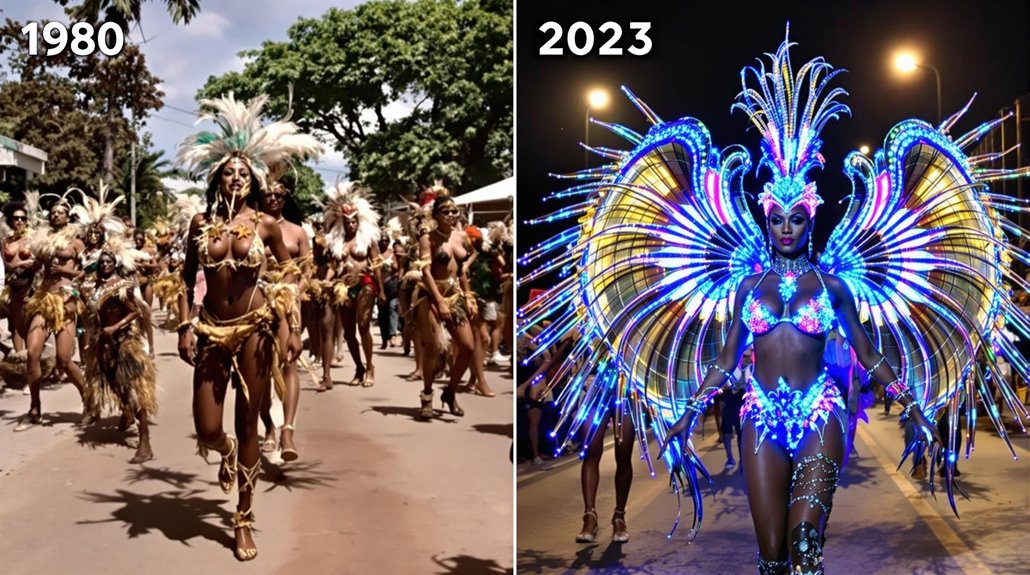
Kadooment Day's evolution tells the story of Barbados itself. You'll find its roots in 1637's sugar cane plantations, where enslaved workers created lively celebrations despite harsh conditions. After emancipation in 1834, these festivities grew into community-wide events featuring music, dance, and masquerade. By the 1970s, the festival transitioned into a major tourist attraction, with the Junior Chamber of Commerce and Barbados Tourism Authority adding modern elements like the Soca Monarch competition and elaborate LED-lit costumes. Today, it's a $20-million economic powerhouse that draws international celebrities while preserving authentic Bajan traditions. The festival's path from plantation fields to global stage holds countless fascinating stories.
Origins in Sugar Cane History
The sweet stalks of sugar cane planted in 1637 would forever change Barbados's destiny and give birth to one of its most cherished celebrations - Kadooment Day. When a Dutch settler introduced sugar cane to the island, they couldn't have known they were setting the stage for centuries of cultural change.
You'll find that Kadooment Day's roots run deep into the colonial period, when sugar cane harvests dominated the island's economy. The celebration emerged as a crucial moment for enslaved workers, who'd seize this rare opportunity to honor their heritage and find moments of joy amid their harsh reality. This significance became even more apparent during events like the Bussa Rebellion of 1816, which highlighted the complex social patterns surrounding the sugar industry.
After slavery's abolition in 1834, you'd see how Kadooment Day transformed while maintaining its connection to sugar cane heritage. The celebration continued to serve as a powerful reminder of the island's agricultural history, shifting from a harvest festival into a broader cultural celebration. Today, when you participate in Kadooment Day, you're connecting with centuries of Barbadian history that began with those first sugar cane plantings.
The Early Plantation Celebrations
During plantation life, you'd witness lively masquerade bands weaving through sugar cane fields as enslaved workers altered their brief moments of celebration into powerful displays of cultural resistance. These early Kadooment Day festivities featured spirited competitions like greased pole climbing, while calypso music filled the air across sugar estates.
You'll find that even after the 1834 abolition of slavery, Kadooment Day remained a crucial expression of Barbadian culture, as freed people continued these celebrations to preserve their heritage. The sugar crop's seasonal rhythms still influenced these gatherings, laying the foundation for what would later become the modern Crop Over Festival.
When you look at the early 20th century, you'll see how the Junior Chamber of Commerce transformed these plantation-based celebrations into organized carnival events at Kensington Oval. They introduced float parades, expanded masquerade bands, and added calypso contests and beauty pageants. Though Grand Kadooment celebrations on plantations diminished as the sugar industry declined in the 1940s, the tradition's spirit endured through small community gatherings until its official revival in the 1970s as part of the modern Crop Over Festival.
Post-War Decline and Changes
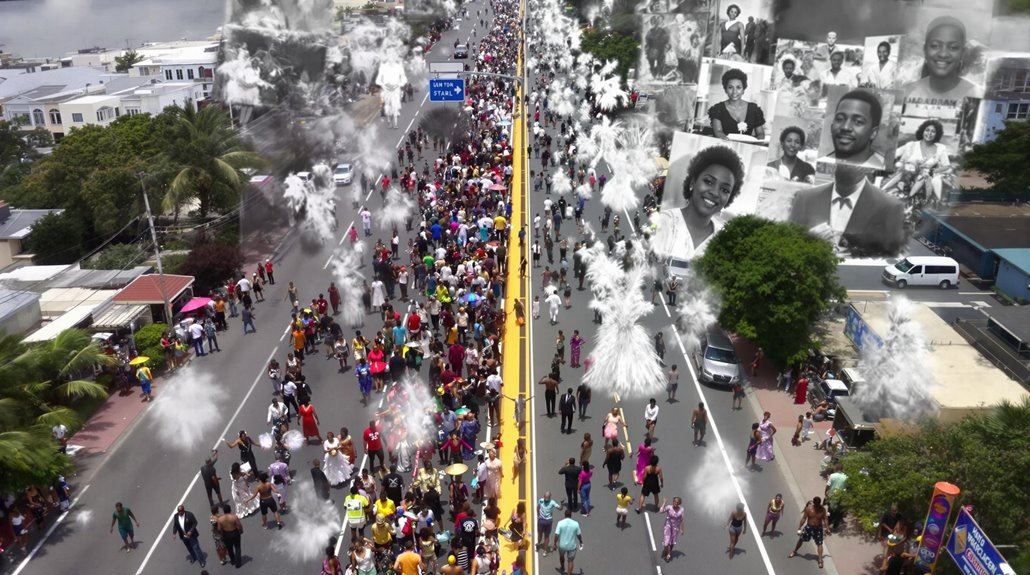
World War II's aftermath brought significant shifts to Barbados' sugar industry, which you'd see reflected in Kadooment Day's changing terrain. As sugar plantations closed their doors, the once-grand celebrations began to dwindle, though local communities maintained smaller-scale festivities through oral traditions and grassroots gatherings.
You'll find that the 1950s marked a crucial attempt at revival when the Junior Chamber of Commerce stepped in to breathe new life into the festival. They organized annual carnivals at the Kensington Oval, complete with masquerade bands, float parades, calypso competitions, and beauty contests. Despite these efforts, the festival couldn't fully recapture its former grandeur.
The real renewal came in the 1970s when you'd witness the government's strategic move to enhance summer tourism. They reimagined the Crop Over Festival, including Kadooment Day, with innovative additions like decorated cart parades. Hotels initially provided the floats, but this soon sparked wider community involvement. You'll notice how this period marked a significant evolution, as local designs and cultural elements were woven into the celebration's fabric, creating a fresh identity that honored both tradition and modern expression.
Tourism Revival in 1974
Strategic innovation marked 1974 as an essential year when the Barbados Tourism Authority breathed new life into Kadooment Day celebrations. You'll find this revival was far from a simple cultural preservation effort - it was a calculated move to transform the island's summer tourism landscape. The authority's decision to reintroduce the festival, particularly the grand parade held on the first Monday of August, aimed to attract both regional and international visitors during the traditionally slower season.
The tourism authority's approach centered on three key initiatives:
- Engaging local hotels to provide decorated carts and floats for the parade, establishing pivotal private sector partnerships
- Developing the festival as a major tourist attraction while maintaining authentic Barbadian cultural elements
- Creating a sustainable economic model that would amplify visitor arrivals during the summer months
This strategic revival wasn't just about preserving traditions - it represented a sophisticated blend of cultural heritage and economic development. By positioning Kadooment Day as a must-see cultural celebration, Barbados successfully created a new tourism draw that would continue to attract visitors from across regional and international markets.
National Cultural Foundation's Impact
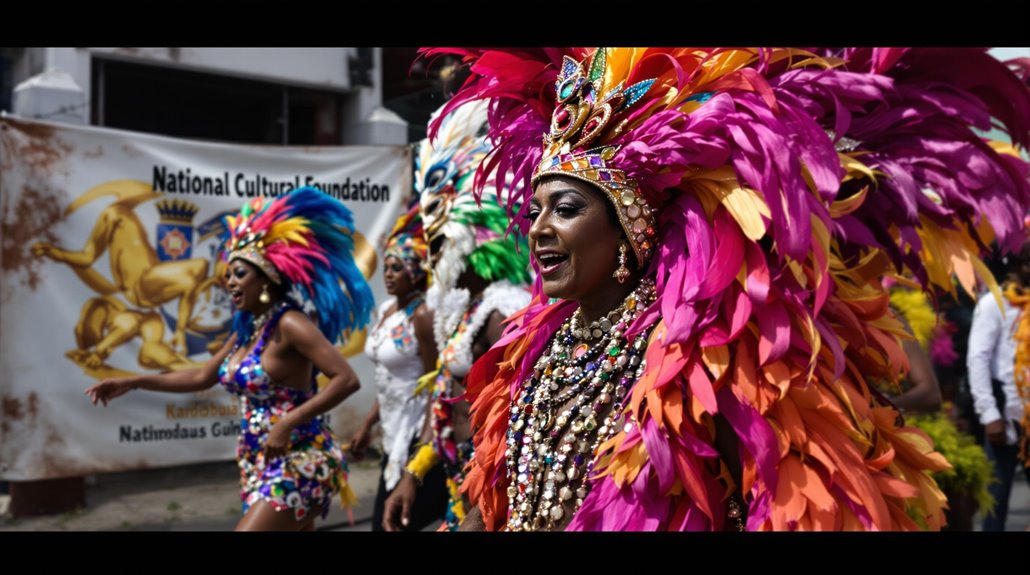
A revolutionary shift in Kadooment Day's management occurred with the establishment of the National Cultural Foundation (NCF) in 1983. Since taking charge of conceptualizing and producing the celebrations, the NCF has transformed the festival into one of the world's most diverse carnival events.
You'll notice the NCF's impact throughout every aspect of the celebration. They've successfully revived traditional folk elements of Barbadian culture while introducing fresh events like the Crop Over Promenade and Cohobblopot. Their dedication to promoting local musical talent has considerably enhanced the festival's soundscape, supporting songwriters, arrangers, and producers who shape the celebration's distinctive sound.
The NCF's innovative additions have become festival highlights. You'll experience this in the playful revelry of Foreday Morning, where mud, powder, and paint masquerade has become a cherished tradition. The foundation's emphasis on enhancing the Grand Kadooment parade has resulted in spectacular displays of costumes, glitter, and glamour. Through these carefully curated elements, you're witnessing the NCF's ongoing commitment to preserving and adapting Barbadian cultural expressions within the festival framework.
Modern Festival Highlights
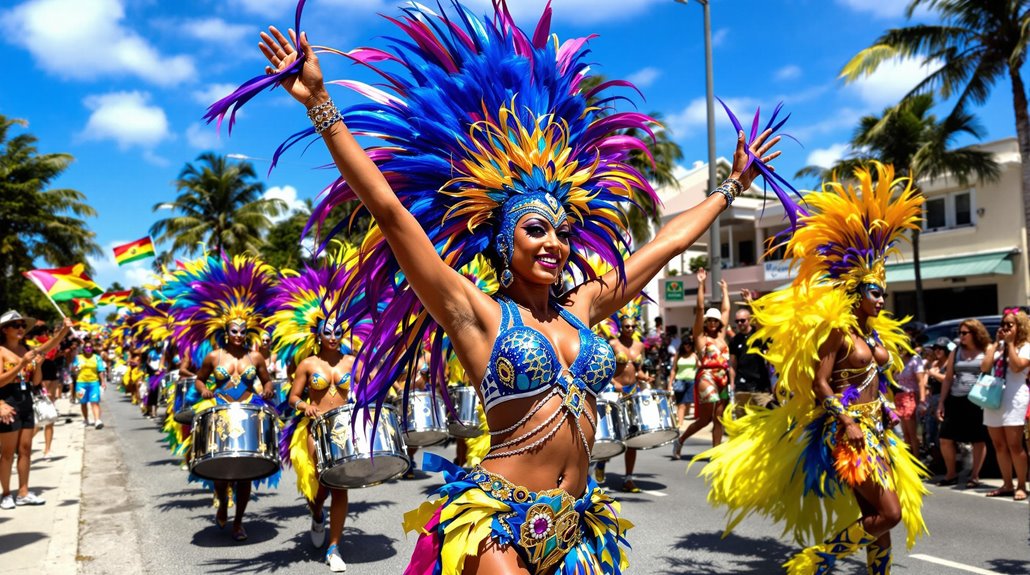
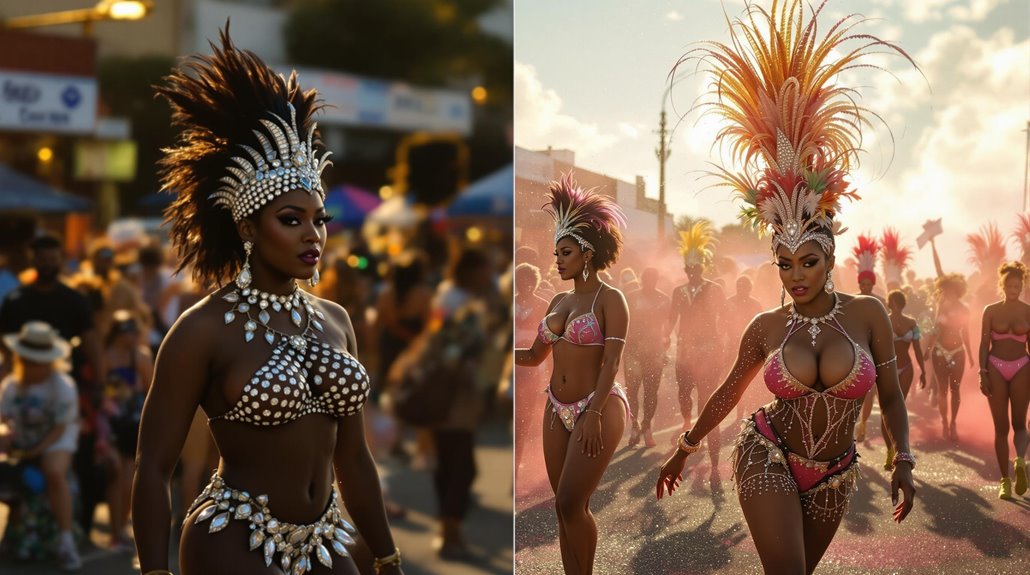
The modern Kadooment Day stands as Barbados' most spectacular cultural showcase, drawing over 15,000 costumed revelers to its expanded parade route from the National Stadium to the Mighty Grynner Highway. You'll witness an explosion of sequins and feathers as masqueraders wind their way through the streets, creating a mesmerizing display that's caught the attention of international media outlets worldwide.
The festival's highlights have evolved to include:
- The prestigious Soca Monarch competition, where performers battle for supremacy in high-energy performances that keep the crowd moving
- The crowning of the Calypso Monarch, celebrating the island's rich musical heritage
- The extension of the parade route to Black Rock road, allowing more spectators to experience the festivities up close
You'll find yourself immersed in the pulsating rhythms of soca and calypso music that serve as the celebration's heartbeat. As the grand finale of the Crop Over festival, Kadooment Day has become a must-see event that brings together locals and visitors in a lively display of Barbadian culture and creativity.
Music and Dance Evolution
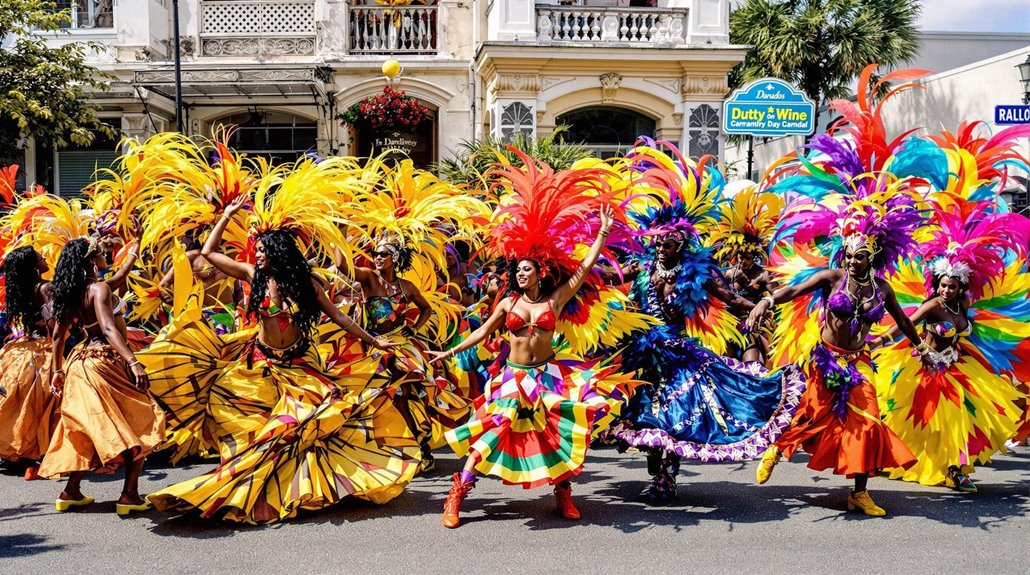
Tracing Kadooment Day's musical odyssey reveals a fascinating blend of traditional Bajan folk sounds and modern Caribbean rhythms. Since the Second World War, you'll notice how the festival's soundscape has dramatically shifted from purely traditional Barbadian folk tunes to a lively mix dominated by calypso and soca beats.
When you look at the dance evolution, you'll see a similar transformation. Traditional Bajan folk dances have merged with contemporary carnival moves, creating a unique fusion that captures both the island's heritage and its modern spirit. This evolution became particularly evident in the 1970s with the introduction of the Soca Monarch competition, which has since become one of the festival's most anticipated events.
You'll find that while the music and dance styles have evolved, they've maintained their rhythmic and energetic core. Today's Kadooment Day celebrations showcase this perfect balance: performers and revelers move to infectious soca beats while incorporating elements of traditional dance, creating an atmosphere that's both authentically Bajan and thoroughly contemporary. It's this vibrant blend that keeps drawing people to the festival year after year.
Costume Design Through Time
Evolution of Kadooment costume design mirrors the festival's progression from humble beginnings to spectacular celebration. You'll find that early costumes started simply, with basic elements like feathers, masks, and capes that let revelers celebrate the end of the crop season with modest yet meaningful apparel.
As you investigate the festival's timeline, you'll notice how the 1980s marked a turning point when costume designers began pushing creative boundaries. They introduced dramatic backpacks and towering headpieces that transformed masqueraders into walking works of art. Today's costumes showcase state-of-the-art technology, from LED-illuminated designs to motorized components that bring costumes to life.
- Basic designs evolved into intricate masterpieces featuring detailed beadwork and sequins
- Traditional materials gave way to high-tech elements, including digital prints and electronic components
- Competitive elements emerged, driving designers to create increasingly spectacular pieces
The transformation from simple to sophisticated has made costume design an integral part of Kadooment's identity, with each year bringing new innovations that keep audiences spellbound and participants keen to showcase their elaborate attire.
International Celebrity Influence
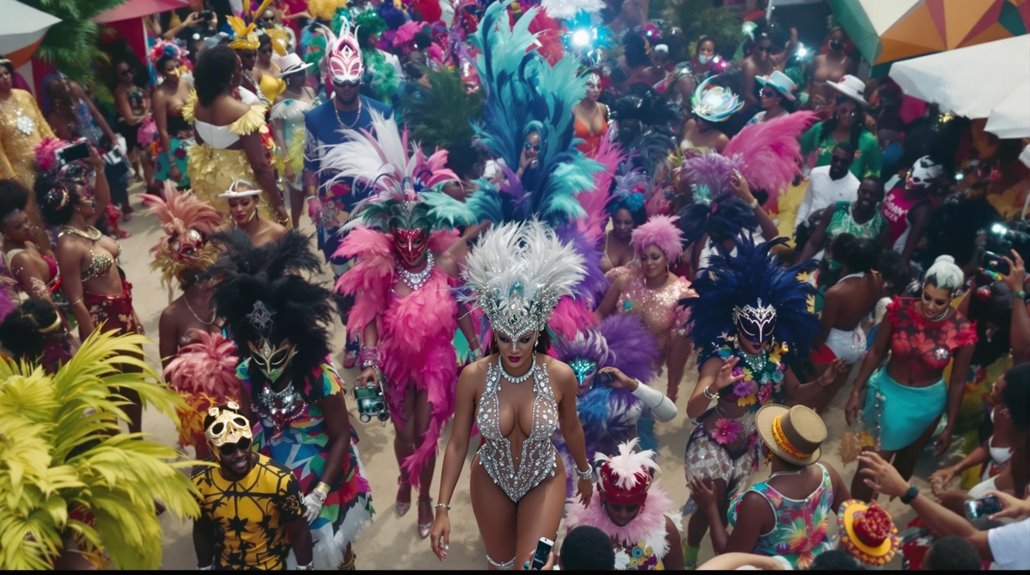
Through its colorful history, Kadooment Day has expanded far beyond Barbados' shores, drawing A-list celebrities who've altered the festival into a global cultural phenomenon. You'll find stars like Rihanna, Lewis Hamilton, and Jourdan Dunn joining the festivities, donning elaborate costumes, and dancing alongside local revelers in the parade.
These high-profile participants have amplified Kadooment Day's reach through their social media presence. While respecting the festival's privacy policy, celebrities share glimpses of their experiences, introducing millions of followers to Barbados' rich cultural traditions. Their involvement has sparked a surge in international tourism, particularly during the Crop Over Festival's grand finale.
You're witnessing a fascinating blend of global influence and local tradition as these celebrities immerse themselves in authentic Bajan culture. They don't just observe from the sidelines - they become active participants in the celebrations, helping to preserve the festival's authenticity while broadening its appeal. This marriage of international stardom and traditional festivities has created a unique, ever-changing dynamic that's raised Kadooment Day's status on the world stage while maintaining its cultural roots.
Economic Impact and Growth
Money flows abundantly during Kadooment Day, generating over $20 million annually for Barbados' economy. Since its revival in 1974, the festival has transformed from a simple harvest celebration into a major economic powerhouse, creating jobs and boosting tourism revenue. From Foreday Morning until the grand finale, you'll find local businesses thriving as visitors flock to the island.
The festival's economic success can be measured through:
- Significant hotel occupancy rates during festival season
- Creation of year-round employment in costume design, event planning, and entertainment
- Growth in corporate sponsorships and business partnerships
When the National Cultural Foundation took charge in the 1980s, they brought structure and commercial opportunities that expanded the festival's reach. You'll notice how this transformation has created a sustainable economic model that benefits both large corporations and small local vendors.
The COVID-19 pandemic's impact in 2020 and 2021 revealed just how essential Crop Over and Kadooment Day are to Barbados' economy. When the festival was canceled, many businesses and entertainers who'd built their livelihoods around these celebrations faced significant financial challenges, highlighting the festival's pivotal role in the island's economic ecosystem.
Pandemic Effects and Adaptations
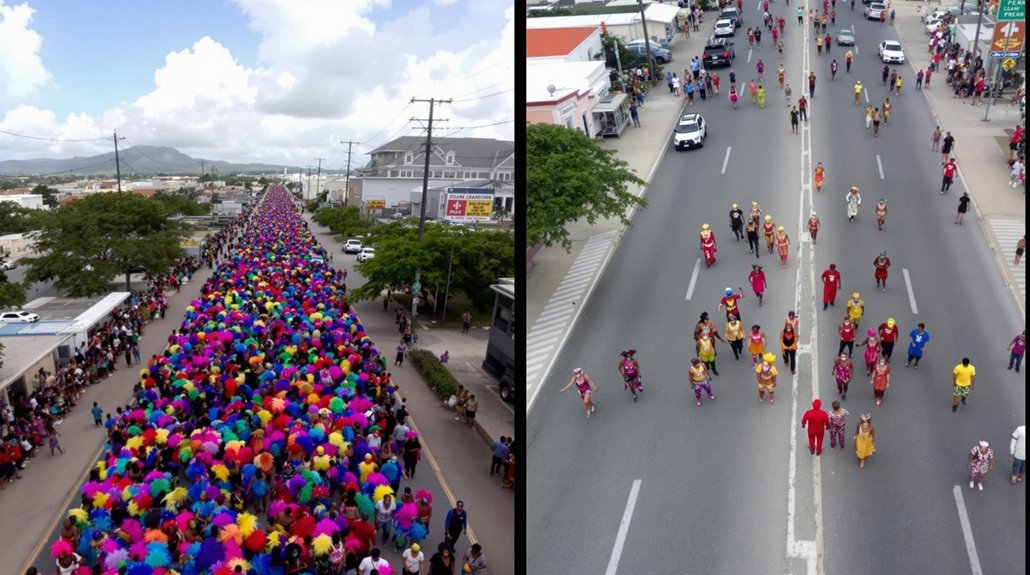
The COVID-19 pandemic dealt a devastating blow to Kadooment Day, forcing the cancellation of its lively celebrations in both 2020 and 2021. You'd find that these extraordinary cancellations left a significant void in Barbados' cultural calendar, affecting not just the festivities but also the livelihoods of countless individuals who depend on the Crop Over Festival.
In response to these challenges, you'll notice how organizers quickly pivoted to create alternative celebrations. Virtual events became the new standard, allowing you to experience aspects of the festival from the safety of your home through livestreamed performances and digital presentations. While these adaptations couldn't fully replicate the energy of traditional celebrations, they helped preserve the cultural connection that's so crucial to the community.
As you look toward the future, you'll see that uncertainty still surrounds large-scale gatherings, but the National Cultural Foundation remains committed to keeping Kadooment Day alive. They've introduced socially distanced celebrations and hybrid events that combine both in-person and virtual elements, demonstrating how this beloved tradition continues to adapt while prioritizing public health and safety.
Cultural Heritage Preservation
View this post on Instagram
Down through the decades, Kadooment Day has emerged as an essential cornerstone in preserving Barbados' rich cultural heritage. Since the National Cultural Foundation took charge in 1983, you'll find that community engagement has strengthened the festival's role as a cultural guardian. The event's masquerade traditions, calypso rhythms, and Soca beats continue to thrive, showcasing the island's artistic soul.
You'll uncover how Kadooment Day safeguards Barbadian culture through:
- Local artisans crafting intricate costumes and floats, passing down traditional design techniques to new generations
- Dance troupes performing authentic cultural expressions that keep historical performance styles alive
- Regional and international media coverage that amplifies Barbadian heritage on the global stage
The festival's evolution has created an ever-changing platform where traditional practices meet contemporary expressions. Through the dedicated efforts of cultural practitioners and the National Cultural Foundation, you're witnessing more than just a celebration - it's a living museum of Barbadian traditions. As masquerade arts and musical heritage continue to flourish, Kadooment Day stands as a living chronicle to successful cultural preservation through active community participation.
Future of Kadooment Day
Innovation drives Kadooment Day's evolution into the modern era, as festival organizers adopt new technologies and sustainability initiatives to guarantee its future. You'll find the National Cultural Foundation actively reshaping the celebration to maintain its cultural significance while appealing to both local and international participants.
The festival's reach has expanded dramatically through global livestreaming capabilities, allowing you to experience Kadooment Day's lively atmosphere from anywhere in the world. Meanwhile, sustainability initiatives are taking center stage, with organizers implementing eco-friendly costume materials and reducing single-use plastics throughout the event.
You'll notice significant changes in how the festival operates, particularly in response to recent public health challenges. The organizers are considering staggered start times and enhanced crowd management strategies to ensure everyone's safety. They're also exploring the possibility of extending the festival's duration and incorporating educational components to deepen your understanding of Barbadian culture. These adaptations reflect a careful balance between preserving tradition and embracing necessary changes, guaranteeing that you'll continue to enjoy Kadooment Day for generations to come.