
Groundhog Day in the US and Canada: Predicting Spring’s Arrival
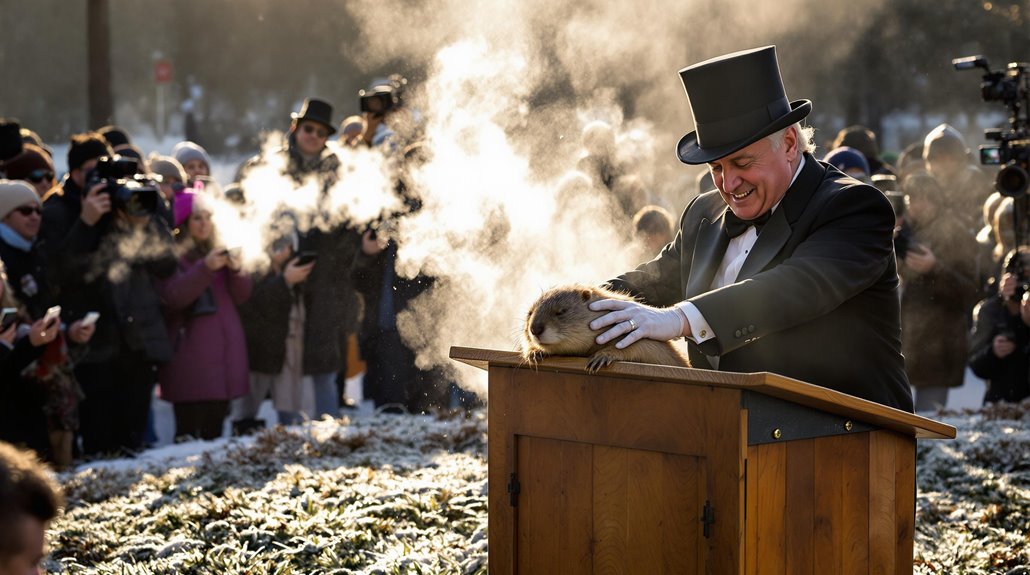
Groundhog Day brings together communities across North America each February 2nd to watch famous groundhogs predict winter's end. You'll find the most celebrated forecaster, Punxsutawney Phil, in Pennsylvania, while Canada boasts its own stars like Wiarton Willie and Shubenacadie Sam. The tradition blends ancient European customs with New World folklore - if the groundhog sees its shadow, expect six more weeks of winter; if not, spring's coming early. Though these furry meteorologists only maintain about 30-40% accuracy, their predictions continue drawing thousands of enthusiasts annually. There's much more to uncover about this charming cultural phenomenon that bridges two nations.
Origins and Cultural Significance
On February 2nd each year, millions of Americans and Canadians turn their attention to a peculiar weather-forecasting tradition that blends ancient European customs with New World folklore. You'll find that this beloved celebration has deep roots in both the Celtic festival of Imbolc and the Christian festival of Candlemas, where people observed hibernating animals emerging from their winter slumber as nature's way of predicting spring's arrival.
When German settlers arrived in Pennsylvania, they brought with them their weather-predicting folklore and adapted it to the local groundhog, establishing what would become an enduring cultural phenomenon. Today, you'll recognize this tradition most famously through Punxsutawney Phil, who's been making his annual predictions since 1887. The timing of Groundhog Day isn't random - it falls precisely between the winter solstice and spring equinox, marking a significant seasonal shift that farmers and communities have long celebrated.
The tradition has gained even more cultural significance since the 1993 film "Groundhog Day," which has added a new dimension to the holiday's meaning. You'll now hear people using the term to describe repetitive situations, cementing its place in modern vocabulary.
Famous Weather-Predicting Groundhogs
Several renowned groundhogs step into the spotlight each February 2nd to make their keenly anticipated weather predictions. Among these weather-predicting groundhogs, Punxsutawney Phil stands as the most celebrated, having delivered his annual forecasts in Pennsylvania since 1887. You'll find his Canadian counterpart, Wiarton Willie, drawing crowds in Ontario with similar fanfare and tradition.
If you're enthusiastic to catch the first prediction of the day, you'll want to turn your attention to Shubenacadie Sam in Nova Scotia. Thanks to the region's easternmost location in North America, Sam kicks off the day's prognostications before any other groundhog. In Quebec, you can follow the newer but increasingly popular Fred la Marmotte, who's been building a dedicated following among French-speaking Canadians.
Not all weather-predicting traditions continue uninterrupted, though. In New Jersey, the death of Milltown Mel in 2022 created unexpected legal complications for the town's Groundhog Day celebrations, highlighting how these beloved customs often rely on the availability of suitable animal forecasters and proper planning.
The Punxsutawney Phil Tradition
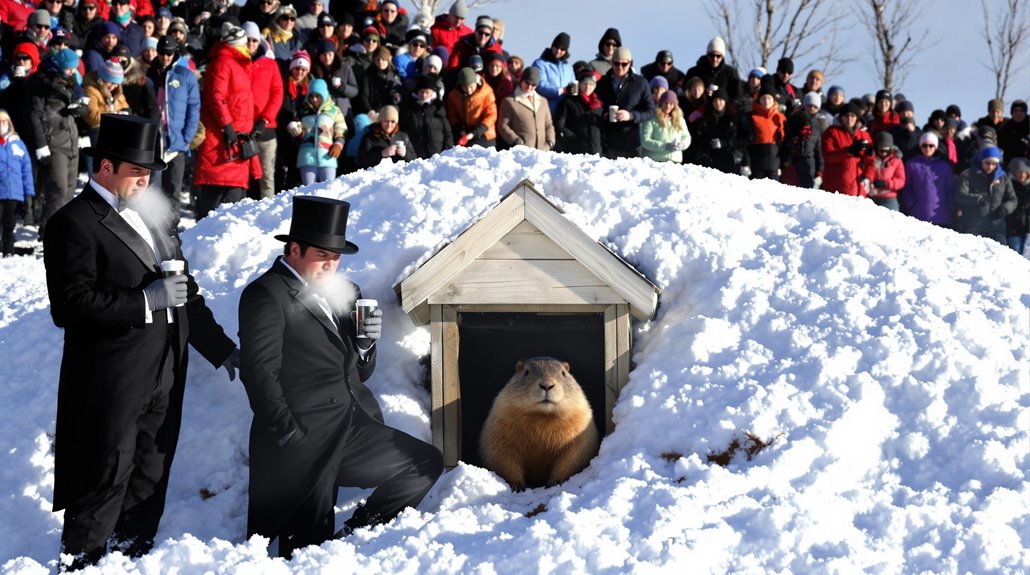
Since its inception in 1887, the Punxsutawney Phil tradition has captured America's imagination as the country's most iconic Groundhog Day celebration. You'll find thousands of enthusiastic spectators gathering at Gobblers Knob in Punxsutawney, Pennsylvania, each February 2nd to witness Phil's annual weather prediction, which has become a nationally televised event.
The Groundhog Day tradition follows a simple yet fascinating premise: if Phil sees his shadow, you can expect six more weeks of winter weather. If he doesn't spot his shadow, you'll be treated to an early spring. While Phil's predictions have garnered widespread attention, you might be interested to know that his forecasting accuracy hovers around 40% over recent years.
When he's not making his famous predictions, you can find Phil residing in his specially designed burrow at the Punxsutawney Memorial Library. Though he's generally well-behaved, Phil has been known to cause occasional excitement by escaping his quarters, prompting library staff to launch impromptu rescue missions. Despite these minor mishaps, Phil's enduring legacy as America's premier weather-forecasting groundhog continues to draw crowds and media attention year after year.
Canadian Groundhog Day Celebrations
While Punxsutawney Phil dominates American headlines, Canada boasts its own impressive lineup of weather-predicting groundhogs. You'll find these furry forecasters scattered across the country, from Ontario's Wiarton Willie to Nova Scotia's Shubenacadie Sam, who holds the distinction of being North America's first groundhog to make predictions each February 2nd due to the region's earlier sunrise.
Recent years have brought notable changes to Canada's Groundhog Day traditions. In 2022, Wiarton Willie's handlers introduced an understudy following the original Willie's death, while Quebec's Fred la Marmotte was creatively replaced with a child holding a stuffed toy during their annual celebrations. These adaptations show how communities are keeping the beloved tradition alive despite challenges. The festivities at Shubenacadie Wildlife Park continue to draw crowds impatient to witness Sam's annual prediction. This year, Canadians are particularly hopeful for an early Spring forecast, especially after the 2022/2023 winter proved so harsh that Ottawa's Rideau Canal couldn't open its skating season for the first time in history. These groundhog predictions, while playful, reflect Canadians' genuine anticipation of warmer weather.
Shadow Folklore and Predictions
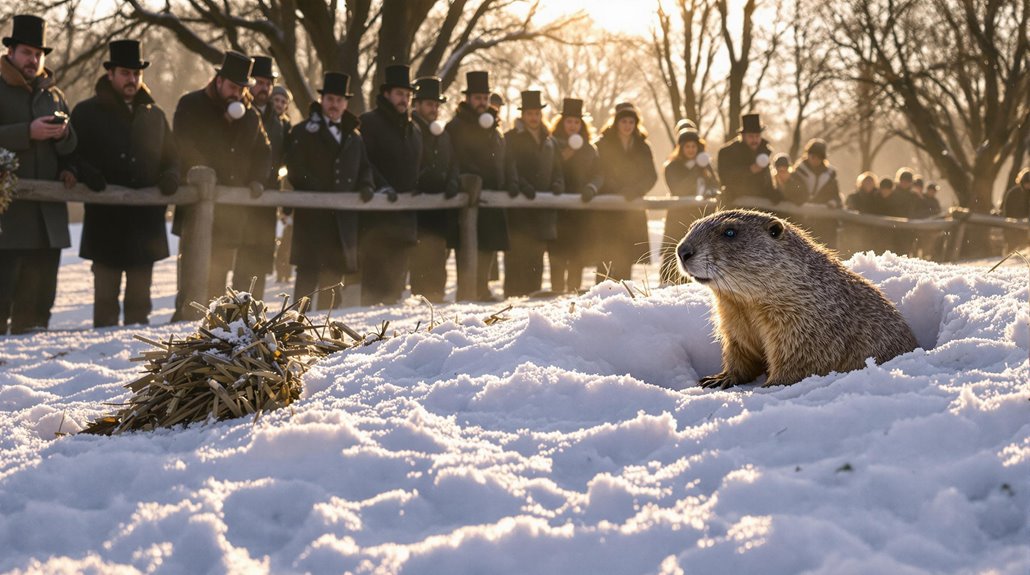
The mysterious shadow folklore at the heart of Groundhog Day centers on a simple premise: if the groundhog spots its shadow on February 2nd, you can expect six more weeks of winter weather. If there's no shadow in sight, you'll see an early spring arrival. This tradition, rooted in European and Celtic folklore, has become a beloved cultural phenomenon across North America.
You'll find that Punxsutawney Phil, the most celebrated groundhog forecaster, made headlines in 2023 when he didn't see his shadow, predicting an early spring. His Canadian counterparts, Wiarton Willie and Shubenacadie Sam, aligned with his forecast that year, also anticipating winter's early end. However, you might want to take these predictions with a grain of salt - Phil's track record over the past decade shows only about 30% accuracy.
While the shadow-based predictions may not be scientifically reliable, they've maintained their cultural significance. You'll notice that each year, communities gather enthusiastically to watch these weather-forecasting groundhogs make their annual predictions, keeping this unique tradition alive despite its questionable accuracy.
Annual Festivities and Events
Jubilant crowds descend upon Punxsutawney, Pennsylvania each February 2nd for North America's most famous Groundhog Day celebration. You'll join thousands of enthusiastic spectators who gather before dawn to watch Punxsutawney Phil make his annual weather prediction, which is now livestreamed globally. The Punxsutawney Groundhog Club organizes a festive atmosphere that extends well beyond the morning forecast, featuring a talent show and the refined Groundhog ball.
You won't find these celebrations limited to just Punxsutawney, though. Cities across the United States and Canada host their own annual events with local groundhogs making similar predictions about whether they'll see their shadows. These regional celebrations have evolved into unique festivals, complete with groundhog races and themed activities that draw visitors from near and far. While there have been many Punxsutawney Phils throughout the years, the tradition remains a beloved cultural phenomenon that attracts significant media attention. Whether you're participating in the main celebration in Pennsylvania or attending a local event, you'll experience a uniquely North American tradition that alters a simple weather prediction into a full-scale community celebration.
Weather Patterns and Accuracy
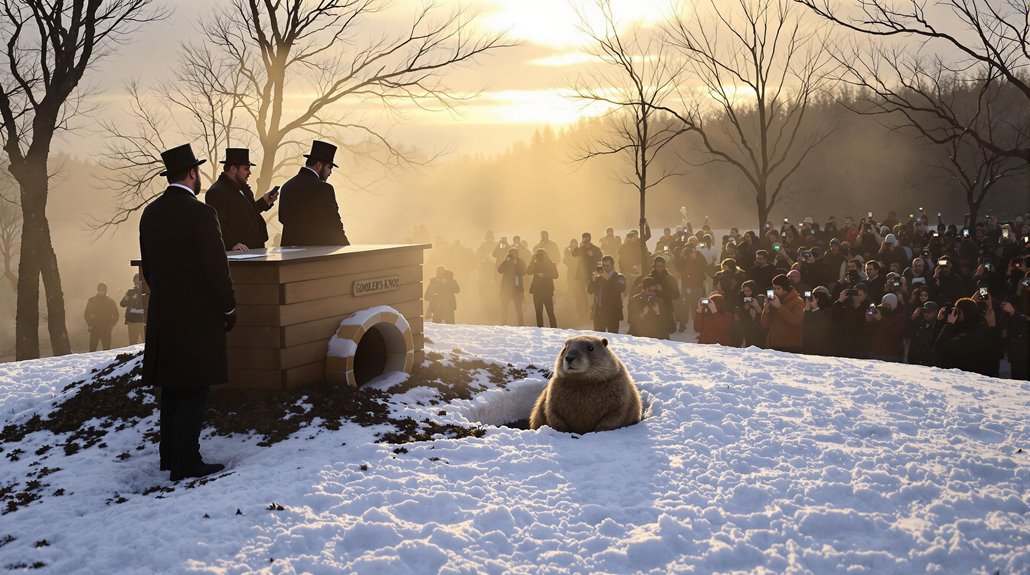
Despite his celebrity status, Punxsutawney Phil's weather forecasting skills have proven less than reliable, with federal agencies reporting his accuracy rate at just 40% in recent years. When the groundhog sees its shadow, tradition dictates that winter will last another six weeks. However, this year's prediction has sparked particular interest due to the unusual consensus among weather-predicting groundhogs across North America.
You'll find these interesting patterns in groundhog predictions:
- More than a dozen groundhogs in the U.S. and Canada have supported Phil's early spring forecast
- The tradition stems from European farming practices that linked animal behavior to weather patterns
- Groundhog seeing and shadow observation have become deeply ingrained in North American culture
- Phil's track record of predicting six more weeks of winter is more common than early spring forecasts
- Other notable groundhogs like Octoraro Orphie have aligned their predictions with Phil this year
This rare agreement among weather-predicting groundhogs has caught the attention of observers, though experts remind us that these predictions remain more about tradition and celebration than scientific accuracy.
Historical Evolution of Celebrations
Dating back to the 18th century, Groundhog Day celebrations have metamorphosed from simple German immigrant customs into elaborate festivities deeply woven into North American culture. What began as a folk tradition of observing hibernating animals in the weeks following the winter solstice has evolved into a phenomenon that captures widespread attention each year.
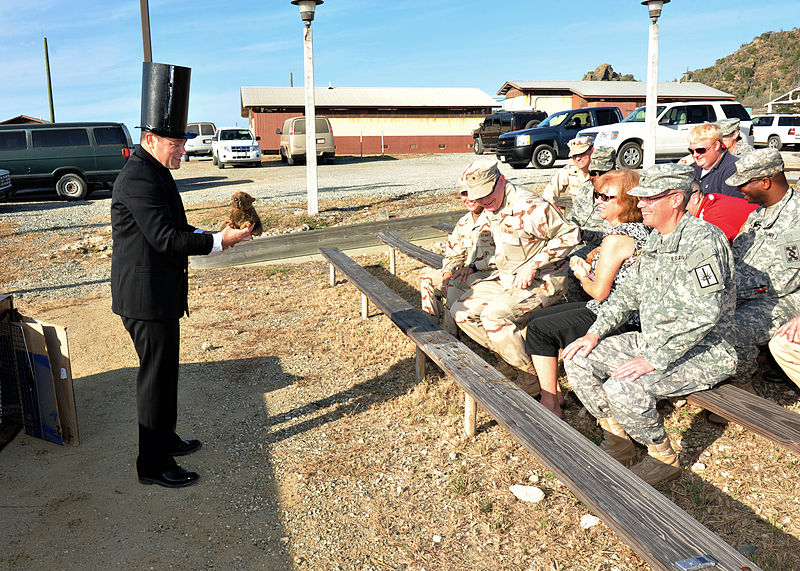
The reformation really took shape in 1887 when Punxsutawney, Pennsylvania held its first official Groundhog Day event featuring the now-famous Punxsutawney Phil. You'll find that this celebration has grown from a small local gathering into a major tourist attraction, drawing thousands of visitors annually. As the tradition gained popularity, other communities across the United States and Canada began establishing their own Groundhog Day events with their local weather-predicting groundhogs.
The 1993 release of "Groundhog Day" starring Bill Murray marked another significant milestone in the celebration's metamorphosis. The film's success introduced the tradition to a broader audience and cemented the event's place in popular culture. Today, you'll see Groundhog Day celebrated with increasing fanfare, featuring festivals, media coverage, and community gatherings that extend far beyond the simple weather prediction ritual of the past.
Popular Media and Entertainment
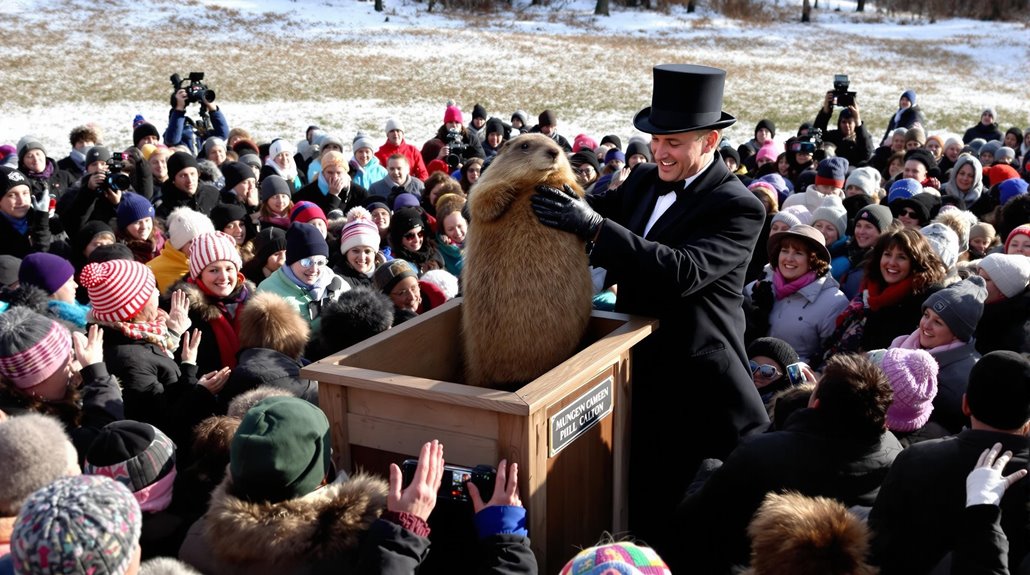
The enduring cultural impact of Groundhog Day reached new heights with the 1993 release of the Bill Murray film "Groundhog Day," which converted a quirky weather-prediction ritual into a mainstream entertainment phenomenon. The movie's premise of a time loop, where Murray's character relives the same day repeatedly, has become a metaphor for feeling stuck in life's routines.
The film's influence on popular culture can't be overstated, spawning numerous adaptations and references across media platforms. You'll find Groundhog Day's legacy in:
- TV shows that have parodied the time loop concept
- Live broadcasts of Punxsutawney Phil's annual prediction
- Video games incorporating the repeating day theme
- Children's books explaining the tradition
- An opera adaptation of the original film
When you watch media coverage of modern Groundhog Day celebrations, you'll notice how the event has evolved from a simple weather folklore into a full-fledged entertainment spectacle. The combination of Bill Murray's iconic performance and the tradition's inherent charm has created a cultural touchstone that continues to reverberate with audiences through various forms of media and artistic expression.
Regional Customs and Variations
Diversity flourishes across North America's Groundhog Day celebrations, with each region adding its own unique immersion to the tradition. While Punxsutawney Phil remains the most renowned weather-forecasting groundhog in the United States, you'll find Canada boasting its own collection of celebrated meteorological mammals, including Quebec's Fred la Marmotte, Nova Scotia's Shubenacadie Sam, and Ontario's Wiarton Willie.
You'll explore that these regional celebrations have evolved beyond the simple shadow-watching ceremony. Some communities have created groundhog-themed festivals where you can participate in unique activities like groundhog races, while others have welcomed modern technology to share their celebrations. Whether you're in the United States or Canada, you can now follow your favorite groundhog's prediction through live broadcasts and social media updates.
Despite the varying customs across North America, you'll notice that the heart of the tradition remains constant: communities gather enthusiastically to watch their local groundhog predict whether spring will arrive early or if winter will persist for six more weeks. Each region's distinct approach to the celebration helps keep this cherished tradition fresh and engaging for new generations.
Impact on Modern Society
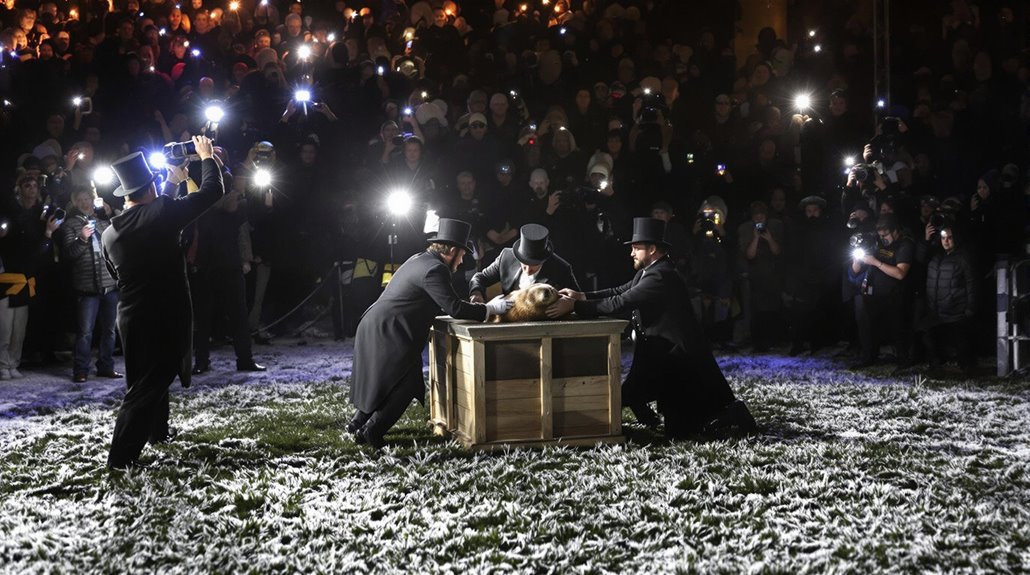
Regional variations in Groundhog Day celebrations have grown into something much bigger than their humble beginnings, shaping modern society in unexpected ways. You'll find that whether the groundhog predicted an early spring or didn't see his shadow, the event now reaches far beyond local weather predictions.
Modern Groundhog Day celebrations impact society through:
- Digital platforms streaming live predictions every Friday morning during the event
- Economic surges to communities through festivals, merchandise, and tourism
- Entertainment value through movies, media coverage, and social media engagement
- Cultural symbolism representing hope for springlike weather during winter months
- Community building, even during challenges like the COVID-19 pandemic
You're now part of a tradition that's successfully adapted to modern times while maintaining its folksy charm. Communities have transformed this mid-winter celebration into a multi-faceted cultural phenomenon that supports local economies and brings people together. Through technology and social media, you can participate in celebrations across North America, making the tradition more accessible than ever. While debates about prediction accuracy continue, the event's true value lies in its ability to create shared experiences and maintain cultural connections in our digital era.